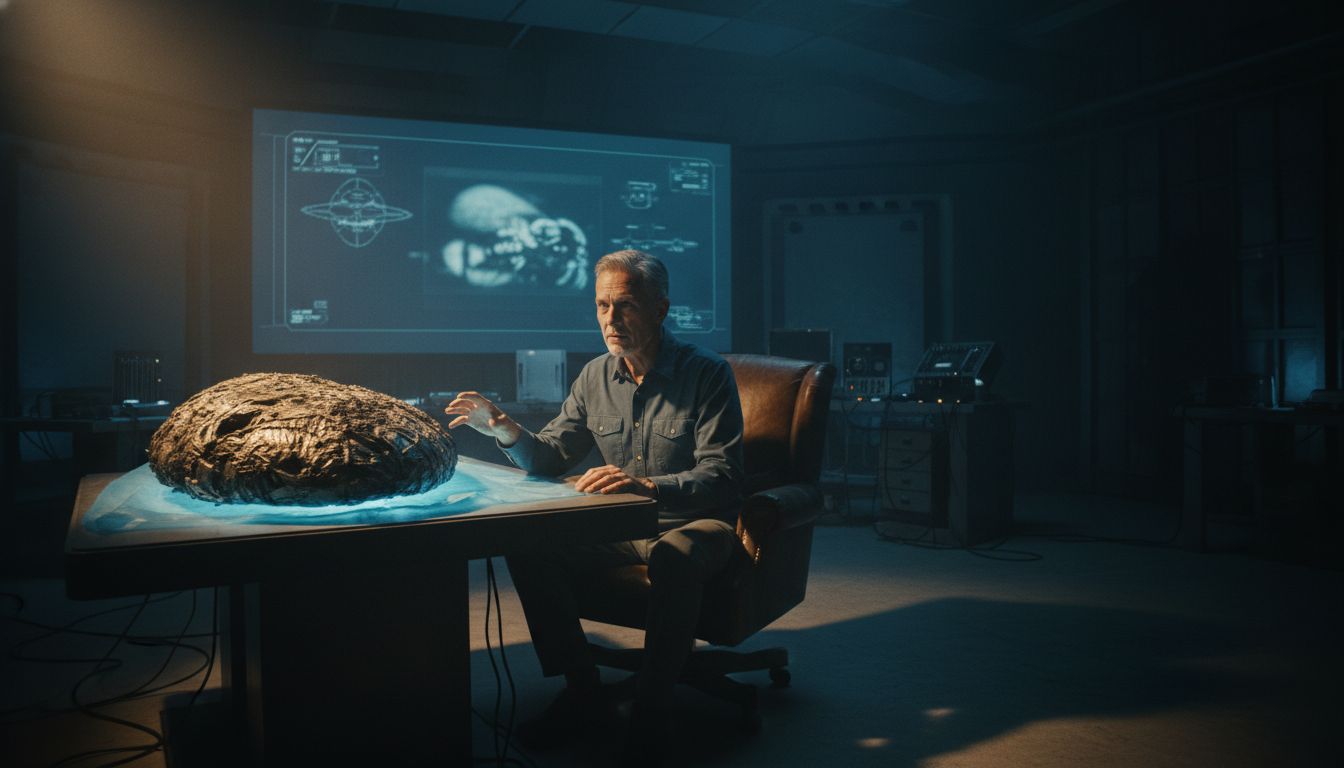
In a lengthy interview recorded for documentary filmmakers Jeremy Corbell and George Knapp, former Defense Intelligence Agency officer Dr. James Lacatski – who oversaw the Advanced Aerospace Weapon System Applications Program (AAWSAP) and later the classified “Kona Blue” effort – warned that the United States’ investigation of unidentified aerial phenomena remains far from transparent. Lacatski, who served as the principal architect of the Pentagon’s covert “UFO” research cell in the early 2000s, told the journalists that a Department of Homeland Security (DHS) program tasked with studying non‑human biologics and craft is still operational, albeit under a veil of secrecy that “looks like it may be privately funded” despite official statements to the contrary.
Lacatski’s account builds on a growing body of declassified material that first emerged after the 2020 release of the Advanced Aerospace Threat Identification Program (AATIP) files. He explained that AAWSAP, which was rebranded as Kona Blue in 2015, was designed to collect and analyze physical evidence from alleged extraterrestrial encounters, including hull fragments recovered from alleged crash sites. “When we opened the first hull breach, the propulsion signatures were unlike anything we had ever seen in conventional aerospace engineering,” he said, referring to anomalous thermal and electromagnetic readings that suggested a propulsion system operating without observable exhaust. The description mirrors earlier public references to the “tic‑tac” objects captured on Navy video in 2014, a phenomenon that has repeatedly resurfaced in congressional testimony.
According to Lacatski, the recent establishment of the All‑Domain Anomaly Resolution Office (AARO) – the Pentagon’s publicly announced successor to AATIP – has been used as a “disinformation conduit.” He alleges that AARO’s public briefings often highlight benign explanations or outright deny the existence of any ongoing investigations, a strategy intended to “manage the narrative” while the underlying intelligence work continues in classified channels. “We’ve been played,” Lacatski told Corbell, “not just by the media but by the very agencies that claim to be shedding light on the issue.” He added that congressional hearings, such as the 2023 House Armed Services Committee briefing, have been limited to “high‑level overviews” that omit the technical data and counter‑intelligence measures that are central to the program’s work.
The interview also touches on the broader counter‑intelligence context, suggesting that the U.S. government has deliberately cultivated a veil of ambiguity to protect both national security and potential commercial interests. Lacatski referenced a series of declassified documents released through the National Archives that detail “containment protocols” for recovered material and outline “non‑attribution agreements” with private contractors who may be financing parts of the research. He cautioned that such arrangements make it difficult for oversight bodies to assess the full scope of the program, noting that “the line between public funding and private sponsorship has become deliberately blurred.”
While Lacatski’s claims are striking, they remain uncorroborated by official sources. The Department of Homeland Security has repeatedly denied any ongoing program focused on extraterrestrial biologics, and the Office of the Director of National Intelligence has described AARO’s mandate as “limited to anomalous aerial observations of unknown origin.” Nonetheless, Lacatski’s testimony adds a new layer to the ongoing debate over government transparency and the scientific legitimacy of UFO research. As the Pentagon prepares to release additional briefings later this year, observers will be watching to see whether the “secret” elements Lacatski describes will finally surface in the public record or remain confined to classified archives.