Overview
A multinational research team announced on December 9, 2025 that synthetic‑aperture radar (SAR) surveys have identified a complex network of underground chambers and cylindrical shafts extending beneath the Giza plateau, including the Great Pyramid, the Pyramid of Khafre and the Sphinx temple. The radar data, collected over a six‑month period by the European Space Agency’s Sentinel‑1 satellite and a high‑resolution airborne platform operated by the University of Cambridge, reveal anomalies consistent with large, man‑made voids up to 30 metres in diameter and several hundred metres in length. The team describes the findings as “the first scientifically validated evidence of a hidden megastructure” beneath the iconic monuments.
Methodology and Findings
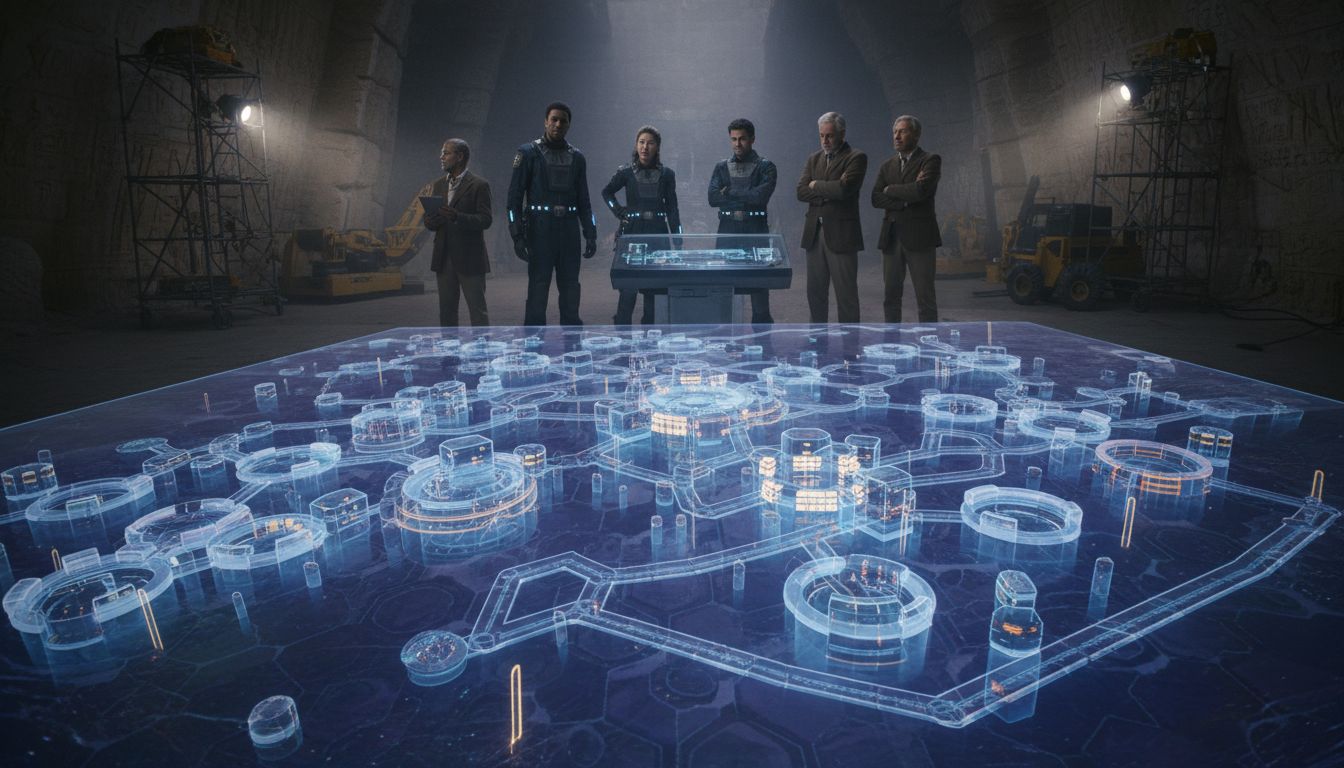
The researchers employed interferometric SAR (InSAR) to map subtle changes in the ground’s electromagnetic reflectivity, a technique that can penetrate sand, limestone and other surface materials. By comparing multiple passes, they generated a three‑dimensional model that shows a series of parallel cylindrical voids oriented roughly north‑south, intersected by a lattice of rectangular chambers. Preliminary estimates suggest the main cavity beneath the Great Pyramid lies about 70 metres below the base, with a volume comparable to a modern sports arena. “The geometry of the voids does not match any known natural formation,” said Dr. Sarah Collins, lead geophysicist at Cambridge’s Department of Earth Sciences. “Their regularity points to intentional construction.”
Proposed Functions and Historical Context
While the purpose of the underground complex remains speculative, the authors propose two plausible scenarios. First, the chambers could have served as energy‑storage or cooling systems, an idea inspired by recent studies of ancient Egyptian water‑management infrastructure. Second, the network might have functioned as a data‑archival conduit, possibly housing stone‑carved records or hieroglyphic tablets protected from the harsh desert climate. Similar subterranean features have been documented at Saqqara and Abydos, but none on the scale suggested by the Giza SAR data. The discovery revives longstanding debates about the engineering capabilities of the Fourth Dynasty, a period traditionally associated with the construction of the pyramids themselves.
Expert Reaction and Skepticism
The announcement has been met with cautious interest from the archaeological community. Dr. Mohamed Hassan, senior Egyptologist at the Egyptian Museum, emphasized the need for ground‑truth verification: “Remote‑sensing techniques are powerful, but without physical access we cannot rule out geological anomalies or modern disturbances.” Egypt’s Ministry of Antiquities has reiterated that any excavation must comply with UNESCO’s World Heritage guidelines and obtain a formal permit. The ministry’s spokesperson, Laila Farouk, noted that “while we welcome scientific inquiry, the preservation of the Giza monuments is our paramount responsibility.”
Next Steps
The research consortium is seeking funding to conduct a limited, non‑invasive drill‑core investigation at a location identified as the most promising access point. If successful, the core samples could confirm the material composition of the voids and help determine whether they are indeed man‑made. Simultaneously, the team plans to share the full SAR dataset with the international scientific community for independent analysis. As Dr. Collins cautioned, “We are at the early stages of understanding what lies beneath Giza. Rigorous, collaborative work will be essential before any conclusions about purpose or chronology can be drawn.”
Implications
Should the underground structures be authenticated as ancient constructions, the find would reshape contemporary interpretations of Old Kingdom engineering and could open new avenues for studying how the ancient Egyptians managed resources and information. Conversely, if the voids prove to be natural formations or modern intrusions, the episode will still underscore the value of advanced remote‑sensing tools in heritage research. For now, the Giza plateau remains a focal point of both scientific curiosity and cultural stewardship, with the next phase of investigation poised to balance discovery with preservation.