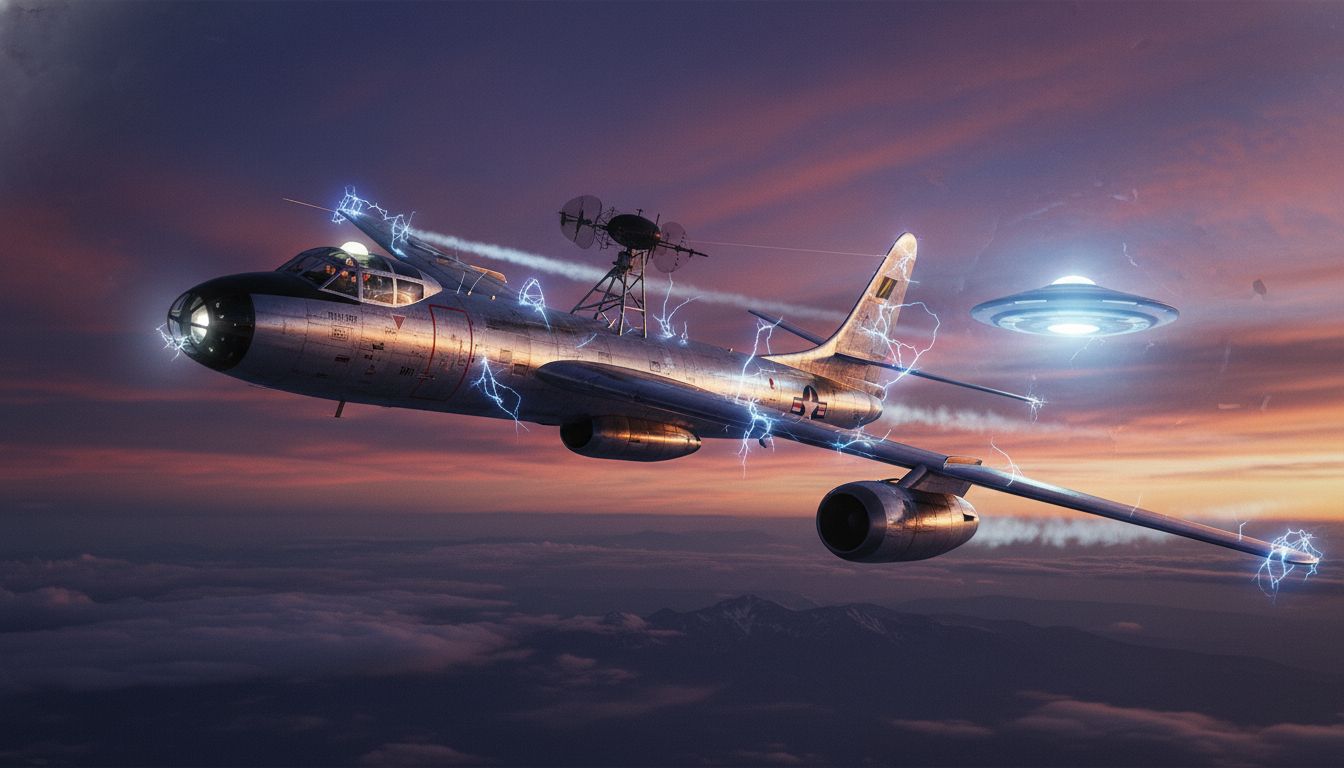
The United States Air Force’s RB‑47 “Stratojet” encountered an unidentified aerial phenomenon on the night of 17 July 1957, a case that resurfaced in recent congressional UAP hearings as an example of a high‑altitude, instrument‑detected encounter. The six‑man crew—pilot Lewis Chase, copilot James McCoid, navigator Thomas Hanley, and electronic‑monitor specialists John Provenzano, Frank McClure and Walter Tuchscherer—had taken off from Forbes Air Force Base in Kansas, climbed to roughly 30,000 feet and proceeded on a routine training sortie over the Gulf of Mexico. At approximately 0400 hours, while the aircraft was just off the coast of Gulfport, Mississippi, the monitors recorded an anomalous return on the plane’s electronic counter‑measure (ECM) system that appeared to track the aircraft’s position.
Walter Tuchscherer later described the signal as “a bright, moving blip on the scope that swept from one side of the aircraft to the other, as if something were circling us.” The initial interpretation was that the return was a ground‑based transmission that had reflected off the ionosphere, a common source of false readings in the era’s radar and ECM equipment. However, the signal’s consistent lateral motion and its persistence for several minutes prompted the crew to suspect a genuine airborne object. The anomaly was corroborated by visual sightings from the pilot and copilot, who reported a “shiny, disc‑shaped” object moving at a speed that outpaced the RB‑47’s own 500 knots. Ground radar at the nearby control tower also logged a contact that matched the aircraft’s heading and altitude, further validating the crew’s observations.
The encounter lasted close to an hour, during which the unidentified object appeared, disappeared, and re‑appeared multiple times, maintaining a distance of a few hundred yards and mirroring the bomber’s maneuvers. At one point the object accelerated ahead of the RB‑47, then decelerated to allow the bomber to catch up, a pattern described by the crew as “cat‑and‑mouse.” The aircraft’s electronic systems suffered intermittent interference, and the crew reported a brief loss of radio communication that lasted roughly 30 seconds. After the object finally vanished into the night sky, the RB‑47 completed its mission and returned to base without further incident.
Following the flight, each crew member filed detailed reports with their chain of command, documenting both the visual and electronic data. According to later accounts, the pilots sensed that senior officers were reluctant to publicize the incident. “There was a clear effort to keep the file quiet,” one former crew member told researchers, noting that the reports were classified for more than a decade and that requests for declassification were initially denied. The incident only entered the public domain in the early 1990s, when the Air Force’s “Project Blue Book” archives were partially released. The case has since been cited by UFO researchers as a rare example of a high‑altitude, instrument‑verified encounter involving a manned military aircraft.
In the context of today’s renewed scrutiny of unidentified aerial phenomena, the RB‑47 episode offers a historical benchmark. During the 2022‑2023 congressional hearings on UAPs, senior defense officials referenced the 1957 encounter to illustrate the long‑standing challenge of reconciling pilot testimony with sensor data. Dr. Jacques Vallée, a veteran ufologist and former astronomer, remarked that “the RB‑47 report is one of the few Cold‑War era incidents where visual, radar and onboard electronic signatures line up, suggesting an event that cannot be dismissed as simple equipment glitch.” While the Air Force has not publicly identified the object, the incident remains part of the UAP database maintained by the All‑Domain Anomaly Resolution Office (AARO), underscoring the need for systematic data collection and transparent analysis of such encounters.