Overview
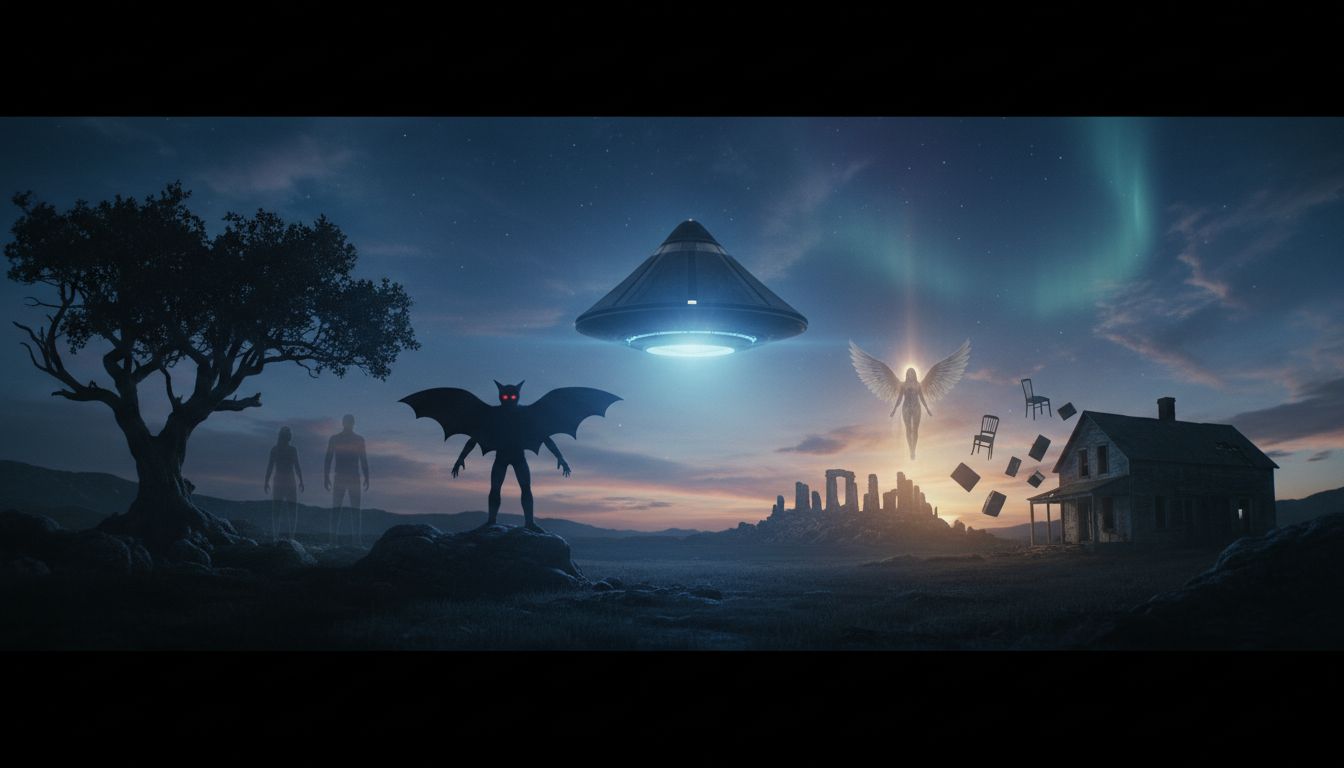
A new essay circulating in UAP‑research circles proposes that a single non‑human intelligence is responsible for a wide range of “high‑strangeness” reports—including UFO sightings, the Mothman legend, shadow‑person encounters, poltergeist activity, and historic angelic visions. The piece, authored by veteran investigator Joe Biscotto of the UAP Reporting Center, draws on the work of Jacques Vallée and John Keel and argues that these disparate phenomena are different manifestations of the same interdimensional entity using “portals” or “rifts” to interact with human consciousness. While the hypothesis is framed as a unifying model, it remains speculative and has yet to gain traction among mainstream scientists or government UAP programs.
The Witness Account
Biscotto’s narrative centers on a personal experience at the abandoned West Mountain Sanitarium in Scranton, Pennsylvania. He recounts that, while exploring the decaying ward with a small group, a full‑body apparition materialized, wearing period hospital attire and moving through the room as if it belonged there. The incident was followed by a sudden physical event—a friend’s earring was ripped from her ear and hurled across the space, accompanied by unexplained banging outside. “It wasn’t imagination. It was the same kind of breach I’ve heard described in UAP reports for decades,” Biscotto writes, positioning the encounter as a bridge between classic “ghost” reports and modern UFO sightings. The anecdote is presented as a cornerstone for the broader theory that such “breaches” are consistent across high‑strangeness cases.
The Unified Theory
According to the essay, the recurring pattern of “high strangeness” can be explained by an intelligence that operates from higher dimensions—a concept loosely linked to string‑theory frameworks that allow for extra spatial dimensions beyond the familiar three. Vallée’s “control system” hypothesis, first articulated in the 1960s, is revived here: the intelligence allegedly manipulates human perception by opening temporary doorways, allowing phenomena to manifest in forms familiar to the observer—UFOs for pilots, shadow figures for isolated individuals, angelic beings for religious contexts. The article cites historical accounts, ranging from 19th‑century “angelic” visions to 20th‑century cryptid sightings, as evidence that the same underlying mechanism is at work, merely wearing different cultural masks.
Scientific Context
The proposal intersects with ongoing scientific discourse on multidimensional physics and the emerging field of anomalous phenomena research. While string theory does predict additional dimensions, there is currently no empirical evidence linking those dimensions to observable entities such as UFOs or poltergeists. Researchers at institutions like the Pentagon’s Unidentified Aerial Phenomena Task Force have emphasized data‑driven analysis of sensor recordings, deliberately avoiding speculative metaphysical explanations. Dr. Hannah Miller, a physicist at the University of Colorado, notes, “Theoretical models that invoke extra dimensions are valuable for exploring fundamental physics, but they must be grounded in reproducible measurements before they can explain macroscopic events.” Thus, the unified intelligence model remains outside the mainstream scientific methodology.
Reactions and Outlook
The essay has elicited a mixed response within the UAP community. Advocates, including several independent investigators, praise the attempt to synthesize fragmented reports into a coherent framework, arguing that it encourages interdisciplinary collaboration between folklorists, psychologists, and physicists. Critics, however, caution against conflating anecdotal testimony with rigorous evidence. “Combining UFOs, cryptids, and religious visions under a single banner risks overlooking the distinct sociocultural factors that shape each phenomenon,” says Dr. Luis Garcia, a historian of paranormal belief. As the debate unfolds, the theory underscores a broader shift: researchers are increasingly willing to entertain non‑conventional hypotheses while demanding higher standards of documentation. Whether the “single intelligence” model will evolve into a testable scientific theory or remain a speculative narrative depends on future data collection, peer‑reviewed analysis, and, perhaps, the next compelling eyewitness account.


