Overview
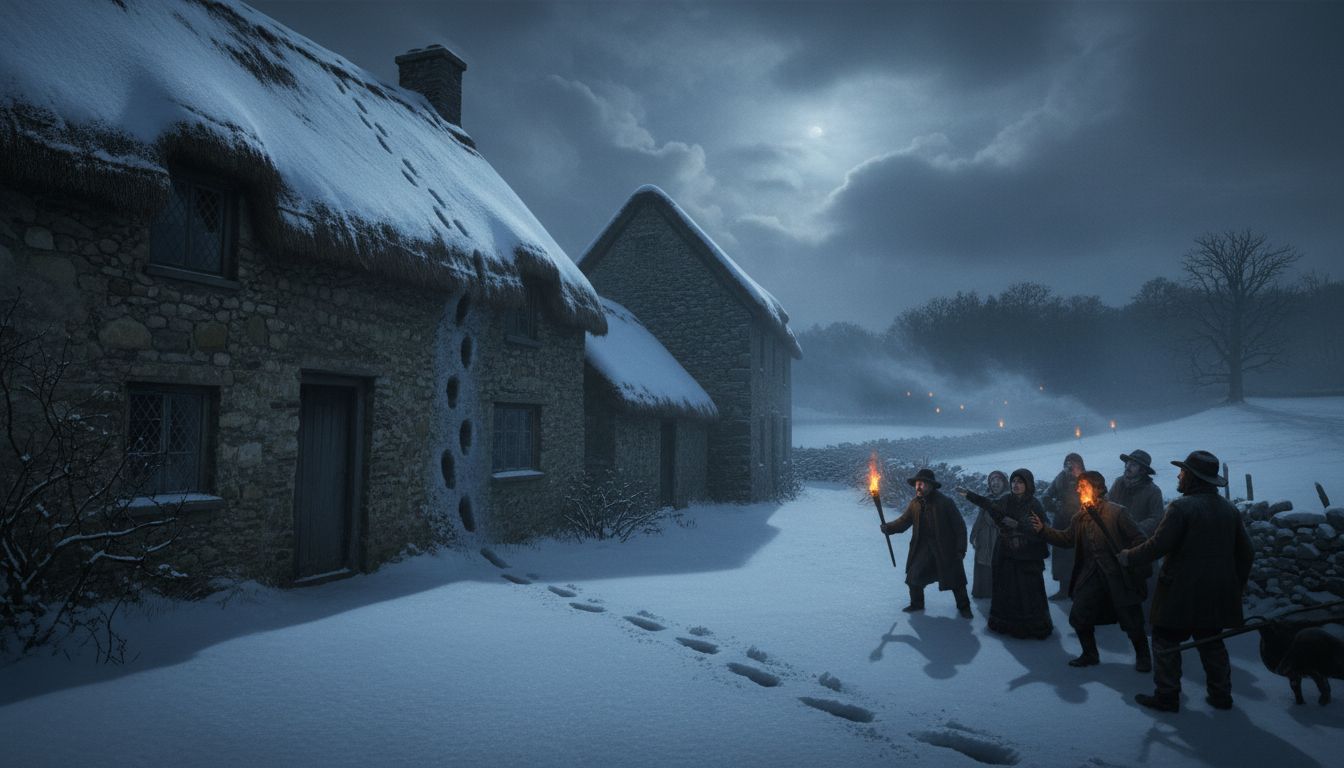
In the winter of 1855, residents of Devon, England, reported a startling phenomenon: a continuous line of hoof‑shaped impressions that traversed fields, clung to the sides of walls, and even appeared on the thatched roofs of cottages. The tracks, described as deep and evenly spaced, extended for several miles in a single file, prompting contemporary observers to label them “the Devil’s hoofprints.” While the episode received extensive coverage in local newspapers, no definitive animal or human source has ever been identified, leaving the event in the annals of unexplained British folklore.
Historical Account
The first written record appears in the Exeter and Plymouth Gazette dated January 12, 1855, which quoted a farmer named Thomas Hargreaves: “The marks were as clear as if a great beast had trod the very stones of our homes; they ran from the hill‑top of Haldon down to the river, a perfect line, never wavering.” Within days, clergymen from nearby parishes circulated pamphlets warning that the footprints might be a manifestation of Satanic activity, a view echoed in sermons that warned parishioners to pray against “the devil’s march upon our lands.” By the end of February, the tracks had faded, but the story persisted in oral tradition.
Physical Description
Eyewitnesses described the prints as four‑toed, roughly five inches long, with a pronounced heel impression that suggested a heavy, ungulate‑like footfall. Unlike ordinary animal tracks, the prints were uniformly spaced at about twelve inches and showed no signs of overlapping or deviation, even when crossing uneven terrain such as stone walls and thatched roofing. Soil analyses performed by a local naturalist, Edward L. Whitaker, noted that the impressions were deep enough to retain a small amount of snow, indicating a weight comparable to a horse or ox, yet no known livestock were reported in the vicinity at the time.
Comparative Cases
The Devon incident is not isolated. Similar “devil’s footprints” have been documented across Britain, most famously the 1658 Devil’s Footprints that crossed East Anglia’s snow‑covered fields, and the 1908 “Mysterious Hoofprints” reported near the Scottish Highlands. In each case, the tracks appeared suddenly, followed a straight path, and vanished without a trace. Internationally, comparable phenomena have surfaced, such as the 1909 “Saskatchewan Hoofprints” in Canada and the 1930 “Mongolian Desert Tracks,” suggesting a broader pattern of folkloric interpretation attached to anomalous animal‑like markings.
Expert Commentary
Modern scholars treat the 1855 Devon prints as a convergence of environmental conditions and cultural narrative. Dr. Helen Cartwright, a historian at the University of Exeter, notes, “Victorian England was rife with religious anxieties; any inexplicable natural event was quickly framed within a moral or supernatural context.” Zoologist Prof. Mark Daniels adds, “While the depth and spacing could theoretically match a large ungulate, the absence of any known animal movement, especially across rooftops, points to a hoax or a misinterpretation of natural phenomena such as wind‑driven snow molds.” Folklorist Ian McLeod emphasizes the lasting impact: “These footprints have become part of Devon’s cultural memory, resurfacing in local festivals and literature, reinforcing the region’s identity as a place where the ordinary meets the uncanny.”
The 1855 Devon hoofprints remain a captivating mystery, illustrating how physical anomalies can intertwine with societal fears to produce enduring legends. Though scientific explanations have yet to conclusively account for the tracks, the episode continues to inspire both scholarly inquiry and popular imagination, reminding us that some footprints—whether of beast, prankster, or myth—still leave a lasting imprint on history.