Overview
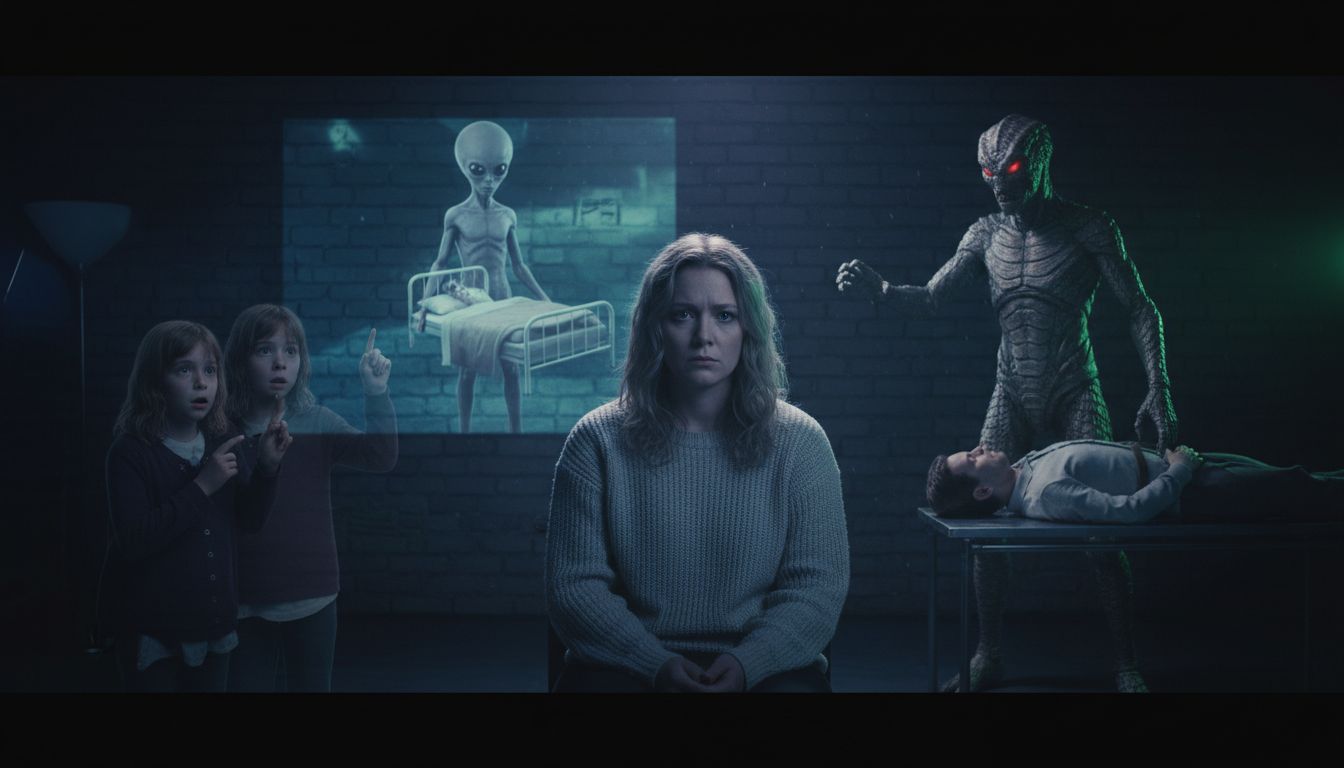
Identical twin sisters Audrey and Debbie Hewins have become a focal point in the UFO‑abduction literature after recounting a series of encounters that began when they were five years old. Their case, documented in Kathleen Marsden’s The Alien Abduction Files and supported by a series of personal notebooks, describes repeated interactions with two distinct types of extraterrestrial entities: bald, large‑headed gray figures and later, reptilian‑humanoid beings. The twins report classic abduction phenomena—missing time, sensations of floating in a fluid, and invasive medical procedures that they interpret as part of a broader hybridization program.
Early Encounters and “Bald Men”
According to the Hewins sisters’ diaries, the first incidents occurred in the mid‑1990s. The twins repeatedly begged their parents not to send them to bed, fearing the appearance of “bald men” with oversized heads and black, almond‑shaped eyes. Sketches in the girls’ notebooks from age five show simple line drawings of these entities, while later entries contain detailed narrative accounts. One entry describes a night when the sisters awoke to a silent, humming presence in their bedroom; the figures stood motionless, observed them, and then vanished without a trace. The twins’ consistent description of the entities’ physical traits aligns with the classic “gray” archetype reported in many abduction testimonies.
Missing Time and the 2007 Reptilian Contact
The Hewins’ reports also include episodes of missing time, a hallmark of alleged abductions. In January 2007, both sisters experienced a sudden lapse of approximately thirty minutes while at home. Upon regaining consciousness, they found themselves in a dimly lit chamber, surrounded by other abductees encased in gel‑filled containers. The twins recall a sensation of weightlessness as they were lifted into a craft‑like environment, where reptilian‑humanoid figures—described as taller, with scaled skin and elongated heads—performed what they perceived as reproductive and genetic procedures. The sisters noted the presence of metallic instruments and a low, resonant hum that accompanied the “floating” experience.
Invasive Experiments and Hybridization Claims
Subsequent entries in the Hewins’ notebooks detail a series of invasive experiments. The twins describe the insertion of needle‑like devices into their forearms, the extraction of blood samples, and what they interpreted as DNA alteration. One passage recounts a “procedure” that involved the placement of a small, translucent pod near the abdomen, which the twins later associated with reproductive manipulation. While the sisters interpret these actions as evidence of an alien‑human hybridization agenda, the lack of corroborating physical evidence makes verification difficult. Nonetheless, the consistency of the twins’ accounts over decades—spanning childhood to adulthood—adds a layer of credibility that researchers find noteworthy.
Expert Context and Scholarly Perspective
UFO researchers caution against drawing definitive conclusions from single‑case reports, emphasizing the need for corroboration and methodological rigor. Dr. John Mack, a former Harvard psychiatrist who studied abduction phenomena, argued that repeated, detailed narratives—especially when recorded contemporaneously—merit serious psychological and phenomenological analysis. Similarly, sociologists of twin studies note that identical twins often exhibit heightened empathy and shared perception, which can amplify the recall of unusual events. While the Hewins case does not provide physical artifacts, its documentation—spanning over two decades and supported by independent publication—offers a valuable data point for ongoing investigations into alleged extraterrestrial contact.
Implications and Ongoing Inquiry
The Hewins sisters’ experience underscores several persistent themes in abduction reports: the presence of multiple entity types, the use of fluid‑based environments, and claims of genetic experimentation. If the alleged hybridization program were substantiated, it would have profound implications for our understanding of potential extraterrestrial motives. For now, the case remains part of a broader corpus of anecdotal evidence that researchers continue to evaluate alongside physiological studies, eyewitness reliability assessments, and cultural analyses. As the twins maintain their records and continue to speak publicly, the Hewins narrative will likely remain a reference point for both skeptics and believers examining the intersection of psychology, folklore, and the enduring mystery of unidentified aerial phenomena.


