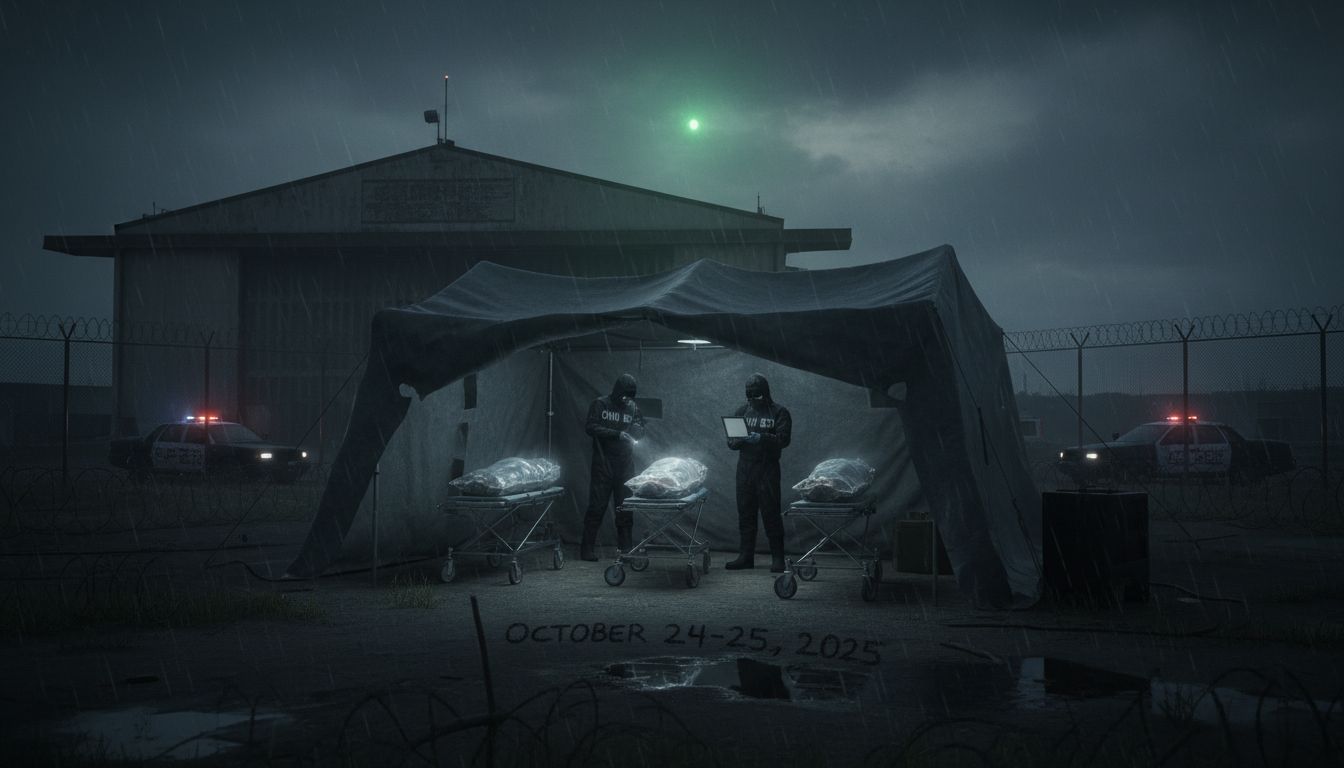
Three civilian researchers employed by the United States Air Force were discovered dead at Wright‑Patterson Air Force Base in Ohio over a twelve‑hour span between the evening of Oct. 24 and the early morning of Oct. 25, 2025. The individuals, whose names have not been released pending notification of next‑of‑kin, were found in separate locations on the installation’s research campus. The Ohio Bureau of Criminal Investigation (OBCI) and the Air Force Office of Special Investigations (AFOSI) have taken joint jurisdiction of the case, but officials have not yet disclosed a cause of death or any indication of foul play.
“Law enforcement is actively pursuing all leads and conducting a thorough forensic examination,” said OBCI spokesperson Lt. Col. Megan Hargrove in a brief statement to the press on Thursday. “We are treating this as a routine investigation until additional evidence is gathered.” AFOSI’s public affairs office echoed the sentiment, noting that agents are “coordinating with base medical personnel, the medical examiner’s office, and federal authorities to determine the circumstances surrounding these tragic losses.” Neither agency has ruled out accidental, natural, or criminal causes, and the investigation remains in its early stages.
Wright‑Patterson has long been associated with advanced aerospace research and, more recently, with the United States’ limited public disclosures on unidentified aerial phenomena (UAP). The base houses the Air Force’s Advanced Aerospace Threat Identification Program’s successor, the All‑Domain Anomaly Resolution Office (AARO), which was established after the Pentagon’s 2022 UAP report. Because of that connection, members of the UFO‑research community have quickly linked the deaths to possible classified work on UAPs. Online forums and social‑media groups have begun circulating speculation that the three researchers may have been involved in sensitive data analysis or sensor testing, though no evidence has been presented to substantiate those claims.
Historically, Wright‑Patterson has been the site of several high‑profile incidents involving unexplained aerial sightings, most notably the 1947 “Foo Fighter” reports and the 2004 “Nimitz” encounters that later featured in the Department of Defense’s UAP videos. The base’s legacy as a hub for aerospace intelligence has fostered a persistent aura of secrecy, prompting both legitimate journalistic inquiry and fringe conjecture whenever unusual events occur. In this case, the lack of an official cause of death fuels the narrative, but investigators stress that speculation does not replace factual findings.
Family members of the deceased have been asked to withhold public comment as the investigation proceeds. The Air Force has offered counseling services to base personnel and has pledged full cooperation with civilian authorities. As the OBCI and AFOSI continue forensic testing, autopsy results, and interview transcripts, the broader community will be watching for any official updates that might clarify whether the tragedy is linked to occupational hazards, health issues, or an as‑yet‑unknown factor. Until then, the focus remains on delivering answers to the families and ensuring that the integrity of the base’s research mission is upheld.


