Overview
In Irish folklore, the Cóiste Bodhar, commonly translated as the “Death Coach” or “Silent Coach,” is a supernatural carriage associated with death, misfortune and the passage of souls from the living world. According to an account published by Moon Mausoleum on Oct. 3, 2026, the apparition is traditionally believed to travel through the countryside at night, appearing—or more often being heard—as an omen that someone’s death is imminent.
The legend forms part of a wider body of Irish supernatural traditions involving banshees, headless riders and spirits connected with burial and mortality. Although versions of the Death Coach have circulated beyond Ireland and entered broader British and American popular culture, the story remains particularly tied to Irish landscapes and oral folklore.
A Phantom Coach and Its Riders
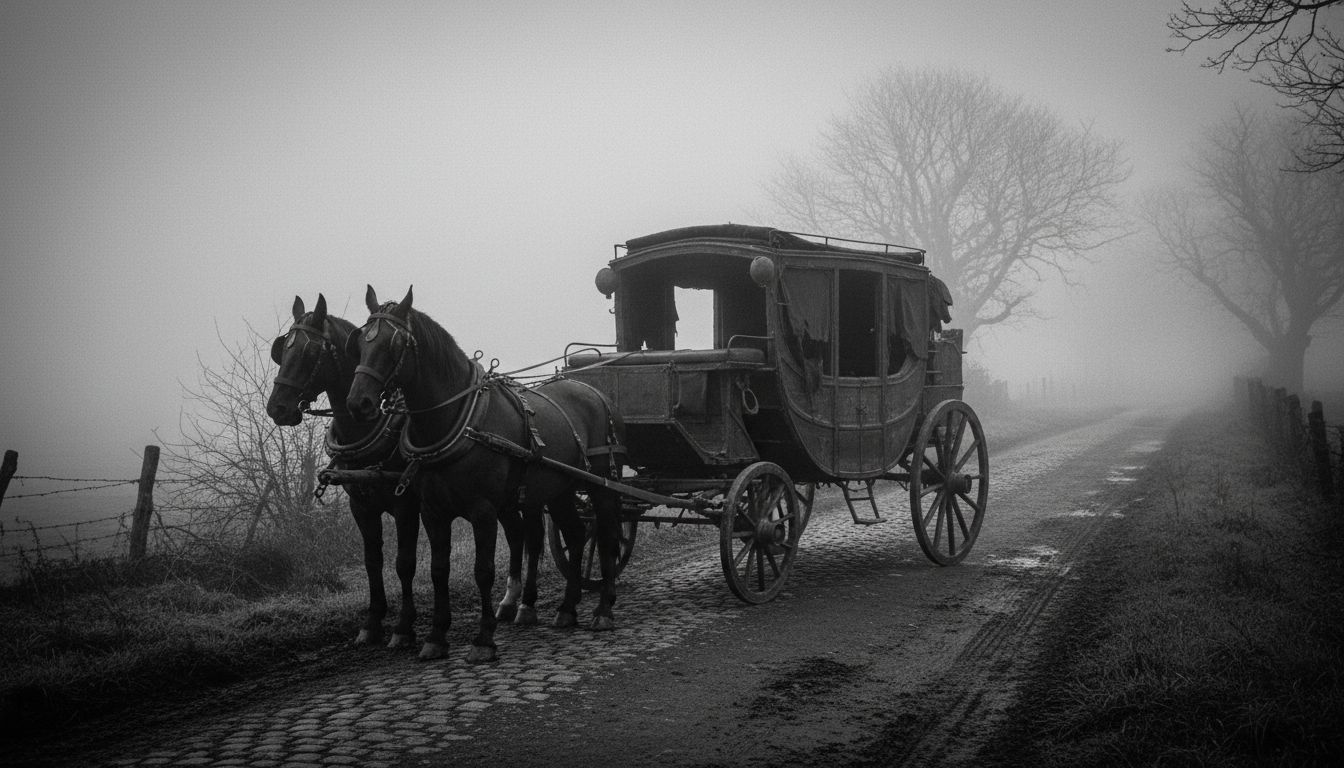
Descriptions of the Cóiste Bodhar vary, but the most familiar version portrays an ornate, dark carriage drawn by four or six headless horses. The coach is sometimes said to be driven by a headless coachman dressed in tattered black clothing. In these accounts, the driver is identified with the Dullahan, or Gan Ceann, an Irish figure whose name means “without a head.”
The Dullahan may appear behind the reins or ride alongside the coach on a black horse. Some versions of the legend also place a coffin at the rear of the carriage, symbolizing the fate awaiting the person or family connected to its appearance. Moon Mausoleum describes the coach as having dim, unnatural lanterns and moving through mist as though it were floating above the ground.
Sound as a Warning
A central feature of the tradition is that the Death Coach is often heard before it is seen. Witnesses in folklore are said to hear galloping hooves, creaking wheels and the crack of a whip carried through the night air. The sounds are presented not as ordinary travel but as a supernatural warning that death is near.
The coach’s appearance is also linked in some stories to the banshee, or bean sídhe, a female spirit whose lament is traditionally associated with the death of a member of certain families. In these accounts, the banshee may wail alongside the coach or act as a herald announcing its arrival. The two figures therefore share a symbolic role: warning the living that a death or serious misfortune is approaching.
Folklore’s Meaning and Legacy
The belief that the coach cannot return empty gives the legend its sense of inevitability. Once it has arrived to claim a soul, folklore holds that no human action can prevent the death. Those who obstruct or challenge it may suffer misfortune, reinforcing the coach’s role not merely as a ghost story but as a supernatural force beyond human control.
As with many traditional legends, the Cóiste Bodhar should be understood as a cultural and folkloric belief rather than a documented paranormal phenomenon. Its enduring appeal lies in the way it turns familiar elements—horses, roads, wheels and night travel—into symbols of mortality. The Death Coach’s continuing presence in ghost stories, literature and popular culture reflects the lasting power of Irish folklore to give shape to fears surrounding death, uncertainty and the unknown.