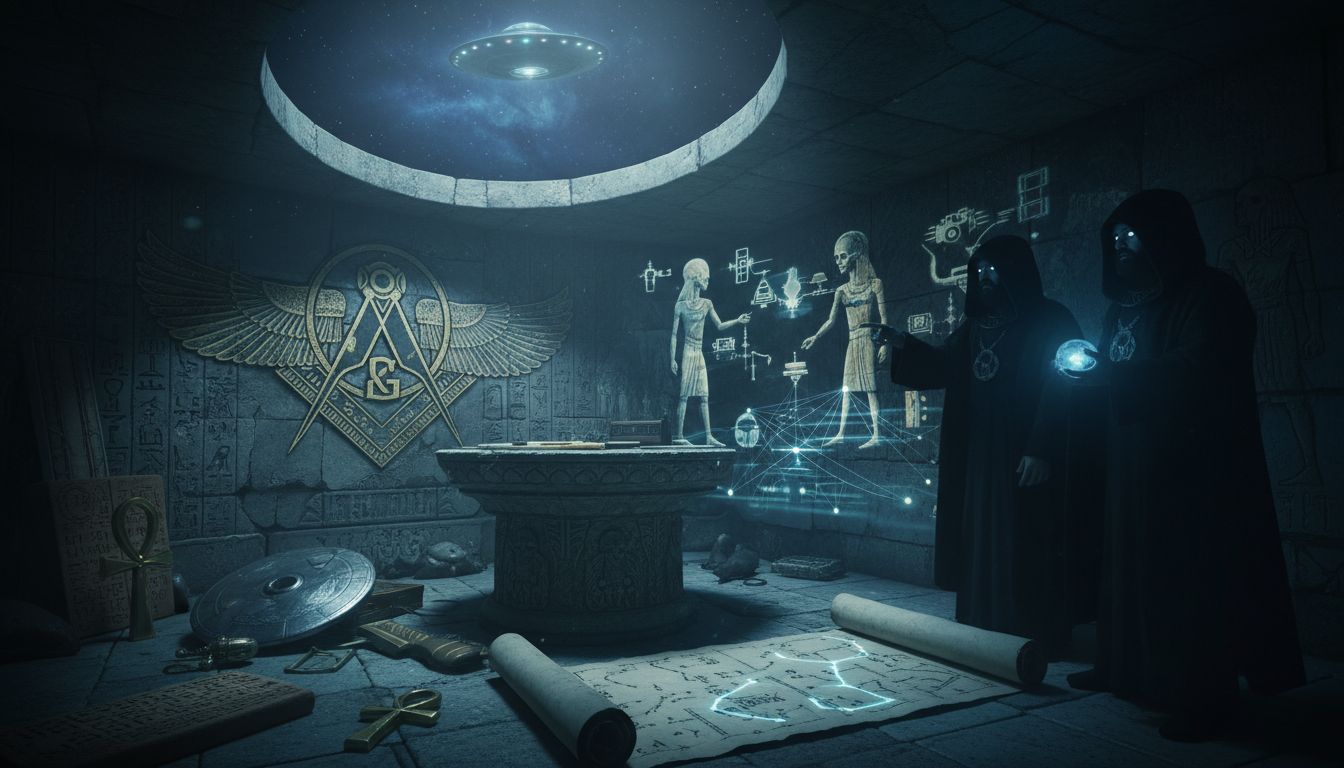
The idea that modern secret societies such as the Freemasons trace their roots to an extraterrestrial encounter thousands of years ago has resurfaced in a series of articles on UFO‑focused websites. Proponents point to the Anunnaki—a pantheon described in Sumerian texts and popularized by author Zecharia Sitchin—as the “ancient engineers” who allegedly created humanity and transmitted esoteric knowledge to early mystery schools in Egypt and Mesopotamia. According to these writers, the rituals of the medieval Knights Templar and the later Freemasons are “almost identical” to those taught in those ancient schools, suggesting a continuous line of hidden instruction that survived through the ages.
Sitchin’s work, which began in the 1970s, rests on his own translations of cuneiform tablets that he claimed described a planet called Nibiru and a race of beings who came to Earth to mine gold. Critics in the fields of archaeology and Assyriology have repeatedly rejected his linguistic methods and conclusions, noting that mainstream scholarship finds no evidence of alien contact in the ancient record. Nevertheless, the narrative has attracted a niche following that interprets symbolic motifs—such as the “hooded man” and stylized heads found in medieval iconography—as visual echoes of an alien legacy.
The connection to contemporary events is presented as a chain of influence extending from the medieval period to the founding of the United States, the Apollo moon landings, and even the assassination of President John F. Kennedy. Advocates argue that members of secret societies have historically occupied “positions of power and influence,” allowing them to shape political decisions and, in some cases, conceal knowledge of ancient extraterrestrial bases on the Moon. The claim that NASA’s 1969 landing was a cover for “ancient lunar installations” is cited alongside alleged references in Masonic symbolism to celestial navigation and “hidden wisdom.”
Scholars of secret societies, however, caution against conflating documented historical facts with speculative mythmaking. Historian Michael G. Haines notes that while the Freemasons did adopt elements of medieval chivalric orders, their rituals were largely shaped by Enlightenment‑era philosophies and the social networks of the 17th and 18th centuries. Likewise, the Knights Templar were dissolved in the early 14th century, and any direct institutional continuity with later fraternal groups is tenuous at best. The suggestion that these organizations possess “evidence of alien presence” remains unsubstantiated, as no credible archival material or physical proof has been presented to the academic community.
The resurgence of these theories reflects a broader cultural fascination with hidden histories and the desire to locate humanity’s origins beyond conventional narratives. While the UFO‑insight article frames the hypothesis as a “great achievement in human history” tied to the moon landings, mainstream experts stress that extraordinary claims require extraordinary evidence—something the current body of research does not provide. As interest in both secret societies and the ancient astronaut hypothesis persists, the dialogue continues to occupy a fringe space where speculative storytelling meets the public’s appetite for mystery, rather than a rigorously vetted historical discourse.


