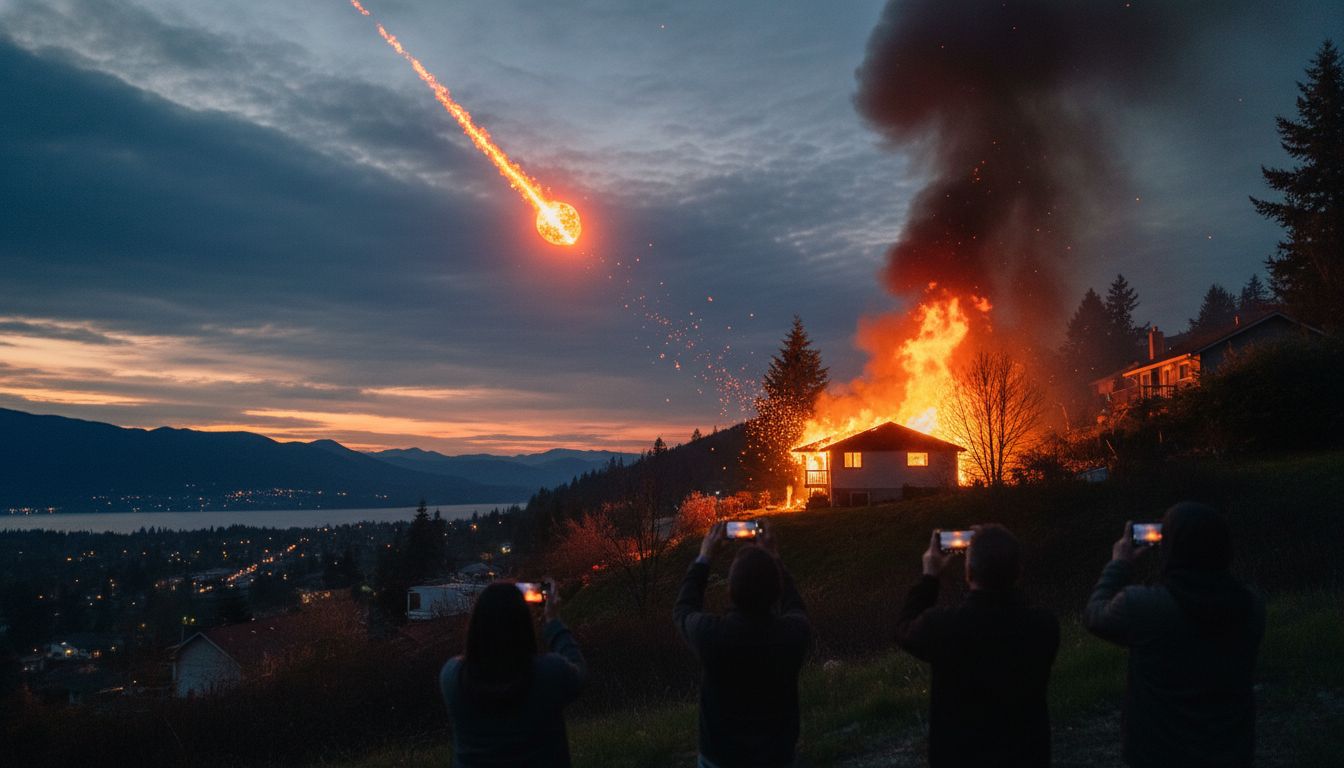
A bright, orange‑glowing sphere streaked across the night sky over the small community of Peach land, British Columbia, on the evening of March 16, 2021, before descending toward a residential property and igniting a fire that nearly consumed the home. The incident was captured on video by a passerby, who described the object as “a massive fireball that started flying towards us.” The footage, which quickly spread on social media, shows the orb moving at a steep angle, trailing a faint tail before striking a wooden deck and setting it alight. Fire crews from the Peach land Volunteer Fire Department arrived within minutes, battling a blaze that forced the occupants to evacuate and threatened to engulf the adjacent house.
Local authorities launched an immediate investigation. The Royal Canadian Mounted Police (RCMP) and the British Columbia Wildfire Service examined the scene, looking for evidence of an aircraft, a fireworks device, or any other conventional source that could explain the ignition. “We have found no signs of a conventional launch mechanism, no debris consistent with a rocket or a drone, and no indications of arson,” said RCMP Sgt. Mark Gillespie, who led the inquiry. The fire department’s after‑action report confirmed that the fire originated at the point of impact, where the deck material was reduced to ash within seconds, but it did not identify a definitive cause for the luminous object that struck it.
Meteorologists from Environment Canada were consulted to determine whether the fireball could be attributed to a natural atmospheric event. While meteors entering the Earth’s atmosphere can produce bright fireballs, they typically disintegrate at high altitude and rarely reach the ground with enough kinetic energy to start a fire. “The trajectory and low altitude of this object are atypical for a meteoric event,” explained Dr. Laura Chen, a senior atmospheric scientist at the agency. “It would have needed to retain a substantial amount of mass and velocity to cause the kind of localized ignition we observed, which is uncommon for known meteor phenomena.”
The incident has reignited public interest in unidentified aerial phenomena (UAP) in Canada, a topic that has received renewed attention following the U.S. Department of Defense’s release of its own UAP reports. However, officials cautioned against jumping to speculative conclusions. “Our mandate is to investigate based on evidence,” emphasized Sgt. Gillespie. “At this stage, we have no data that points to an extraterrestrial or paranormal origin. The focus remains on establishing the factual chain of events and ensuring public safety.” The RCMP has kept the case open, pending any new information that might emerge from additional witness statements or forensic analysis of the recovered debris.
For the homeowners, the experience was unsettling but ultimately survivable. “It was terrifying to see something so bright and then watch it hit the house,” said one resident, who asked to remain anonymous. “We’re grateful the fire department got there so quickly; the house is still standing, but we’re left with a lot of questions.” As investigators continue to sift through the video, sensor data, and physical evidence, the Peach land fireball remains an unexplained occurrence—one that underscores the challenges of distinguishing between rare natural events and phenomena that lie beyond current scientific understanding.