Overview
In a recent episode of his program “Interestelar,” renowned Mexican UFO researcher Jaime Maussan reignited debate over a series of ancient artifacts discovered in Mexico, which some believe depict evidence of contact between early civilizations and extraterrestrial beings. Maussan, who has long been at the center of UFO and anomalous archaeology discussions in Latin America, asserts that ongoing investigations increasingly support the authenticity of at least some of these controversial objects. If proven genuine, he claims, they could potentially reshape our understanding of pre-Hispanic history.
The Artifacts and Their Origins
The artifacts in question—carved stones and objects bearing images of alleged non-human beings and spacecraft—have surfaced since 2009 in various states, most notably Jalisco and the town of Ojuelos. According to Maussan, these items have not only been unearthed but also widely commercialized, leading to skepticism regarding their authenticity. Many critics have dismissed them as modern forgeries, citing the proliferation of similar items on the market.
Despite this, Maussan notes that “investigations that have been carried out over 15 years seem to be demonstrating that these pieces are real, or at least some of them.” He emphasizes that even the verification of a single artifact would be significant enough to warrant a re-examination of Mexican history, suggesting that non-human entities may have been present and recorded by ancient peoples.
Scientific Scrutiny and International Interest
A key aspect of Maussan’s argument centers on the scientific analysis conducted by various researchers and institutions. He highlights the involvement of Italian academics, who have used advanced techniques to study the artifacts and reportedly identified features suggesting their authenticity. A dedicated group, known as Sangre de América, has formed in Italy to further investigate these findings, describing the potential implications as “one of the most important discoveries of all time.”
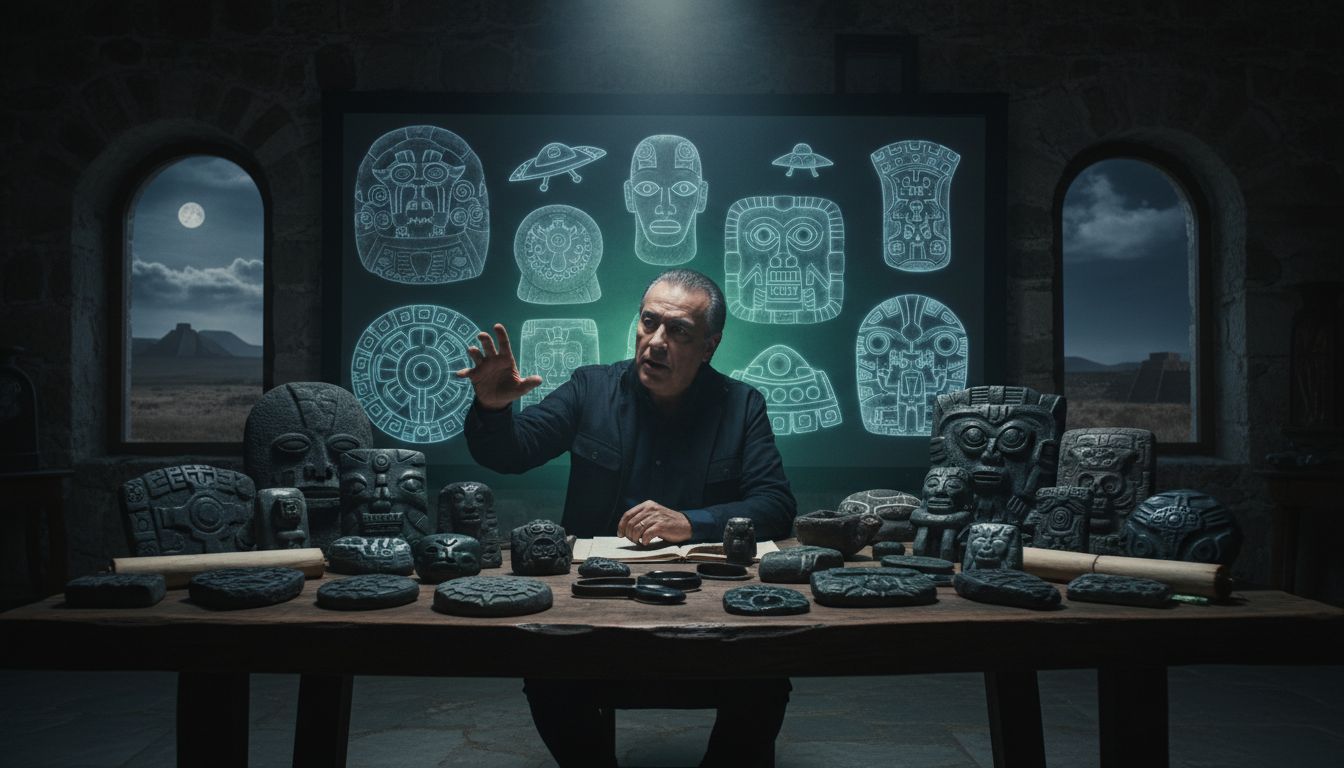
The artifacts themselves include carvings that resemble classic “flying saucers,” humanoid figures with non-human features, and even what some interpret as ancient astronauts with helmets and suits resembling modern space gear. One particularly notable piece is a composite “alien head” crafted from fragments of different rocks, adorned with intricate engravings that allegedly depict both Aztec iconography and extraterrestrial beings.
Skepticism and Calls for Further Research
Maussan acknowledges the controversy, noting that “there are many reproductions that are not authentic, but some of these findings may be real.” He urges the scientific community to engage with the evidence rather than dismiss it outright due to prevailing academic paradigms, stating, “It is an obligation of scientists, not simply to reject [such evidence] because it does not fit their worldview.”
He also references earlier work by Mexican researcher Fernando Correa and an independent team led by Dr. Pablo Enrique García Sánchez, who have connected the Ojuelos region to significant Aztec historical sites and legends. Despite these connections, Maussan concedes that “there is much talk of contact between ancient civilizations and extraterrestrials, but there is no conclusive evidence yet.” He positions these artifacts as potential candidates for such proof, provided that official archaeological and governmental authorities undertake serious investigation.
The Road Ahead
With over 350 distinct artifacts purportedly depicting UFOs and non-human entities, Maussan and his collaborators continue to advocate for transparent, multidisciplinary analysis. He concludes by inviting Mexican authorities to participate directly in the verification process, emphasizing, “If confirmed to be legitimate, history could be modified.” As the debate continues, the question remains whether mainstream science will accept the challenge to rigorously test these controversial claims, or if the line between fringe archaeology and established history will remain firmly drawn.