Overview
On the night of August 21, 1955, a farmhouse near Kelly and Hopkinsville, Kentucky became the focus of one of the most widely reported UFO encounters in American history. The Sutton family—father Billy, mother Ruby, and their three children—claimed that “glowing, goblin‑like” figures hovered around their home, survived repeated gunfire, and persisted until dawn. The incident, now commonly referred to as the Kelly‑Hopkinsville “Goblin” case, has been revisited in a recent episode of Mysterious World (MYS403), where host Jimmy Akin and researcher Dom Bettinelli examined the original accounts, police reports, and subsequent analyses. Their discussion underscores why the case remains a touchstone for both skeptics and believers in extraterrestrial phenomena.
What Happened
According to contemporary newspaper coverage and the Suttons’ own statements, the family first noticed strange lights outside their home around 11 p.m. When they stepped onto the porch, they reported seeing “small, humanoid beings” about three to four feet tall, with large eyes and a faint, phosphorescent glow. The family opened fire with a .30‑caliber rifle and a shotgun; witnesses said the bullets seemed to have no effect, and the entities retreated only to return moments later. By sunrise, the family claimed the beings had vanished, leaving behind a few shallow depressions in the yard. “We heard the gunshots, and they kept coming back,” Akin recounted from the podcast, noting the consistency of the Suttons’ testimony across multiple interviews.
Evidence and Physical Clues
Police and fire officials arrived early the next morning, documenting several physical traces: a series of shallow pits roughly six inches deep, scattered across the lawn, and a faint, oily residue on a nearby fence post. The investigators also recorded a series of loud, metallic clangs that they could not attribute to any known source. However, no bodies, biological material, or definitive artifacts were recovered. The case file, now archived at the Kentucky State Police, includes the original police report, the family’s signed statements, and a handful of newspaper clippings that circulated nationally in the weeks following the event.
Skeptical vs. Paranormal Interpretations
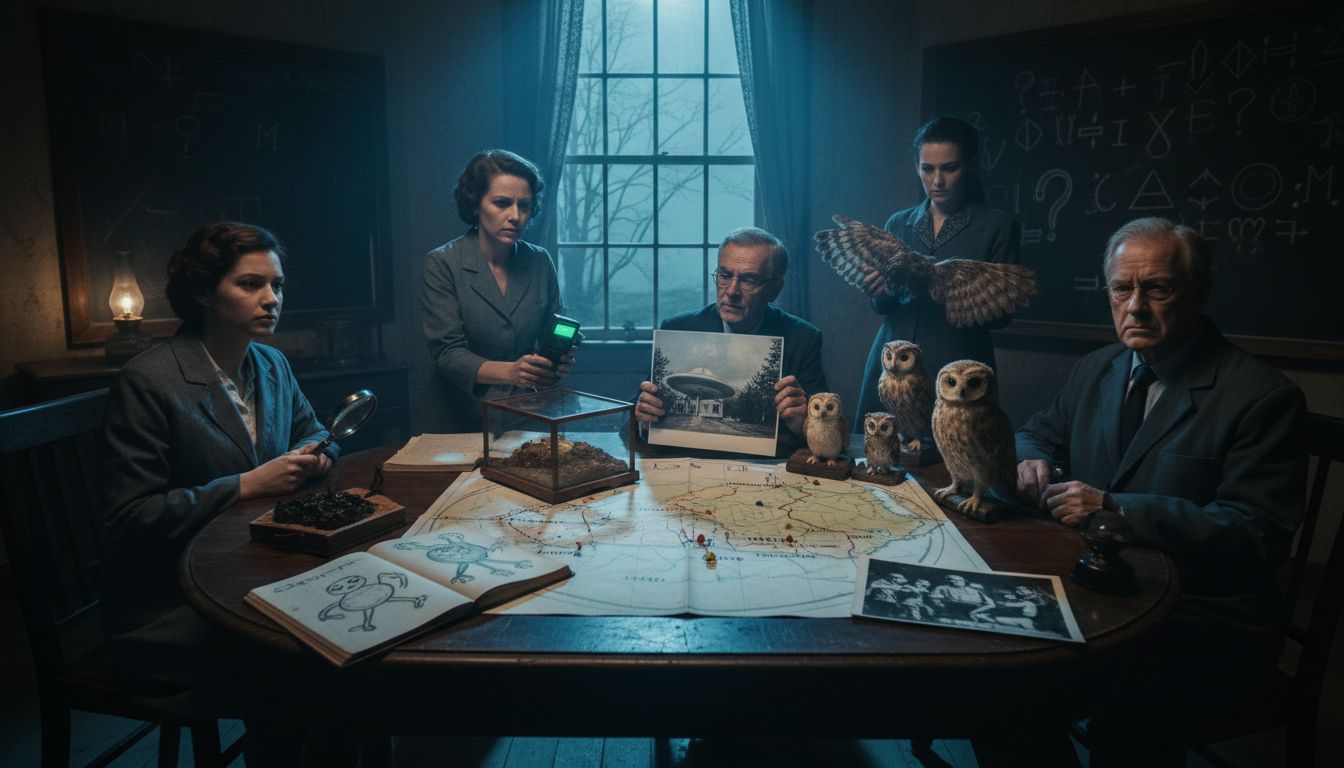
Akin and Bettinelli evaluated a range of explanations. Skeptical investigators such as Joe Nickell have suggested that the “goblins” were likely great horned owls or other nocturnal birds, whose reflective eyes and silent flight could produce the illusion of hovering, luminescent figures. The owl‑theory, however, struggles to explain the reported resistance to gunfire and the repeated return of the entities. Conversely, proponents of an extraterrestrial hypothesis point to the family’s detailed description of the beings’ posture and the inability of conventional weapons to affect them. While the podcast’s hosts stop short of declaring the encounter “alien,” they note that the lack of conclusive evidence leaves the case open to interpretation, and they dismiss supernatural demonological explanations as unsupported by any physical data.
Broader Significance
Beyond the immediate mystery, the Kelly‑Hopkinsville encounter has entered cultural and theological discourse. Akin highlighted that Catholic theology, for example, does not preclude the existence of intelligent life beyond Earth, allowing believers to entertain the possibility of extraterrestrials without doctrinal conflict. The case also illustrates how fear, media amplification, and community memory can shape the narrative of a “close encounter.” As the Mysterious World episode concluded, “whether misunderstood or truly otherworldly, the Kentucky goblins remind us that some events resist easy categorization, urging investigators to balance open‑minded curiosity with rigorous evidence‑based analysis.”


