Overview
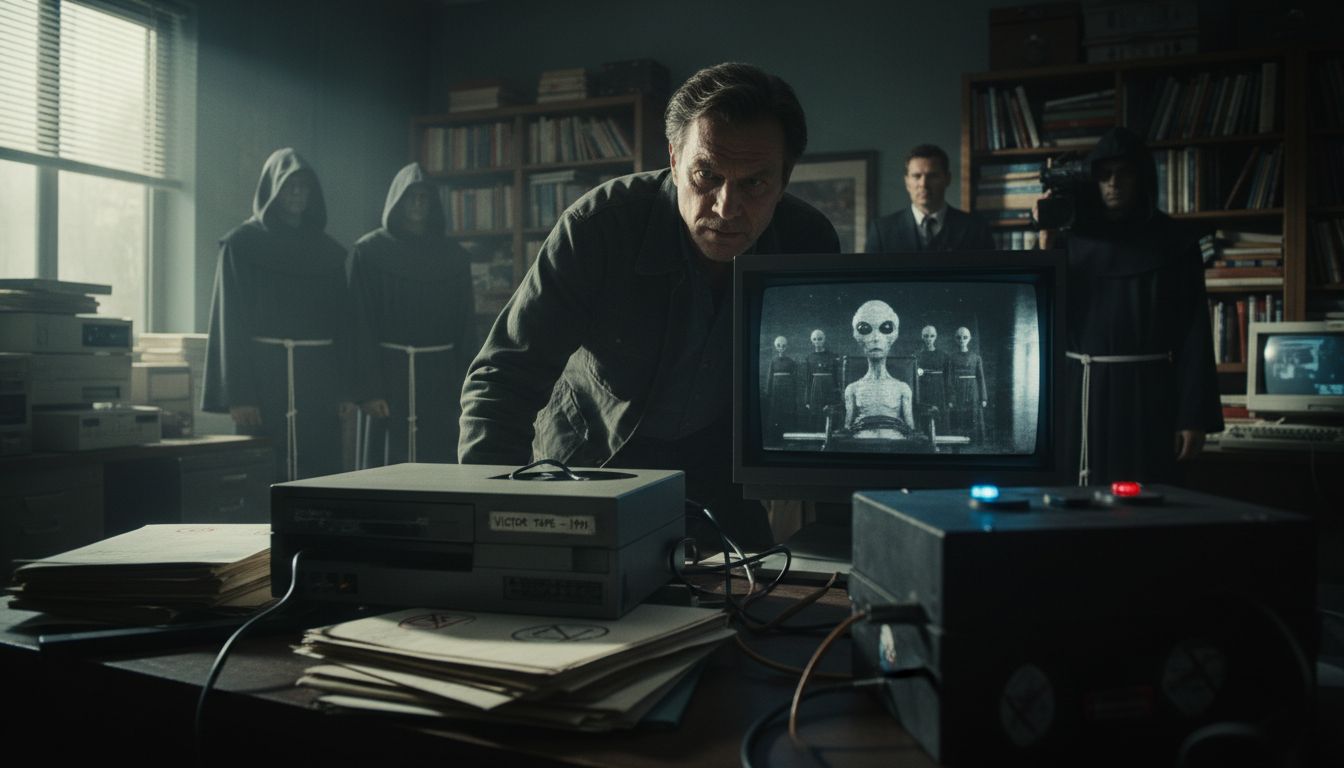
A renewed wave of interest has surged around the so-called “Victor” tape, a notorious piece of purported alien interrogation footage leaked in the early 1990s. In a recent analysis, investigator Jon Stewart has reignited debate over the video’s authenticity, suggesting that the infamous tape may not be a hoax after all. Stewart’s claims, discussed in detail on the Area 52 podcast, draw connections between the Department of Naval Intelligence (DNI), black budget military operations, and coordinated efforts by multiple intelligence agencies.
The Victor Tape: Origins and Controversy
The Victor tape first surfaced in 1997, depicting what appears to be an interview with a non-human entity. For decades, the footage has circulated among UFO researchers, skeptics, and mainstream audiences, often dismissed as a clever fabrication. Yet, as the video’s anonymous source—known only as “Victor”—insisted, the tape was smuggled from a highly secure facility and represents genuine government interaction with non-human intelligence.
Jon Stewart, a former professional wrestler and political candidate, began investigating the tape’s origins during his campaign. His findings, recently shared via Area 52 and other platforms, challenge long-held assumptions. “If I tell you the truth of that film, and if I tell you the truth of what that film is about, you and I will be swinging from an end of a rope,” a source ominously warned Stewart, underscoring the perceived gravity of the information.
Key Revelations: The Role of DNI and DIA
A pivotal element in Stewart’s investigation is the involvement of the Department of Naval Intelligence—not to be confused with the more commonly cited Office of Naval Intelligence. According to Stewart’s sources, including an insider from the Defense Intelligence Agency (DIA), the footage was produced for the DNI, which he describes as the Navy’s clandestine intelligence branch: “They’re the spooks for the Navy. It’s like their CIA arm for their Navy.”
Stewart asserts that the interrogation took place on April 22, 1991, at 3:15 p.m., within a highly secure facility. While the operation was carried out for the Navy’s most secretive intelligence arm, it was coordinated by the DIA, which oversaw a “congo line” of representatives from various three-letter agencies waiting to question the entity. Stewart regards the specific use of “DNI” as a credibility marker, arguing, “It’s the kind of detail a hoaxer might get wrong by accident, but that an insider would get right on purpose.”
This level of inter-agency cooperation, Stewart notes, is consistent with claims from prominent whistleblowers like Lou Elizondo and David Grusch, who have described the DIA as the central clearinghouse for UFO intelligence. The scenario echoes historic incidents such as Roswell (1947) and Varginha (1996), where jurisdictional disputes and agency competition were reported, though Stewart’s sources describe more coordinated efforts.
Unusual Allies: Monastic and Paranormal Involvement
Perhaps the most unexpected revelation in Stewart’s analysis is the reported participation of Carthusian monks from a Vermont monastery. According to Stewart’s intelligence source, these monks, known for their contemplative practices, were brought in as remote viewers—a technique loosely associated with psychic phenomena and previously explored in U.S. intelligence programs.
This detail suggests the government was not solely relying on conventional interrogation methods. Instead, they utilized both military and unconventional personnel to glean information, reflecting a period in which U.S. intelligence agencies were open to experimental approaches in dealing with phenomena beyond traditional scientific understanding.
Disclosure and the 2027 Threshold
Stewart’s investigation emerges at a time of heightened public and governmental attention to unidentified anomalous phenomena (UAP). He references a looming “2027 disclosure threshold,” echoing growing speculation that governments may soon be compelled to reveal more about their knowledge of non-human intelligence. “As the 2027 threshold approaches, the truth about the Victor tape is finally coming to light,” the video summarizes.
While Stewart’s findings do not provide definitive proof of the tape’s authenticity, they add significant context and raise fresh questions about the scope and secrecy of U.S. intelligence operations related to UAP. The renewed scrutiny underscores the enduring public fascination with the unknown—and the persistent call for transparency as alleged disclosure deadlines draw near.