The name Lloyd Berkner is familiar to historians of mid‑century science, not because of any alleged clandestine fleet, but for his work as a physicist and administrator during the International Geophysical Year (IGY) of 1957‑58. Berkner, a former director of the Office of Scientific Research and Development and later a senior official at the National Science Foundation, helped coordinate the unprecedented global effort to study Earth’s atmosphere, oceans and magnetic field. The IGY, backed by more than 60 nations, established a network of research stations in Antarctica and launched the first series of artificial satellites, including Explorer 1, which confirmed the existence of the Van Allen radiation belts. These publicly documented achievements have long been a cornerstone of Earth‑science history.
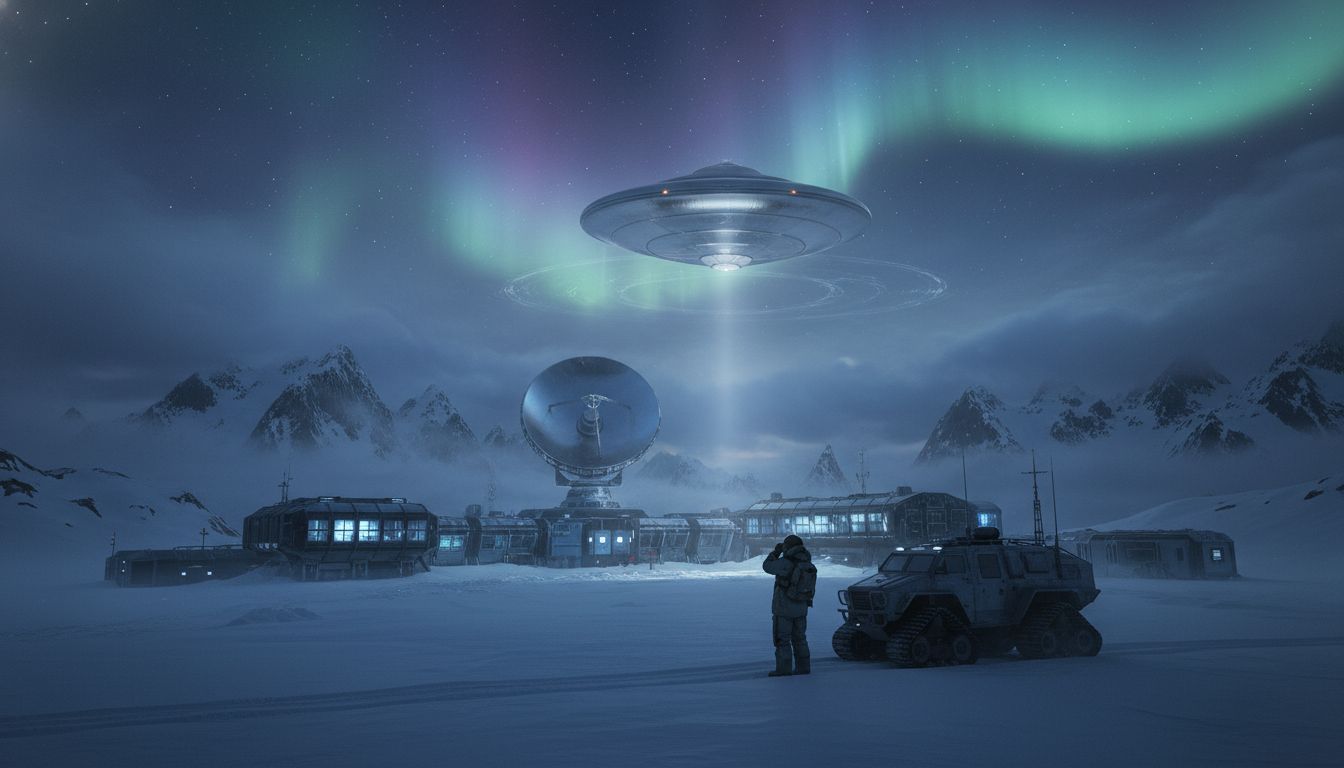
In recent months, a subset of the UFO‑UAP community has begun linking Berkner’s IGY involvement to what they term a “Secret Space Program” (SSP). The claim, advanced primarily by YouTube commentator “Dark Journalist” and former U.S. Antarctic Program participant Eric J. Hecker, hinges on the idea that the IGY’s Antarctic outposts were cover for hidden aerospace operations. Hecker, who describes a background that includes the alleged “Stargate Program,” a stint in the submarine service, and work for defense contractors such as Raytheon and Grumman, says his year‑long deployment at the South Pole in 2010 revealed “things were not as presented to the world.” He has appeared on a number of media programs, including The Alaska Triangle and Redacted with Clayton Morris, and reportedly provided testimony to the Senate Intelligence Committee and the Pentagon’s All‑Domain Anomaly Resolution Office (AARO). The transcript of that testimony is said to be slated for inclusion in the National Archives.
While Hecker’s personal narrative is compelling, independent verification of the alleged SSP activities remains absent. No declassified documents from the National Science Foundation, the Department of Defense, or the AARO have confirmed the existence of secret launch facilities, underground bases, or advanced propulsion systems tied to the IGY era. Scholars of Cold‑War science policy note that the IGY’s logistical footprint in Antarctica was heavily regulated under the 1959 Antarctic Treaty, which explicitly prohibits military activity and the testing of weapons on the continent. “The treaty created a transparent, collaborative framework that made covert operations extremely difficult, if not impossible,” says Dr. Margaret L. Hawkins, a historian at the University of Colorado Boulder. “Any claim that a massive, hidden aerospace program operated under the guise of scientific research would require substantial documentary evidence, which has not surfaced.”
The resurgence of SSP theories reflects a broader pattern in contemporary UFO discourse, where historical events are re‑examined through the lens of alleged government secrecy. Researchers such as Dr. Steven Greer have long advocated for disclosure of advanced technologies, but critics argue that many such claims rely on anecdotal testimony and speculative connections rather than corroborated data. “It’s essential to distinguish between legitimate whistle‑blower accounts and narratives that stretch the available evidence to fit a pre‑existing storyline,” notes Dr. James E. O’Leary, a senior analyst at the Center for Aerospace Studies. “The danger lies in eroding public trust in both scientific institutions and legitimate oversight mechanisms when unverified claims dominate the conversation.”
Nonetheless, the call for deeper investigation is not without merit. The U.S. government’s recent establishment of AARO and the release of several previously classified UAP reports have opened new avenues for systematic study of aerial phenomena. In that context, the testimonies of individuals like Hecker could be valuable, provided they are subjected to rigorous scrutiny and cross‑referenced with archival material. As the National Archives prepares to receive the Senate and AARO testimonies, scholars and journalists alike will be watching for any concrete links between the IGY’s historic scientific mission and the more speculative narratives of hidden space programs. Until such evidence emerges, the mainstream historical record continues to portray Lloyd Berkner and the International Geophysical Year as milestones of open, collaborative science rather than the foundation of a covert extraterrestrial enterprise.


