Overview
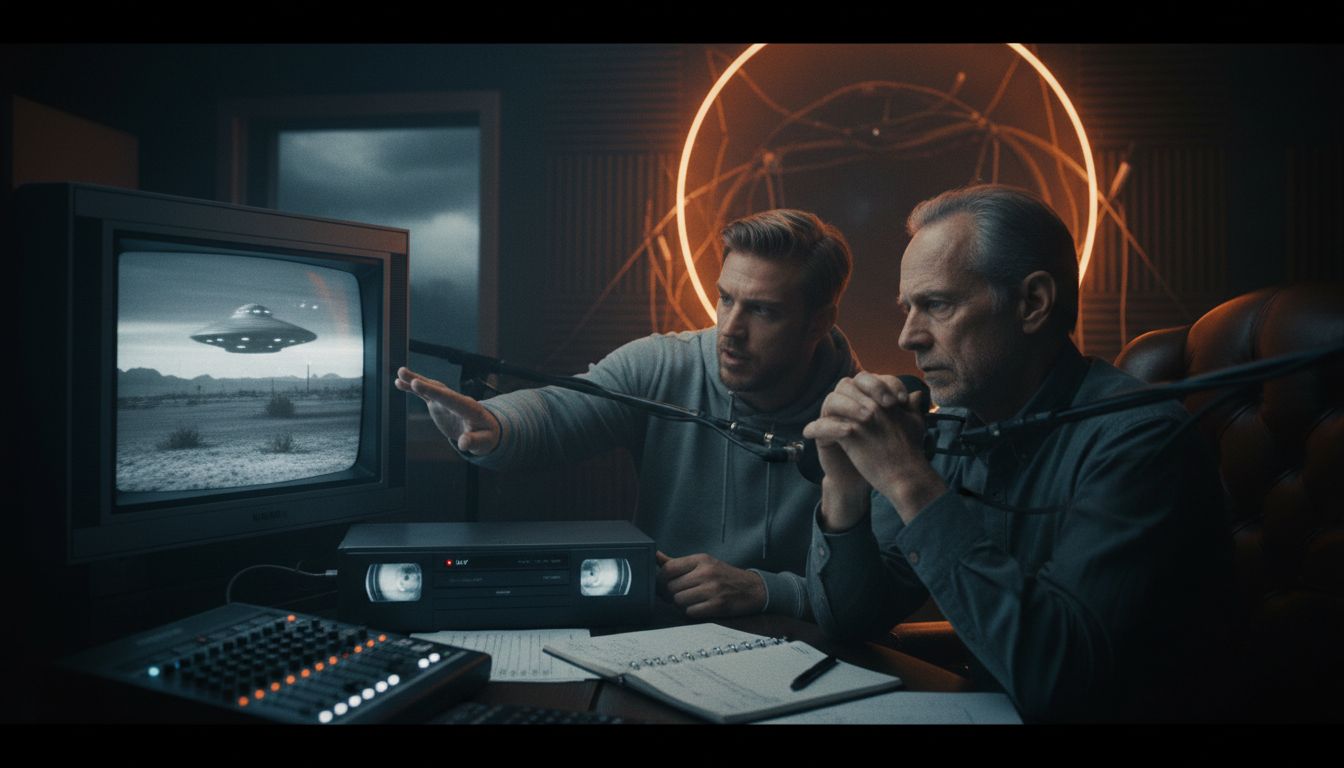
During a recent episode of the American Alchemy podcast, internet personality Logan Paul presented a previously unreleased segment of the infamous 1995 Chuck Clark UFO footage. The clip, sourced from an aging VHS tape, shows a reddish disc hovering over a vehicle while two off‑camera voices react with evident alarm. The episode also featured Bob Lazar, the self‑described physicist who claimed to have worked on reverse‑engineering extraterrestrial craft at the secretive S4 facility near Area 51 in the late 1980s. Paul’s intention was to gauge Lazar’s reaction and assess whether the visual characteristics matched the “Sport‑Model” craft Lazar has described for decades.
Background
The Chuck Clark video has long occupied a gray zone in ufology. Recorded in 1995, the tape was never publicly verified, and its authenticity has been debated among enthusiasts and skeptics alike. Clark, a former law‑enforcement officer, alleged that the footage captured a genuine unidentified flying object, but without corroborating radar data or independent analysis, the clip remained a “legend” rather than documented evidence.
Bob Lazar entered the public eye in 1989 after a televised interview in which he claimed that the U.S. government was conducting reverse‑engineering on nine recovered extraterrestrial vehicles at a covert Nevada installation. Over the years, Lazar’s narrative has been both championed by UFO researchers and dismissed by mainstream scientists due to a lack of verifiable credentials and physical evidence.
The Reveal on American Alchemy
In the podcast recording, Paul played the grainy VHS segment, describing it as “the most compelling UFO footage ever captured on consumer‑grade tape.” The video displays a low‑resolution, reddish‑hued disc that appears to wobble as it hovers directly above a car’s dashboard, illuminating the interior. Ambient background noise includes the panicked murmurs of two unseen witnesses.
The clip’s technical limitations—visible tape degradation, low frame rate, and muted audio—are consistent with a 1990s home video format, which Paul acknowledges. Nevertheless, the visual of a disc “trembling” in place has sparked renewed discussion among hobbyist circles, prompting calls for a forensic frame‑by‑frame analysis.
Lazar’s Technical Assessment
When asked to comment, Lazar offered a measured response:
“It moves correctly, has the right color and the right shape. That makes it very attractive,” he said, emphasizing the disc’s aerodynamic profile.
He further noted the lighting effect on the vehicle’s dashboard:
“Look at the intensity of the light… the car’s instrument panel is illuminated and the craft is directly above it.”
Lazar concluded that the wobble observed in the footage “cannot be faked” and suggested it aligns with the “Sport‑Model” craft he described in his 1990s testimonies. While he stopped short of confirming the object’s origin, his remarks lend a degree of technical credibility that some observers find noteworthy, given his prior claims about reverse‑engineered technology.
Reactions and Next Steps
The release has divided the UFO community. Advocates argue that Lazar’s endorsement, combined with the video’s apparent physical interaction with a terrestrial vehicle, strengthens the case for a genuine sighting. Critics, however, caution that anecdotal testimony and low‑quality media cannot substitute for rigorous scientific validation. Dr. Elena Martínez, a professor of aerospace engineering at the University of Arizona, remarked, “Without independent verification—such as radar logs, multiple angles, or calibrated photometric analysis—the footage remains an intriguing but inconclusive artifact.”
In response to the buzz, a coalition of independent investigators announced plans to digitize the original VHS tape and apply modern image‑enhancement techniques, including motion‑tracking and spectral analysis. The group hopes to release a detailed report within the next two months, aiming to address questions of authenticity, possible camera artifacts, and any measurable anomalous emissions.
As the debate unfolds, the episode underscores a broader trend: the intersection of social‑media influencers, legacy UFO lore, and veteran claimants like Lazar continues to shape public discourse on unidentified aerial phenomena. Whether the Chuck Clark video will transition from “legend” to “evidence” remains to be seen, but the forthcoming forensic review promises a more data‑driven evaluation than past speculative discussions.


