Overview
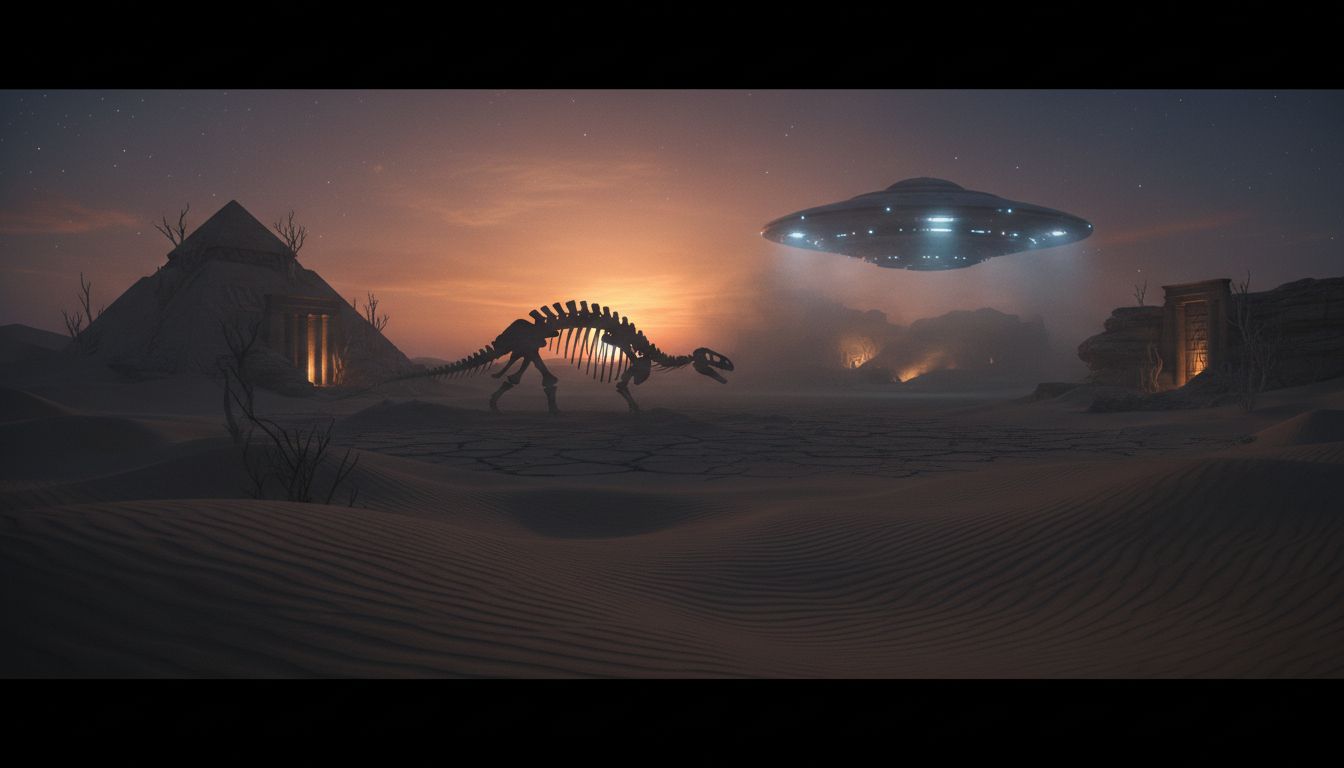
Recent articles on popular‑culture websites have revived the claim that the Sahara Desert once hosted “lost civilizations” alongside dinosaurs such as Spinosaurus. The pieces describe a “Green Sahara” that, between roughly 10,000 and 5,000 years ago, was a lush savanna dotted with lakes, forests, and thriving human societies. Proponents argue that buried stone cities, enigmatic artifacts, and prehistoric fossils together point to a forgotten epoch of advanced knowledge now hidden beneath the dunes. While the climatic transformation of the Sahara is well documented, the suggestion that dinosaurs and sophisticated human cultures co‑existed in the same landscape is at odds with established paleontological and archaeological timelines.
Scientific Context: The African Humid Period
Geologists and climatologists refer to the interval from about 12,000 to 5,000 years ago as the African Humid Period (AHP). Satellite‑derived paleoclimate reconstructions, lake‑bed sediment cores, and pollen analyses confirm that monsoonal rains pushed the Sahara’s aridity far to the north, creating extensive wetlands, grasslands, and river systems. Dr. Amina Boukhalfa, a paleo‑environmental scientist at the University of Tunis, explains, “During the AHP, the Sahara supported megafauna such as hippos and crocodiles, but these animals disappeared long before humans established permanent settlements.” The AHP ended abruptly around 5,500 years ago, giving way to the hyper‑arid conditions that dominate the region today.
Archaeological Evidence: Rock Art and Early Settlements
The most concrete evidence of prehistoric human activity in the Sahara comes from rock‑paintings at sites like Tassili n’Ajjer and Tadrart Acacus. These panels, dated to 8,000–10,000 years ago, depict cattle herding, ritual dancing, and hunting scenes that suggest organized societies with symbolic traditions. “The artistry and recurring motifs indicate a shared cultural framework across a vast area,” notes Professor Léon Moussa, an archaeologist with the French National Centre for Scientific Research. However, no excavated structures comparable to “stone cities” have been uncovered; the few stone foundations identified are modest dwellings or communal enclosures, not the complex urban layouts implied by the sensational claims.
Dinosaurs and the Timeline Gap
Spinosaurus lived approximately 100 million years ago, during the mid‑Cretaceous period, a span that predates the emergence of Homo sapiens by over 90 million years. Fossils of Spinosaurus have indeed been recovered from the Kem Kem Beds of modern‑day Morocco, confirming that large predatory dinosaurs once roamed North Africa. Yet, as Dr. Michael Hernandez of the Natural History Museum in London emphasizes, “There is no credible evidence that any non‑avian dinosaur survived into the Holocene, let alone co‑existed with human groups in the Sahara.” The juxtaposition of dinosaur images with recent human artifacts in the source material conflates two entirely separate epochs.
Controversy, Speculation, and the Paranormal Angle
The narrative that “advanced knowledge” was passed down from mysterious Saharan peoples fuels paranormal speculation, especially in fringe circles that link the alleged artifacts to extraterrestrial contact or lost Atlantean technologies. Such interpretations lack peer‑reviewed support and often rely on anecdotal reports or misidentified objects. While curiosity about the Sahara’s past is legitimate, experts caution against extrapolating from incomplete data. “Science progresses by testing hypotheses, not by leaping to extraordinary conclusions without rigorous evidence,” says Dr. Boukhalfa.
Future Research Directions
Ongoing remote‑sensing projects, such as NASA’s GEDI lidar surveys and the European Space Agency’s Sentinel missions, are mapping subsurface features that could reveal buried river channels and settlement patterns. Collaborative fieldwork between climatologists, archaeologists, and paleontologists aims to refine the chronology of human occupation and environmental change. As Dr. Moussa remarks, “Each new discovery helps us reconstruct how early peoples adapted to a dramatically shifting Sahara, offering lessons that are increasingly relevant in today’s climate‑change discourse.” While the idea of dinosaurs roaming alongside ancient architects remains scientifically untenable, the Sahara’s hidden past continues to intrigue researchers and the public alike.