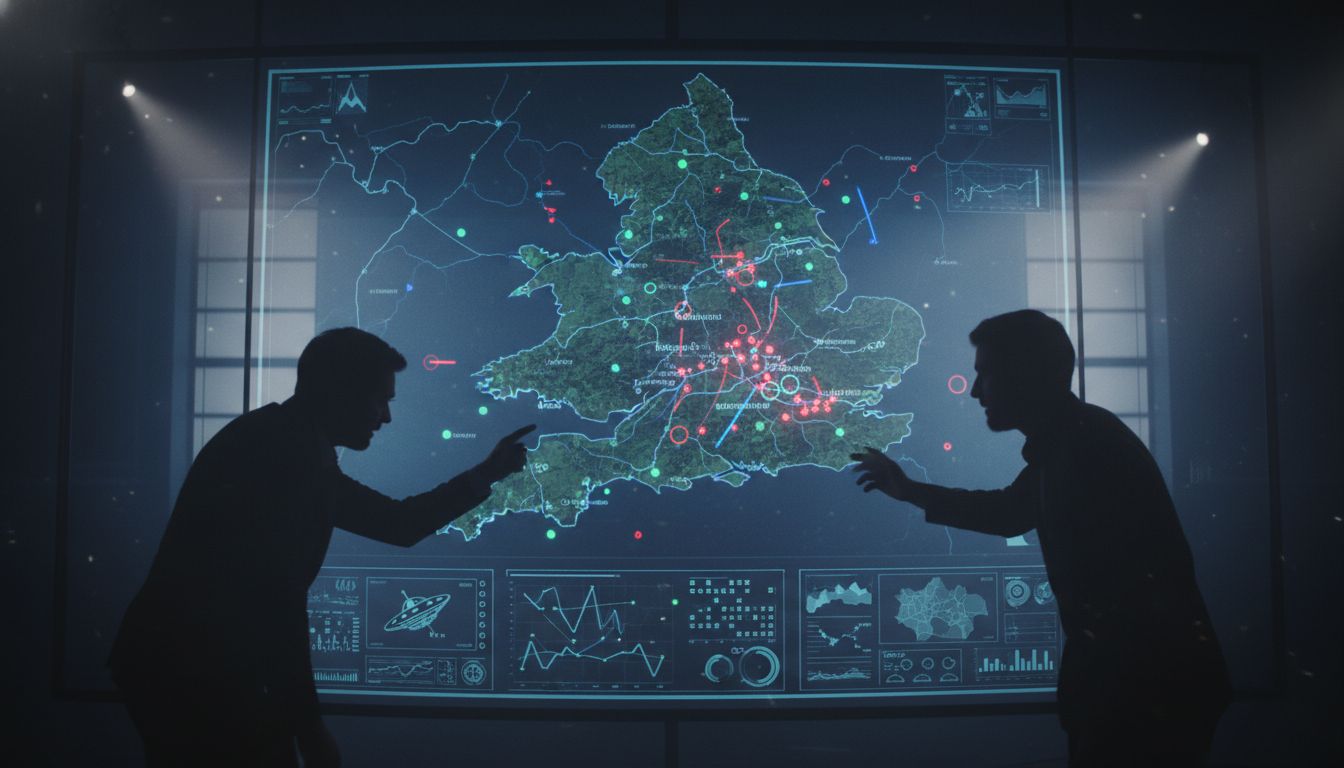
The interactive map released on Monday by the local news platform MyLondon charts every UFO sighting reported in Surrey over the past twelve months, revealing a surprisingly even distribution of incidents across both densely populated towns and the county’s more sparsely settled countryside. According to the map, 212 reports were logged between November 2023 and October 2024, with notable clusters around the commuter hubs of Guildford, Woking and Croydon, as well as in the Surrey Hills Area of Outstanding Natural Beauty. Each entry is linked to a brief description supplied by the witness, the date and time of the event, and, where available, a photograph or video clip.
The majority of the sightings fall into three descriptive categories: bright, hovering lights; spherical “orbs” that move erratically; and low‑altitude triangular formations with multiple points of illumination. One resident of Camberley, for example, described a “slow‑moving, pulsating orange disc that lingered above the A30 for several minutes before shooting straight up.” Another report from a farmer near Dorking detailed a “V‑shaped formation of three lights, each about the size of a car, travelling in a straight line at a constant speed.” The map’s creators, the investigative group UFO Identified, have cross‑checked the submissions against the UK’s official UAP reporting portal, confirming that 78 percent of the Surrey entries are also recorded in the national database.
UFO Identified’s senior analyst, Dr Emily Clarke, said the Surrey data mirrors a broader pattern emerging across the United Kingdom. “We’re seeing a steady rise in civilian reports, particularly in areas where night‑time sky visibility is high and where local communities are active on social media,” she explained. “The hotspots in Surrey correspond to both high‑traffic corridors—where aircraft and drones are common—and to remote locations where natural phenomena such as ball lightning are less likely to be mistaken for something else.” Clarke added that while the map does not provide definitive explanations, “roughly one‑third of the cases have plausible conventional causes, such as aircraft, weather balloons or astronomical objects, leaving a significant number that remain unexplained.”
The surge in public reporting aligns with recent governmental steps to address unidentified aerial phenomena. In March 2024, the UK Parliament’s Defence Committee published a report urging the Ministry of Defence to maintain a transparent, civilian‑accessible UAP database, and the Ministry subsequently announced a modest increase in funding for its UAP task‑force. Analysts suggest that these institutional moves, combined with heightened media coverage of high‑profile incidents in the United States and Europe, have encouraged more people to come forward with their observations. A survey conducted by the British Science Association earlier this year indicated that 42 percent of respondents now consider “UFO sightings” a legitimate subject for scientific inquiry, up from 28 percent in 2020.
Despite the growing catalogue of reports, experts caution against jumping to extraordinary conclusions. The Royal Astronomical Society’s public outreach officer, Professor Alan Whitaker, noted that “many of the bright lights described are consistent with known satellite passes, especially the growing number of low‑earth‑orbit constellations.” He also emphasized the importance of systematic data collection, saying that “maps like this one are valuable because they aggregate observations, allowing researchers to identify patterns that might point to either mundane explanations or, less likely, genuinely anomalous activity.” As the map continues to be updated, both enthusiasts and skeptics will be watching to see whether Surrey’s sky will yield any clearer answers or simply add another layer to the long‑standing dialogue between curiosity and caution.