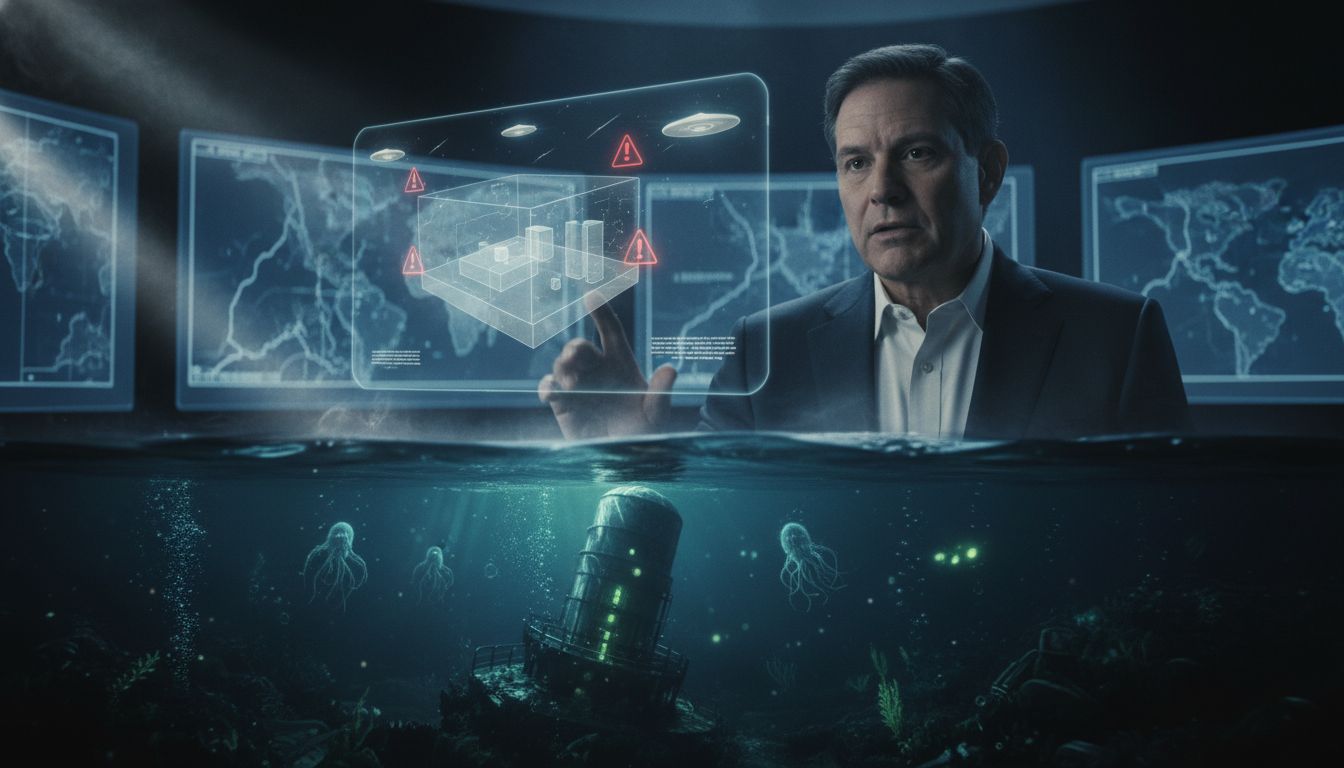
Senator Marco Rubio’s remarks in the newly released trailer for an upcoming documentary have thrust the long‑standing mystery of unidentified aerial phenomena (UAP) over America’s most secure installations into the public eye. In the brief clip, Rubio, a member of the Senate Armed Services Committee, points to declassified footage that shows “unexplained objects” maneuvering above sites that house nuclear weapons and other critical materials. He cautions that the lack of a clear explanation “raises serious questions about our national security and the integrity of our nuclear deterrent,” a line that mirrors concerns voiced in the Pentagon’s 2022 UAP assessment.
The trailer also features underwater recordings captured by the U.S. Navy’s sonar arrays along the Atlantic and Pacific coasts. Analysts in the film describe the anomalies as “high‑speed, low‑signature objects” that appear to dive and re‑emerge without leaving conventional wake patterns. While the Navy has previously acknowledged encounters with “unidentified submerged phenomena,” the footage presented in the documentary is said to be from recent operations in 2024‑2025, suggesting that the phenomenon is not confined to the sky. Experts consulted in the film, including former defense officials and aerospace engineers, note that such behavior challenges known physics and could indicate advanced technology—whether foreign, domestic, or otherwise.
Rubio’s comments come at a time when Congress is intensifying its oversight of UAP investigations. The Senate Intelligence Committee’s 2023 report called for “greater transparency and a dedicated interagency task force” to assess potential threats to critical infrastructure. In response, the Department of Defense established the All‑Domain Anomaly Resolution Office (AARO) last year, tasked with collecting and analyzing data from air, space, and maritime domains. AARO’s director, Dr. Sean Kirkpatrick, has publicly acknowledged that “UAP sightings near nuclear sites have been reported, but we have not yet determined the nature or intent of these objects.” The senator’s statements therefore echo an official acknowledgment that the issue is on the agency’s radar, even as definitive conclusions remain elusive.
Security analysts warn that even the perception of vulnerability can have strategic consequences. A 2024 study by the Center for Strategic and International Studies warned that “adversaries could exploit public uncertainty about UAPs to sow doubt about the reliability of U.S. nuclear safeguards.” Rubio’s emphasis on “restricted nuclear facilities” underscores the potential for espionage or interference, whether the source is a foreign power developing hypersonic platforms or an unknown entity operating beyond current detection capabilities. While no direct link to hostile actors has been established, the pattern of sightings—often clustered around energy‑dense sites—has prompted calls for enhanced sensor coverage and real‑time data sharing among the Department of Energy, the Department of Defense, and intelligence agencies.
The documentary, whose producers have not yet disclosed a release date, aims to compile these disparate strands of evidence into a single narrative. By juxtaposing congressional testimony, naval sonar clips, and interviews with former pilots, the film seeks to move the conversation from speculative “UFO” folklore to a measured assessment of “unidentified aerial and underwater phenomena” as a national‑security issue. As the trailer circulates on social media and news outlets, it is likely to reignite public and legislative pressure for more rigorous investigations, potentially shaping the next round of funding and policy directives for the AARO and related programs.


