Overview
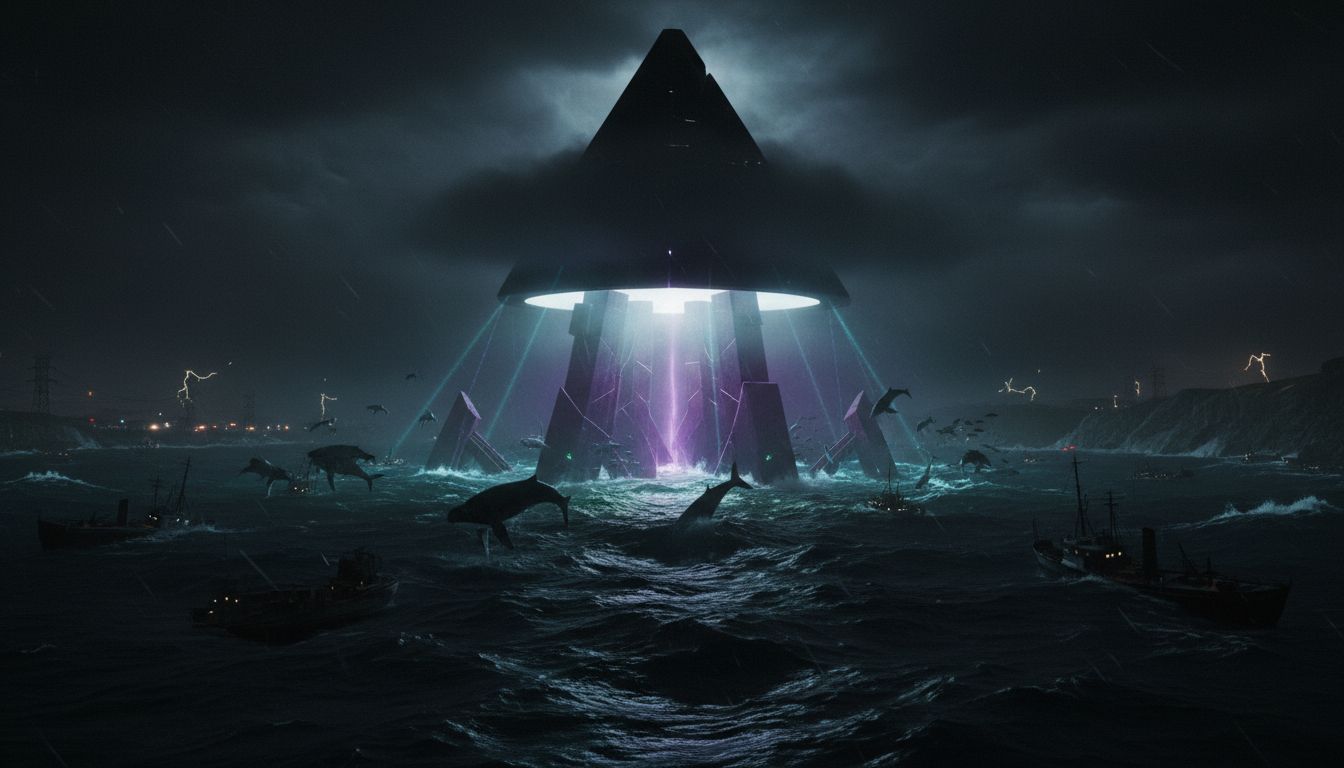
In the past six months, coastal communities from the Gulf of Mexico to the Pacific Northwest have reported a series of unexplained “darkwave” events—sudden, localized blackouts that plunge near‑shore waters into near total darkness for periods ranging from a few minutes to several hours. Fishermen, marine researchers, and offshore platforms have documented abrupt losses of ambient light, a sharp decline in bioluminescent activity, and, in some cases, a temporary cessation of electrical power to nearby facilities. While the phenomenon remains under investigation, a growing number of observers are linking the occurrences to unidentified aerial phenomena (UAP) or other anomalous oceanic processes that may have broader ecological implications.
Documented Incidents
The first widely reported darkwave was recorded off the coast of New Jersey on 12 November 2025, when a commercial fishing vessel experienced a 15‑minute loss of both natural and artificial illumination. Sensors on the vessel logged a rapid drop in ambient photon counts, while the onboard power system briefly shut down without any detectable fault. Similar events followed: a research buoy in the Santa Barbara Channel recorded a 30‑minute blackout on 3 December 2025, and an offshore wind farm off Cape Cod reported a 45‑minute loss of power on 21 December 2025. In each case, standard diagnostic tools found no evidence of equipment failure, and atmospheric conditions were unremarkable.
Scientific Response
Marine scientists are treating the darkwaves as a multidisciplinary research priority. Dr. Emily Hart, senior marine biologist at the National Oceanic and Atmospheric Administration (NOAA), emphasized the need for coordinated data collection:
“We are deploying additional optical and electromagnetic sensors to capture any transient signatures that could explain these events. The abrupt loss of bioluminescence suggests a disturbance to the marine light field, which could affect predator‑prey dynamics and the broader ecosystem.”
The U.S. Navy’s Undersea Warfare Center has also taken interest, noting that the sudden power disruptions could impact naval communications and sensor networks. A joint task force, comprising NOAA, the Navy, and several university oceanography departments, was convened on 5 January 2026 to develop a standardized reporting protocol for future darkwaves.
Potential Explanations
Researchers have outlined several hypotheses, each requiring further validation:
Electromagnetic Pulses (EMP) from Atmospheric Sources – Some scientists propose that rare, high‑altitude lightning (sprites or elves) could generate localized EMPs strong enough to interfere with marine photic processes and nearby electrical infrastructure.
Subsurface Geophysical Activity – Seismic tremors or sudden releases of dissolved gases (e.g., methane) could temporarily alter water clarity and light transmission, though seismometers have not recorded concurrent activity.
UAP Interaction – The Department of Defense’s recent acknowledgment of unexplained aerial observations has prompted a subset of investigators to explore whether unknown aerial platforms could be emitting directed energy or cloaking fields that affect oceanic light. While speculative, the timing and geographic clustering of darkwaves with reported UAP sightings warrant systematic correlation studies.
Anthropogenic Interference – Illegal testing of high‑energy equipment by private entities cannot be ruled out, and authorities are reviewing maritime traffic logs for irregular activity.
Ecological and Societal Impact
Even brief periods of darkness can disrupt marine ecosystems that rely on bioluminescence for communication, navigation, and hunting. Preliminary observations from the Monterey Bay Aquarium Research Institute indicate a temporary decline in planktonic glow, which could ripple up the food chain. For coastal economies, the loss of power to fishing vessels and offshore installations poses safety risks and financial losses.
Local officials in New York and California have issued advisories urging mariners to maintain redundant navigation systems and report any darkwave occurrences to the newly established Marine Anomaly Reporting Center (MARC).
Next Steps
The interdisciplinary task force plans to launch a season‑long field campaign in the spring of 2026, deploying autonomous underwater vehicles equipped with high‑sensitivity photometers, magnetometers, and acoustic sensors. Data will be shared in near‑real‑time with the scientific community via the Ocean Observatories Initiative portal.
In the meantime, experts stress the importance of transparent reporting and caution against premature conclusions. As Dr. Hart noted, “While the allure of exotic explanations is strong, rigorous data collection remains our best tool for understanding and, if necessary, mitigating these mysterious darkwaves.”
The ongoing investigation underscores the intersection of ocean science, national security, and emerging phenomena, reminding policymakers and the public alike that the health of coastal ecosystems may hinge on unraveling the origins of these hidden blackouts.


