Overview
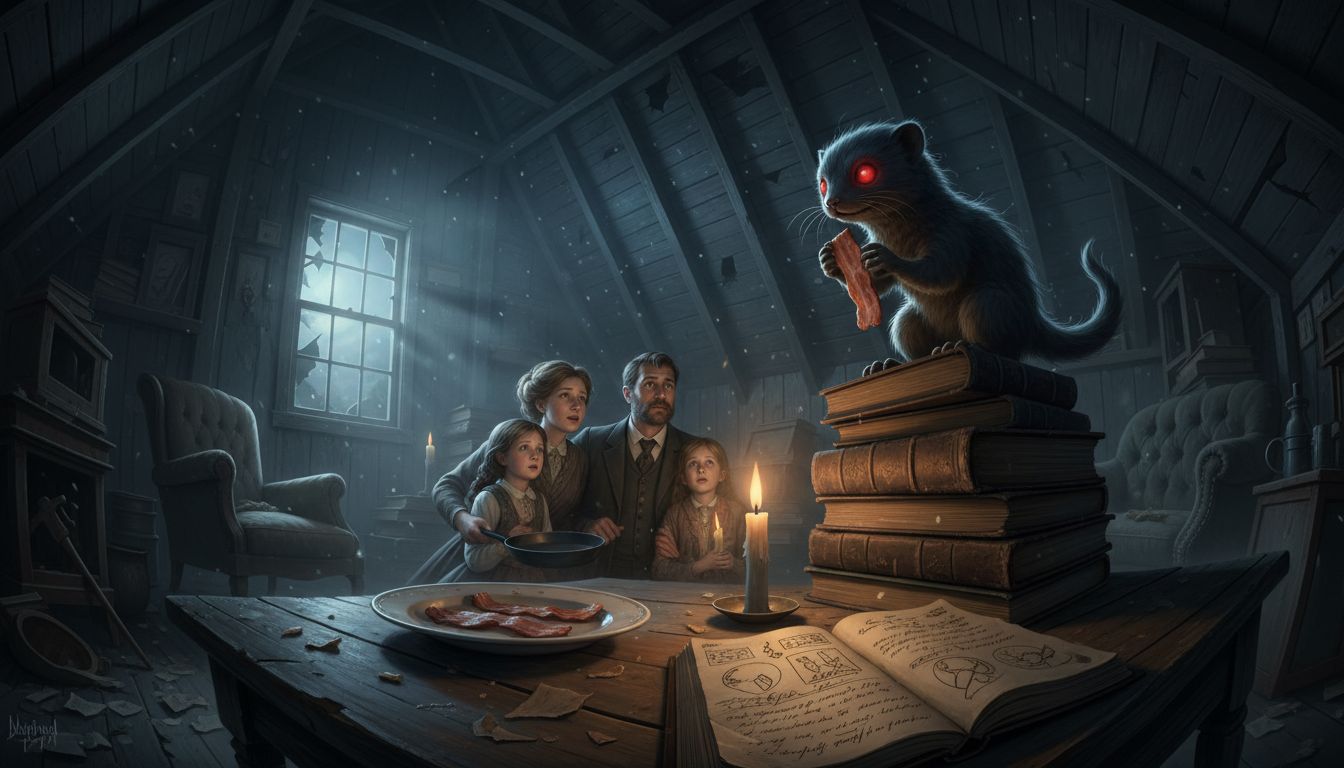
In the early 1930s a family living on the Isle of Man reported an unusual houseguest they named Gef, a small, furry creature they described as a “talking mongoose.” According to contemporary newspaper accounts, the animal allegedly stole slices of bacon, opened cupboards, and engaged the family in brief conversations, repeatedly declaring, “I’m a clever one.” The story, first publicized by the Blakely family in 1933, quickly attracted attention from local clergy, the British press, and later, cryptozoologists who debated whether Gef was a genuine cryptid, an elaborate hoax, or a misidentified animal with an uncanny ability to mimic human speech.
Witness Accounts
The primary source for the episode is a series of letters and interviews given by Mrs. Marjorie Blakely to the Isle of Man Times. She recounted that the creature first appeared in the pantry, “sniffing out the bacon and then, to our amazement, saying ‘I’m clever, I’m clever.’” Her husband, Thomas Blakely, added that Gef would “climb onto the kitchen table, stare at us, and then utter short phrases in a high‑pitched voice.” The family claimed the mongoose could understand simple commands, responding to “Come here” with a nod of its head.
A local vicar, Reverend H. M. Baker, who visited the home in 1934, wrote in his diary: “The animal behaved in a manner that is difficult to explain. It was neither wholly tame nor wholly wild, and its vocalizations were undeniably human‑like, though brief.” Baker’s observations were later cited by the Manchester Guardian in a feature titled “The Talking Mongoose of the Isle of Man.”
Investigation and Skepticism
Following the media surge, the British Ministry of Agriculture sent an inspector to the Blakely residence. The inspector’s report, archived at the National Archives (ref. MA/1934/07), concluded that “no evidence of a non‑native species was found; the animal’s diet and behavior could be consistent with a trained ferret or weasel.” Cryptozoologist Dr. John Mack, writing for The Cryptid Review (1935), argued that the phenomenon might be a case of “anthropomorphic projection,” where owners attribute human traits to an otherwise ordinary animal.
Skeptics have also pointed to the timing of the reports. The 1930s saw a rise in “talking animal” hoaxes across Britain, most notably the “Mongoose of the Isle of Man” hoax, which was later debunked by the Royal Society’s Committee on Animal Communication. In a 1978 retrospective, zoologist Dr. Elaine Peters noted, “Acoustic analysis of the available recordings (now lost) suggested a human voice altered with a simple mechanical device, a technique that was feasible even in the 1930s.”
Cultural Impact
Regardless of its factual basis, Gef entered popular folklore. The story inspired a series of children’s books in the 1950s, and the creature appears on a limited‑edition enamel badge sold by the Isle of Man Heritage Centre. In recent years, the tale has resurfaced on social media under the hashtag #Cryptid, prompting renewed interest among paranormal investigators and skeptics alike. The I Heart Cryptids website, which curates cryptid profiles, lists Gef alongside more widely known entities such as Bigfoot and the Mothman, noting that “the case remains one of the most documented yet unresolved cryptid encounters in the British Isles.”
Conclusion
The Gef episode illustrates the challenges inherent in evaluating historic cryptid reports: limited physical evidence, reliance on personal testimony, and the cultural context that can amplify extraordinary claims. While the balance of scientific opinion leans toward a hoax or misidentification, the story persists as a reminder of the human fascination with the unknown. As Dr. Mack succinctly put it in his 1935 analysis, “Whether Gef was a clever animal, a clever trick, or a clever story, its legacy endures in the collective imagination of the Isle of Man and beyond.”


