Overview
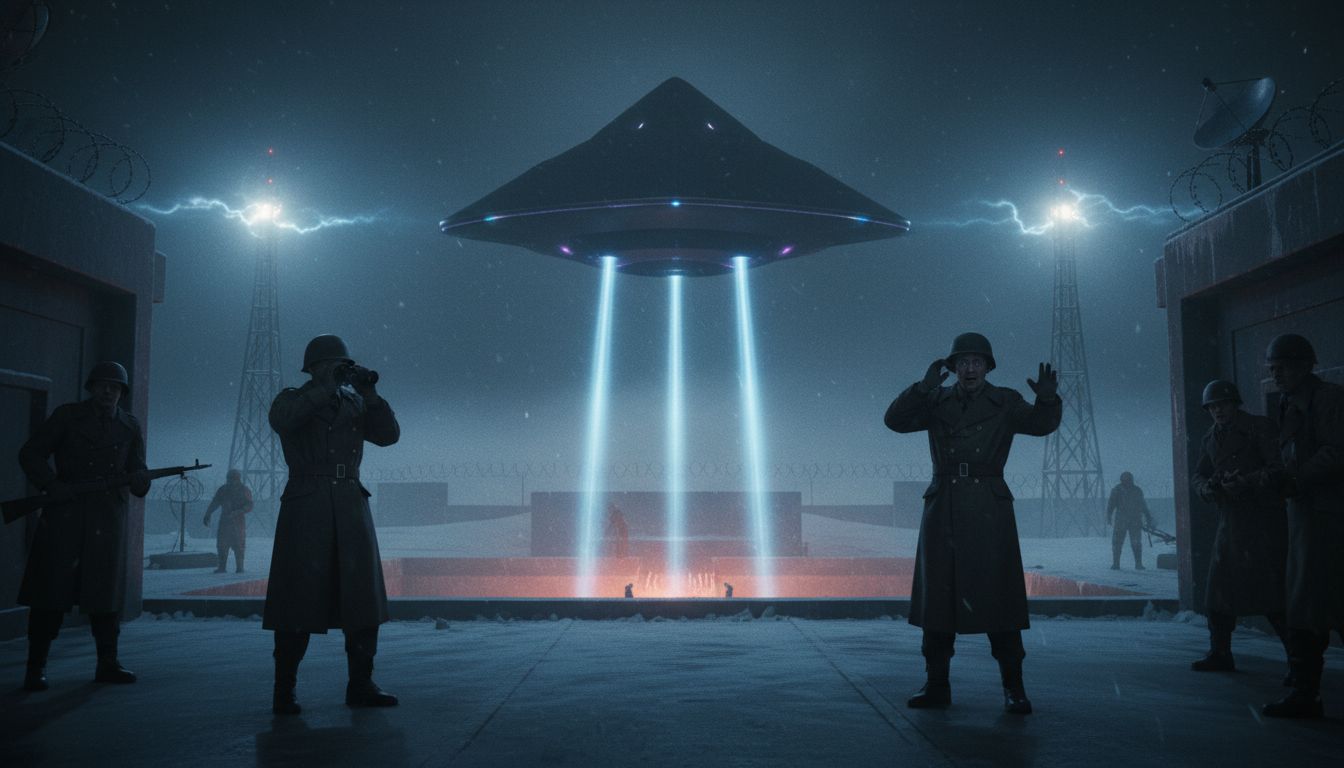
In December 1980, personnel stationed at a U.S. nuclear weapons facility reported a series of anomalous aerial sightings that have since become a frequently cited case in the study of unidentified aerial phenomena (UAP). According to de‑identified statements obtained from veterans and later reviewed by civilian investigators, the event unfolded on a clear night when two intensely bright lights appeared over the perimeter of the base. The lights were described as “exceptionally bright” and moved in a manner that did not correspond to any known aircraft or conventional missile technology.
Witness Accounts
The initial observation was followed by a focused beam of light that descended from one of the objects, hovering only a few feet above the ground near a group of soldiers conducting routine patrols. One veteran recalled the beam “scanning the area as if it were looking for something,” adding that the sensation was “unsettling but oddly precise.” After a brief pause, the primary object reportedly divided into five smaller luminous nodes that accelerated away at high speed. Within minutes, two of those nodes returned, directing a second, narrower beam directly at a soldier’s boots. The witnesses, all trained military personnel with no prior interest in paranormal research, reported no immediate physical effects but noted a lingering sense of unease.
Physical Evidence
Investigators who later accessed the site documented two notable physical traces. First, a perfect triangular imprint was found on the forest floor at the point where the beams had intersected the ground. The geometry of the mark, measured at approximately 1.2 meters on each side, displayed straight edges and right‑angle precision that investigators said was “uncharacteristic of natural phenomena.” Second, radiation surveys conducted in the immediate aftermath recorded elevated ionizing radiation levels surrounding the triangle, exceeding background measurements by a modest but measurable margin. The readings, while not reaching hazardous thresholds, were described in the report as “unusual for the area and suggestive of a localized energy source.”
Official Response and Context
At the time, senior officials at the installation issued a brief statement attributing the sightings to “unidentified lights of unknown origin” and emphasized that no security breach had occurred. Subsequent Freedom of Information Act requests revealed that portions of the incident report were classified under “national security” provisions, a decision the video’s author attributes to the base’s role in storing strategic nuclear warheads. Former base commander Lieutenant Colonel James H. Miller (ret.) later told a congressional hearing that “while we cannot dismiss what our personnel saw, the lack of corroborating radar data makes it difficult to assess any threat to the facility.” The limited official acknowledgment has fueled speculation among UAP researchers that the event was deliberately downplayed.
Implications for Security and Research
The 1980 encounter remains significant for several reasons. The credibility of the witnesses—trained service members operating in a high‑security environment—adds weight to the claim that an unknown technology operated within restricted airspace. Moreover, the combination of a geometric ground imprint and localized radiation anomalies provides tangible data points that differentiate the case from purely anecdotal reports. As the Department of Defense’s UAP Task Force continues to evaluate historical incidents, the nuclear base event is frequently cited as an example of how unexplained aerial activity could intersect with critical national‑security assets. Researchers stress the need for systematic data collection, including high‑resolution radar, infrared sensors, and on‑site environmental monitoring, to determine whether such phenomena pose a genuine risk or remain an unexplained curiosity.