Overview
In a development that has sent shockwaves through the astronomical community, NASA’s Hubble Space Telescope has recorded a phenomenon described as “unprecedented” and with a mere 0.12% probability of natural occurrence. On January 12th, 2025, over 800 stars vanished from view behind an interstellar object known as Threeey Atlas (3II Atlas), currently traversing our solar system. The event, observed independently by both Hubble and ESA’s Gaia spacecraft, is raising questions about the very nature of light, matter, and possibly even extraterrestrial intelligence.
The Atlas Anomaly
The object at the center of this mystery, 3II Atlas, is only the third confirmed interstellar visitor after ‘Oumuamua (2017) and Borisov (2019). Detected by the Atlas survey telescope in Hawaii on March 1st, 2025, Atlas was initially celebrated as a rare opportunity to study material from beyond our solar system. However, the excitement was short-lived as a series of anomalies began to emerge. “In all my decades studying theoretical physics, I have never seen data quite like this,” said Mio Kakaku, a leading physicist commenting on the findings.
Disappearing Stars and Expanding Darkness
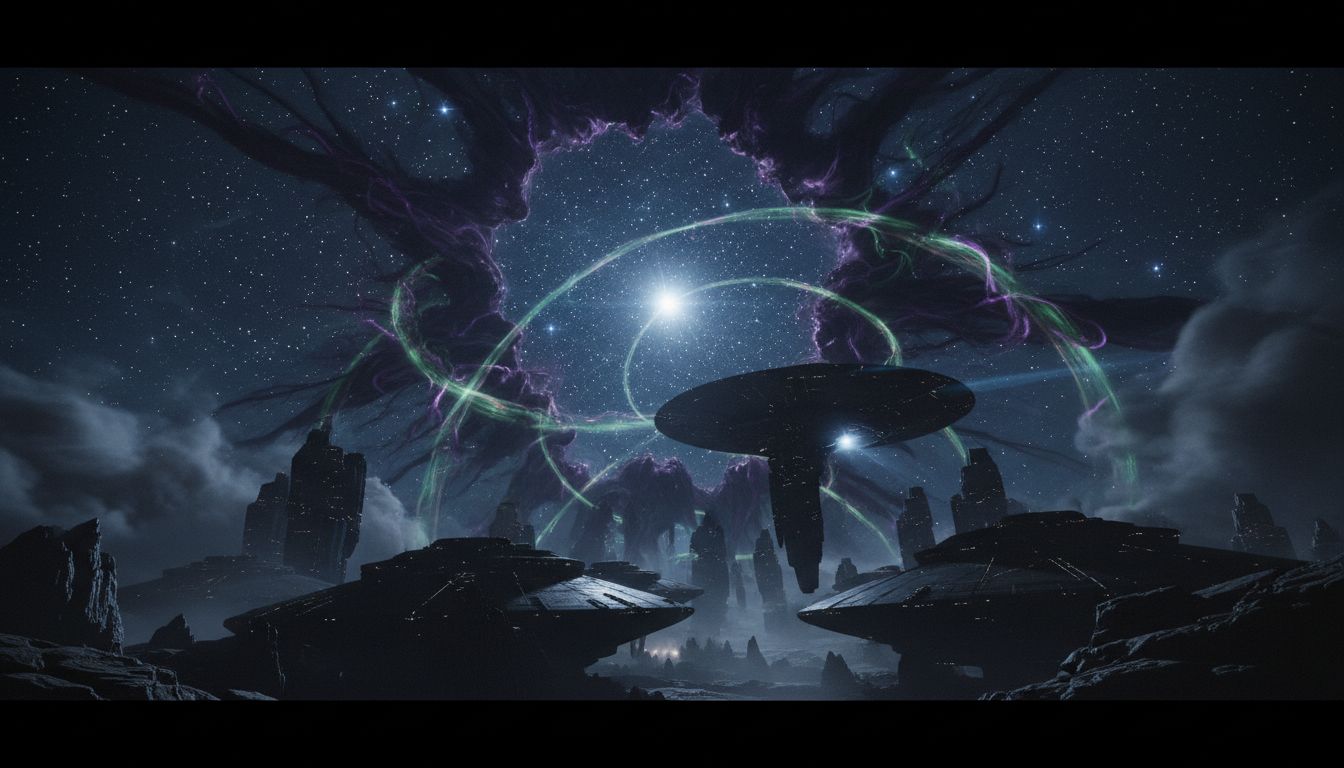
What distinguishes Atlas from previous interstellar objects is not just its trajectory but its behavior. During an observation at the European Southern Observatory in Chile, astronomers were stunned to find a completely dark gap where 847 cataloged stars should have been visible. The affected region, measuring 0.034 degrees in angular diameter, is seventeen times larger than Atlas itself should appear at that distance. Importantly, this is not a case of ordinary occultation, where a passing object temporarily dims background stars. Instead, the stars have vanished across all wavelengths—optical, infrared, and ultraviolet. The region of darkness is also growing, expanding by over 17% in just six hours.
Impossible Physics and Photon Suppression
Atlas’s behavior defies the established laws of optics and astrophysics. “The stars are not being blocked by a solid object. They are being absorbed by something we cannot see,” Kakaku explained. This area of darkness is not static; it is expanding and appears to be moving toward Earth’s orbital path at a speed of 26.3 kilometers per second. NASA’s Jet Propulsion Laboratory has classified the observation as “priority level one”—a designation reserved for events with potential planetary significance.
Additional anomalies compound the mystery. Initial surface reflectivity measurements from the James Webb Space Telescope found Atlas reflects only 2% of incident light, making it darker than any known asteroid or artificial material. More perplexing is the discovery of precisely uniform photon suppression: Gaia’s photometers measured a 23.7% reduction in the brightness of stars within 0.008 degrees of Atlas—across all stellar types and distances, a phenomenon without natural precedent.
Unexplained Radio Emissions
The situation escalated in early April when Chile’s Atacama Large Millimeter Array detected regular radio emissions from Atlas at 343.5 GHz, repeating every 47 seconds for 14 hours. Natural objects such as comets and asteroids do not produce such emissions, and the regularity of the signals is raising speculation about artificial origins.
Scientific Implications and Next Steps
While some observers have begun to ask whether these anomalies could indicate the presence of extraterrestrial intelligence, researchers caution that far more data is needed before drawing such conclusions. What is clear, however, is that Atlas is challenging the boundaries of current astrophysical models. “Nothing in astrophysics creates an identical 23.7% reduction across multiple unrelated stellar sources,” Kakaku noted, summarizing the astonishment felt across the scientific community.
As the region of darkness continues to expand and new data pours in from observatories worldwide, the mystery of Atlas is only deepening. For now, global space agencies are treating the object and its effects with utmost seriousness, and researchers everywhere are watching closely for what the coming weeks may reveal.


