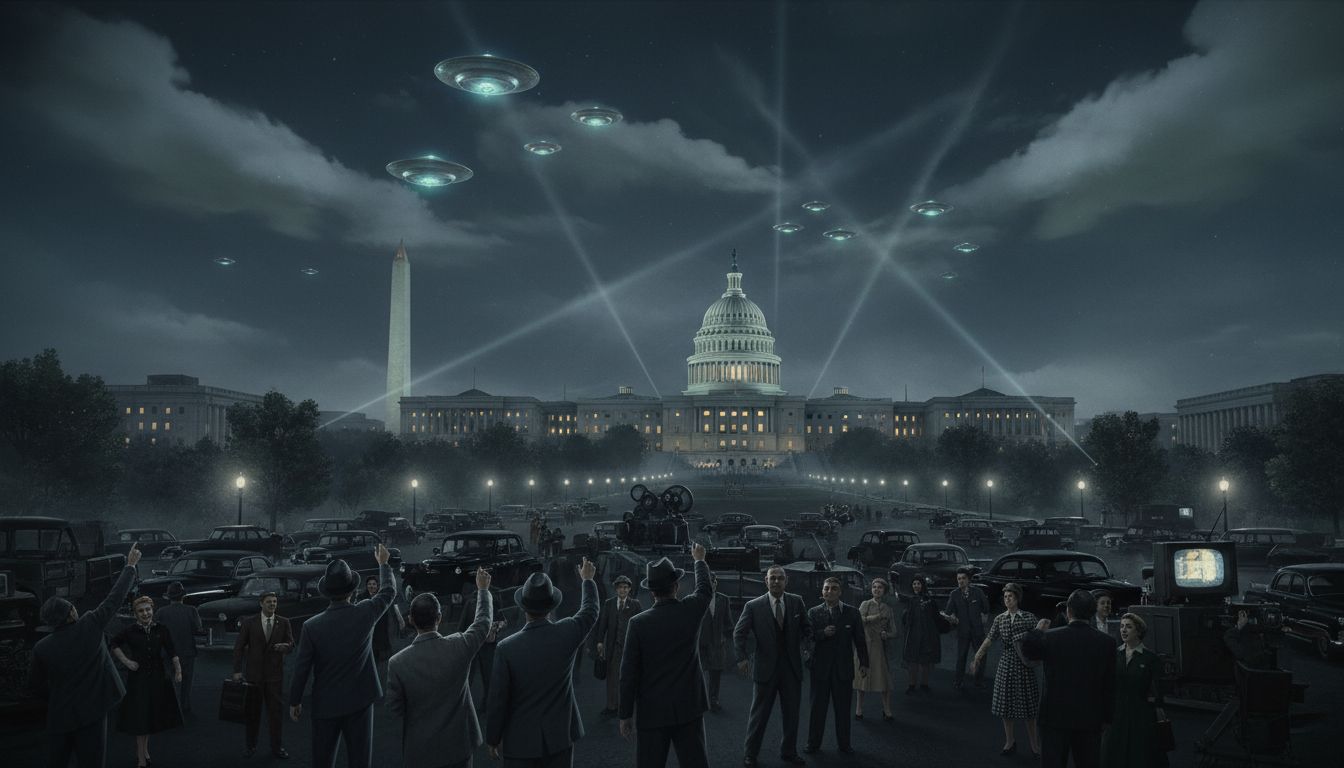
In the early hours of July 19, 1952, radar operators at Washington National Airport and Andrews Air Force Base began logging a series of unexplained returns that would soon dominate national headlines. The blips appeared and vanished in irregular patterns, moving at speeds that exceeded the performance envelope of contemporary aircraft. At the same time, pilots flying the congested air corridors around the capital reported bright, colored lights—white, orange and bluish—darting across the night sky. When two Air Force interceptors were scrambled from Delaware, the radar contacts disappeared, only to reappear after the jets withdrew. The coincidence of radar and visual reports sparked immediate concern among both civilian air traffic controllers and military personnel.
A second wave of sightings unfolded a week later, on July 26‑27. Once again, radar screens at the two Washington facilities lit up with multiple unidentified targets, and a commercial airline captain recounted seeing “four white, glowing lights” streak past his aircraft. Military pilots dispatched to investigate described objects that accelerated far beyond the capabilities of the fighters they flew, vanishing before any pursuit could be sustained. By the end of the week, the story had spread beyond aviation circles; newspapers across the United States ran front‑page pieces with headlines such as “Saucers Swarm Over Capital” and “Jets Chase D.C. Sky Ghosts,” feeding a mixture of public fascination and anxiety that was amplified by the broader context of the Cold War.
The U.S. Air Force, operating under the umbrella of Project Blue Book, took formal responsibility for investigating the incident. On July 29, the Pentagon convened a press conference—the largest since World War II—to present its findings. Air Force officials attributed the radar anomalies to a temperature inversion, a meteorological condition in which a warm air layer traps cooler air beneath it, creating false echoes on radar displays. The explanation, however, was not universally accepted. Radar operators who had logged the contacts argued that temperature inversions could not account for the simultaneous visual sightings, and several pilots insisted that the objects’ rapid maneuvers were inconsistent with known aircraft or atmospheric phenomena. As one senior controller later recalled, “We saw the same thing on the scope and with our eyes; it wasn’t just a glitch.”
The Washington sightings prompted a deeper governmental response. In 1953, the CIA convened the Robertson Panel, a group of scientists tasked with assessing the national security implications of UFO reports. The panel concluded that while most sightings could be explained by natural or technical causes, the public’s reaction posed a risk of mass hysteria and could be exploited by hostile powers. Their recommendation was to downplay UFO reports and to develop a systematic approach for handling future incidents. This policy direction influenced subsequent Air Force investigations and contributed to the establishment of a more formalized reporting structure for unidentified aerial phenomena.
Decades later, the 1952 Washington incident remains a benchmark case for researchers studying unidentified aerial phenomena. It is one of the few events where radar data, eyewitness testimony from trained pilots, and an official governmental investigation intersected so clearly. Scholars of Cold War history note that the episode illustrates how emerging technologies—radar, high‑speed jets, and mass media—combined with geopolitical tension to shape public perception of the unknown. Whether viewed as a meteorological oddity, a misidentified aircraft, or a genuine unexplained event, the July 1952 sightings continue to be cited in discussions about transparency, scientific inquiry, and the role of government in addressing anomalous observations.