Overview
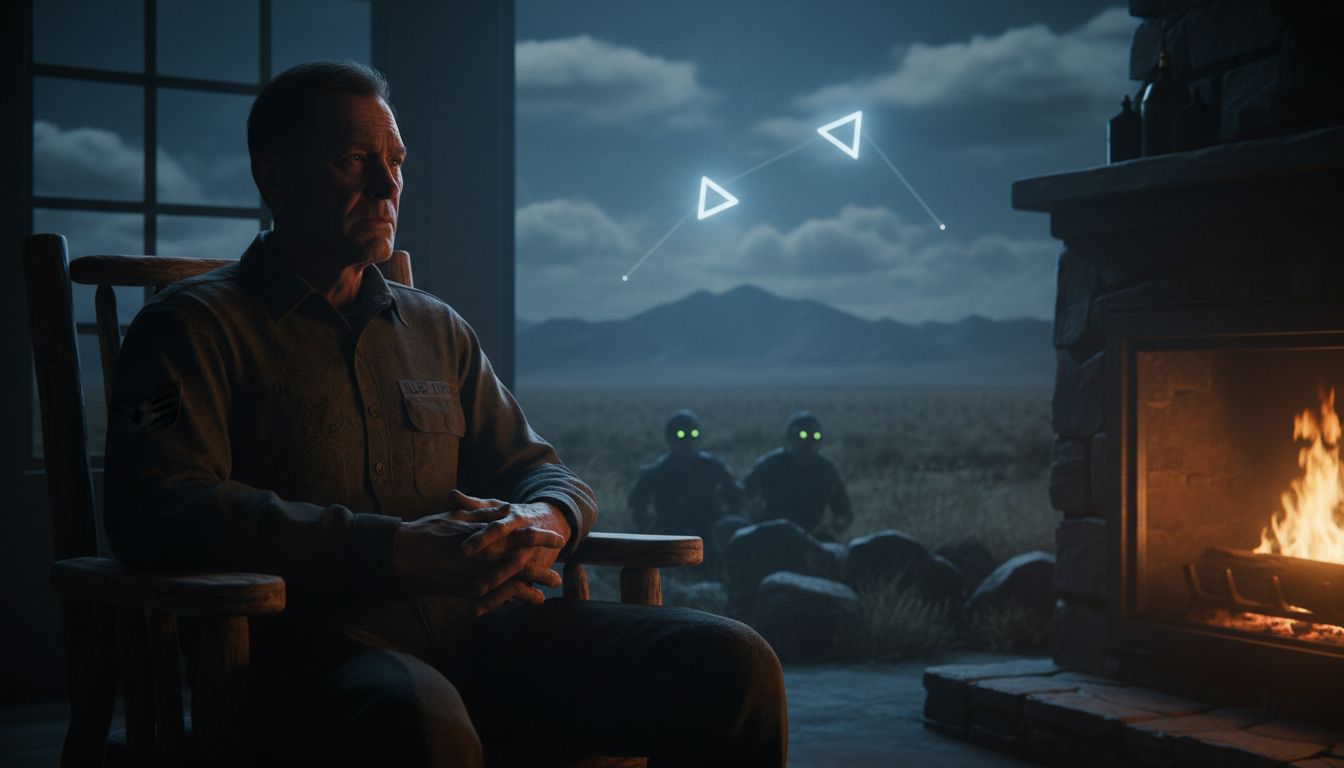
A former United States Air Force enlisted airman, Jeremy D. McGowan, has published the first installment of a personal memoir that details a close‑range encounter with an unidentified aerial phenomenon (UAP). In the account, which appeared on the Medium platform on May 26, 2022, McGowan describes a “chilling” sighting that took place in a restricted airspace zone, where a cluster of silent lights performed abrupt 90‑degree turns at speeds he estimates to be near Mach 1. The narrative is bolstered, he says, by corroborating testimony from two additional observers who recorded the event through night‑vision goggles (NVGs).
Encounter Details
According to McGowan, the incident occurred while he was on duty at an Air Force installation in the early 1990s. He recalls being on a routine patrol when the sky was illuminated by a series of bright, white lights that appeared to move without any audible propulsion. “The objects made instantaneous ninety‑degree turns, accelerating and decelerating in a manner that defied conventional aeronautical performance,” he writes. McGowan estimates the craft were traveling “at or near Mach 1,” a speed that would place them well beyond the capabilities of known civilian aircraft operating in that sector.
The lights remained completely silent, a characteristic noted by several UAP investigators as a recurring feature in modern sightings. The phenomenon persisted for roughly two minutes before the objects vanished from view, leaving no radar trace according to the pilot’s after‑action report.
Witness Corroboration
Crucially, McGowan’s account includes statements from two ground‑based witnesses who were equipped with NVGs during the event. Both observers confirmed that the lights maintained a consistent brightness and shape throughout the maneuver, and that the abrupt directional changes occurred without any visible exhaust plume or contrail. One witness, identified only as “Sgt. L.,” told McGowan’s memoir, “I’ve flown combat missions; I know how aircraft behave. What we saw that night simply didn’t fit any known platform.”
The inclusion of NVG footage, albeit described rather than provided, adds a layer of technical verification that is often missing from anecdotal reports. While the original Medium post does not release the video, the author asserts that the recordings have been preserved for future analysis.
Context and Credibility
McGowan’s background as a USAF veteran lends a degree of credibility to the sighting. He served in the early 1990s, a period when the Air Force’s “Project Blue Book” had already been declassified, but before the more recent establishment of the Unidentified Aerial Phenomena Task Force (UAPTF). The author acknowledges that his recollection may be affected by “memory loss from PTSD and old age,” a disclaimer that underscores the challenges of relying on human testimony decades after the fact.
Nevertheless, the combination of a trained military observer, corroborating witnesses, and the claim of NVG documentation aligns with criteria used by the Pentagon’s UAP investigative panels to assess the reliability of reports. The incident occurred in a “restricted airspace” zone, which, according to Federal Aviation Administration (FAA) maps, is typically reserved for military training and classified operations—factors that raise the stakes for any unexplained aerial activity.
Implications and Next Steps
The sighting, as described in Part 1 of McGowan’s series, adds to a growing body of civilian and military reports that feature high‑speed, silent, and highly maneuverable objects. While the author has not yet released the NVG footage publicly, he indicates that subsequent parts of his memoir will delve deeper into the investigation, including attempts to obtain official records through Freedom of Information Act (FOIA) requests.
Experts in aerospace and defense have noted that such accounts, when corroborated by multiple trained observers, merit further scientific scrutiny. “We need more data—radar signatures, sensor logs, and visual recordings—to move beyond anecdote,” said Dr. Hannah Klein, a senior analyst at the Center for the Study of Extraterrestrial Intelligence. “McGowan’s narrative is a valuable piece of the puzzle, but it is only a piece.”
As the U.S. government continues to grapple with how to classify and study UAPs, personal testimonies like McGowan’s serve as a reminder that the phenomenon remains an operational reality for service members. The forthcoming chapters of his memoir promise additional insight, potentially offering new leads for investigators seeking to separate myth from measurable fact.


