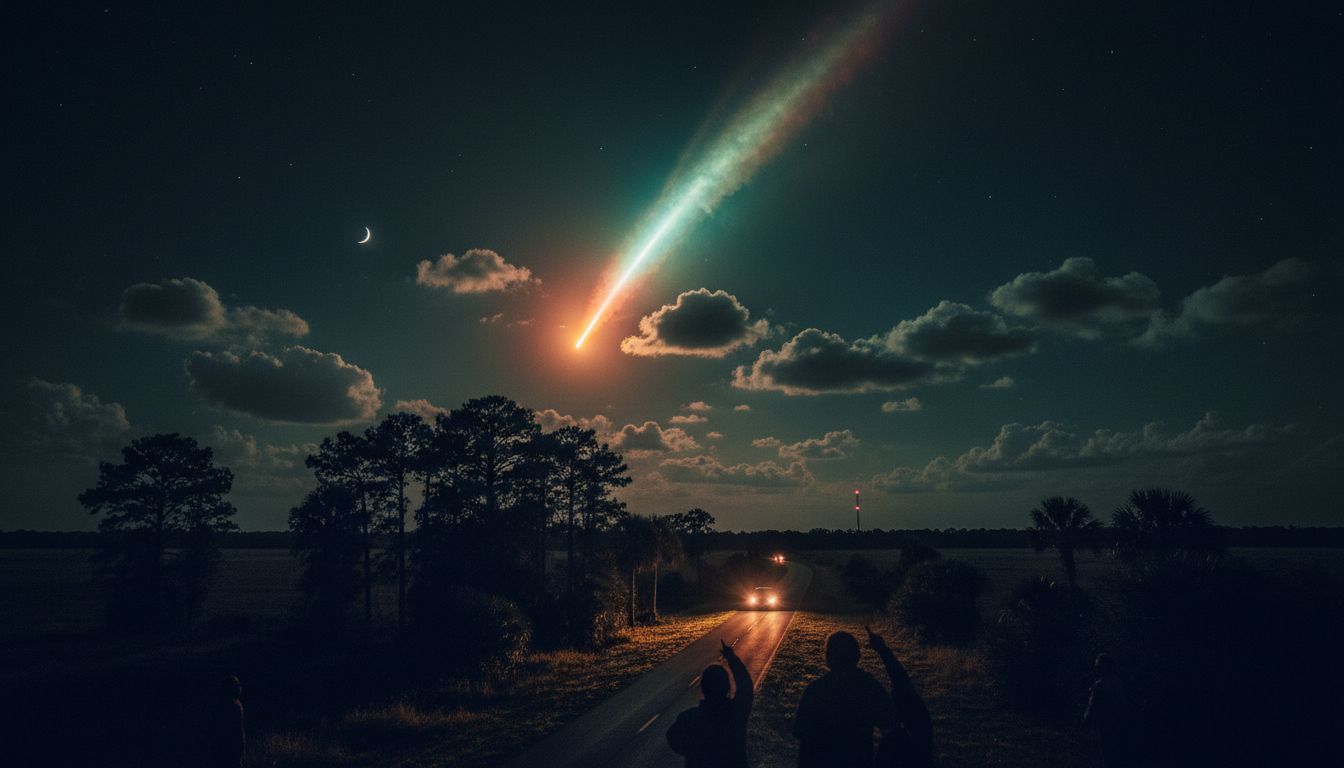
A brilliant flash illuminated the night sky over Central Florida on the evening of November 8, 2025, prompting a wave of social‑media posts that described the phenomenon as a “fireball” and, in some cases, a possible unidentified aerial phenomenon (UAP). The event was observed from Orlando to the Space Coast, with several local tower‑cam feeds and private security recordings capturing a luminous object streaking across the horizon before fading out within a matter of seconds. The sudden brightness, described by witnesses as “as bright as a low‑hanging airplane” and “lasting longer than a typical shooting star,” sparked immediate speculation online, with hashtags such as #FloridaFireball and #UAP trending on Twitter and TikTok within hours of the sighting.
Astronomers at the University of Central Florida’s Center for Space Studies were quick to weigh in, noting that the characteristics reported – a slow, glowing trajectory followed by a rapid breakup – are consistent with a meteoroid entering Earth’s atmosphere at a relatively shallow angle. “Based on the eyewitness accounts and the video evidence, we are looking at a fireball generated by a meteoroid roughly the size of a basketball, entering at about 20 kilometers per second,” said Dr. Elena Ramirez, a planetary scientist who monitors meteor activity for the American Meteor Society. “Such events are not uncommon; the Earth is constantly bombarded by small space rocks, and a few each year become bright enough to be seen over a wide area.” Ramirez added that the International Meteor Organization’s preliminary data log shows a spike in fireball reports for the week of November 4‑10, suggesting that the Florida sighting may be part of a broader meteoroid stream.
The Florida Department of Law Enforcement (FDLE) confirmed that it received multiple calls after the flash, but officials have not opened a formal investigation. “We are aware of the reports and are coordinating with local emergency services and the National Weather Service to verify whether any debris impacted the ground,” said FDLE spokesperson Carlos Mendoza. He emphasized that, at present, there is no evidence of damage or injuries, and that the agency is deferring to scientific experts for a definitive explanation. The United States Space Force’s UAP Task Force, which has been tasked with collecting and analyzing anomalous aerial observations, noted that the incident will be entered into its database for review, but offered no preliminary assessment.
The fireball adds to a growing catalog of recent UAP sightings in the region, which includes a series of unexplained lights over the Orlando International Airport last month and a cluster of radar blips reported by civilian pilots along the Gulf Coast in early October. While the majority of these events have been attributed to conventional explanations—such as satellite re‑entries, atmospheric phenomena, or misidentified aircraft—some remain unresolved pending further data. “The key is to gather as much objective evidence as possible,” said Dr. Michael Hsu, a senior analyst with the National Center for Atmospheric Research. “High‑resolution video, precise timestamps, and triangulated observations allow us to differentiate between meteoric events and potential technological objects.”
As the footage circulates, local residents are reminded that fireballs, while striking, are a natural part of Earth’s interaction with near‑Earth space debris. The American Meteor Society advises the public to report bright meteors to https://fireballs.amsmeteors.org, providing details such as time, location, direction, and any visual characteristics. In the meantime, the Central Florida community will likely recall the night’s unexpected illumination as another reminder of the dynamic sky above—a reminder that, whether labeled a meteor or a UAP, the phenomenon continues to inspire both scientific inquiry and public fascination.