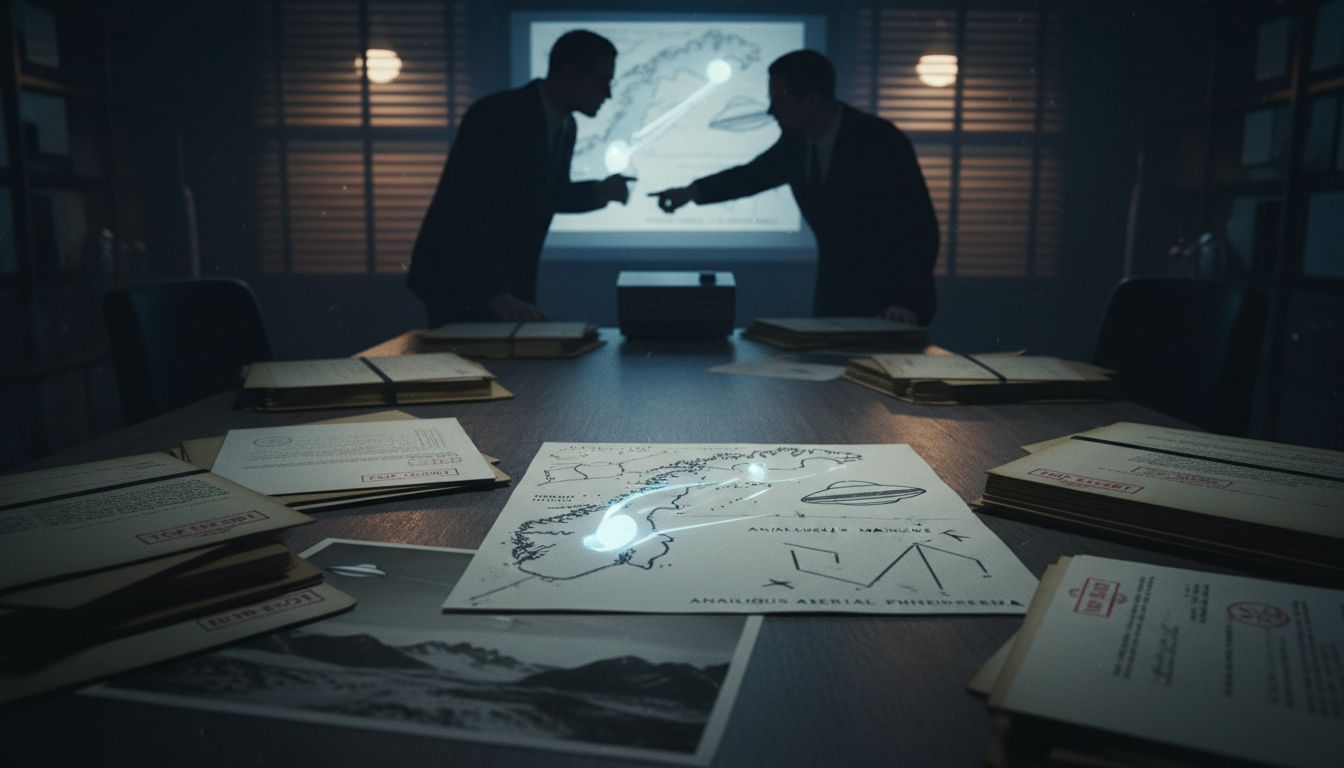
A declassified U.S. Air Force intelligence briefing dated 1962, recently released through the Unredacted.info portal, details a series of nighttime sightings of luminous objects over the skies of southern Norway. The document, titled “UFOs Observed Over Norway,” was prepared by a joint U.S.–Norwegian surveillance team operating out of the 1st Air Division in Iceland and the Norwegian Air Defense Command. According to the report, the objects appeared on multiple occasions between October 1961 and March 1962, moving at speeds and with maneuverability that exceeded the performance envelope of known aircraft, including the Lockheed U‑2 and the Soviet MiG‑19.
The briefing notes that the objects were initially detected by ground‑based radar installations near the town of Tromsø and subsequently confirmed by visual observation teams stationed at the NATO airbase at Bodø. “The contacts exhibited abrupt changes in altitude, instantaneous direction reversals, and acceleration rates that would subject a conventional airframe to structural failure,” the report writes. Photographic evidence, described as “low‑resolution infrared frames,” shows a series of bright, disc‑shaped glows that lingered for several minutes before disappearing without a trace. The observers, a mix of U.S. Air Force personnel and Norwegian radar operators, recorded the events in a standardized “UFO Incident Log” that was circulated among allied intelligence channels.
U.S. officials at the time classified the incidents as “unidentified aerial phenomena” (UAP) and recommended further investigation, but the recommendation was overruled by senior command due to the heightened geopolitical tension of the Cold War. A memo from the Pentagon’s Office of the Deputy Chief of Staff for Intelligence, dated 15 March 1962, states: “While the sightings are of interest, resources must remain focused on known Soviet incursions. No immediate threat assessment can be made without additional data.” The memo also reflects a broader pattern of cautious documentation, noting that similar reports had emerged from Sweden and Denmark, prompting a discreet inter‑service conference in Oslo in April 1962 to assess the potential impact on NATO airspace security.
The release of the documents has rekindled discussion among contemporary UAP researchers and defense analysts about the historical handling of unexplained aerial sightings. Dr. Ellen Rasmussen, a senior researcher at the Norwegian Institute for Defence Studies, remarks that “the Cold‑War era was marked by a genuine concern for any anomalous activity that could indicate a technological advantage, whether Soviet or otherwise. These Norwegian cases illustrate how limited data and the prevailing security mindset often led to the dismissal of phenomena that did not fit existing threat models.” She adds that the newly available radar tracks could be valuable for modern analysts seeking to compare legacy data with recent UAP reports from the same region.
While the declassified files do not provide a definitive explanation for the luminous objects, they do reveal a consistent pattern of allied concern and a systematic approach to documentation. The reports underscore the challenges faced by military observers when confronted with phenomena that defy conventional aeronautical understanding, a challenge that persists in today’s UAP investigations. As the U.S. Department of Defense continues to refine its Unidentified Aerial Phenomena Task Force, the Norwegian incidents serve as a reminder that the phenomenon is not new, and that historical records may hold clues to both technical and methodological improvements in future analyses.


