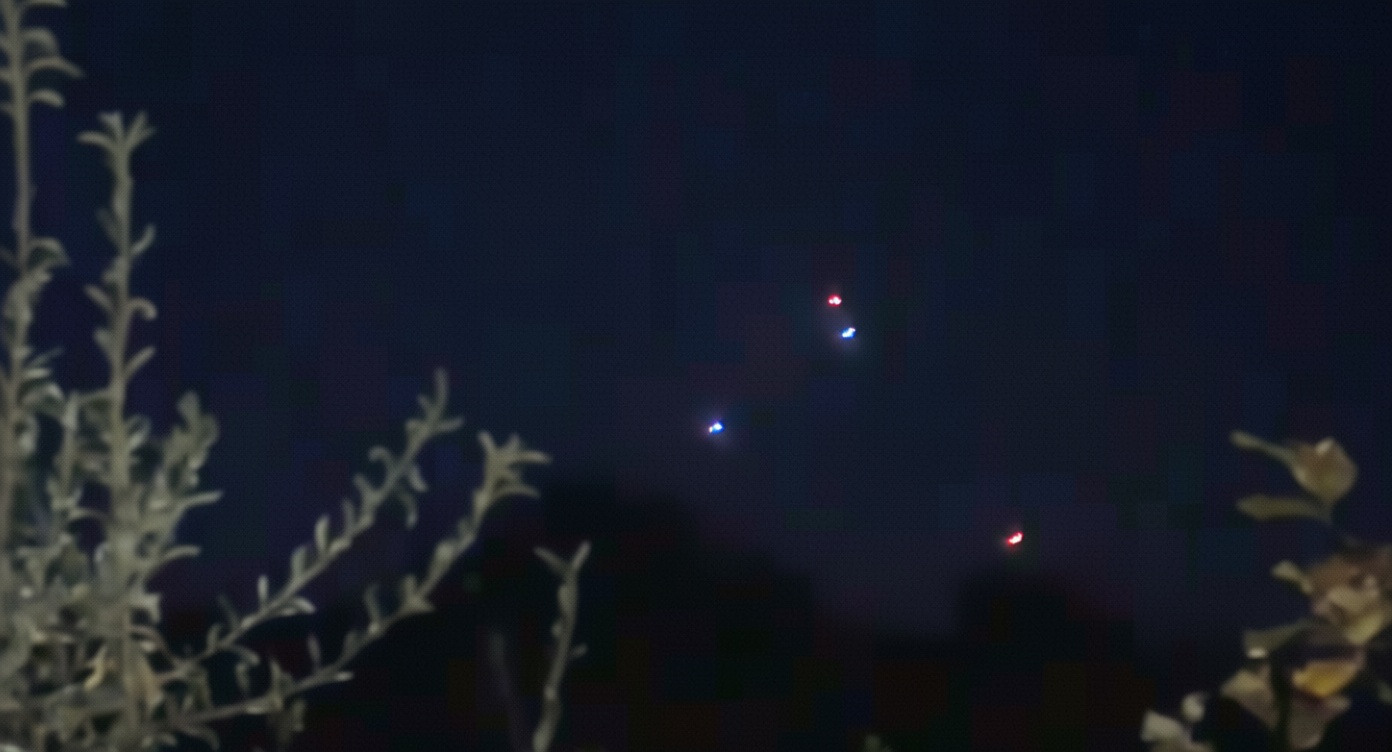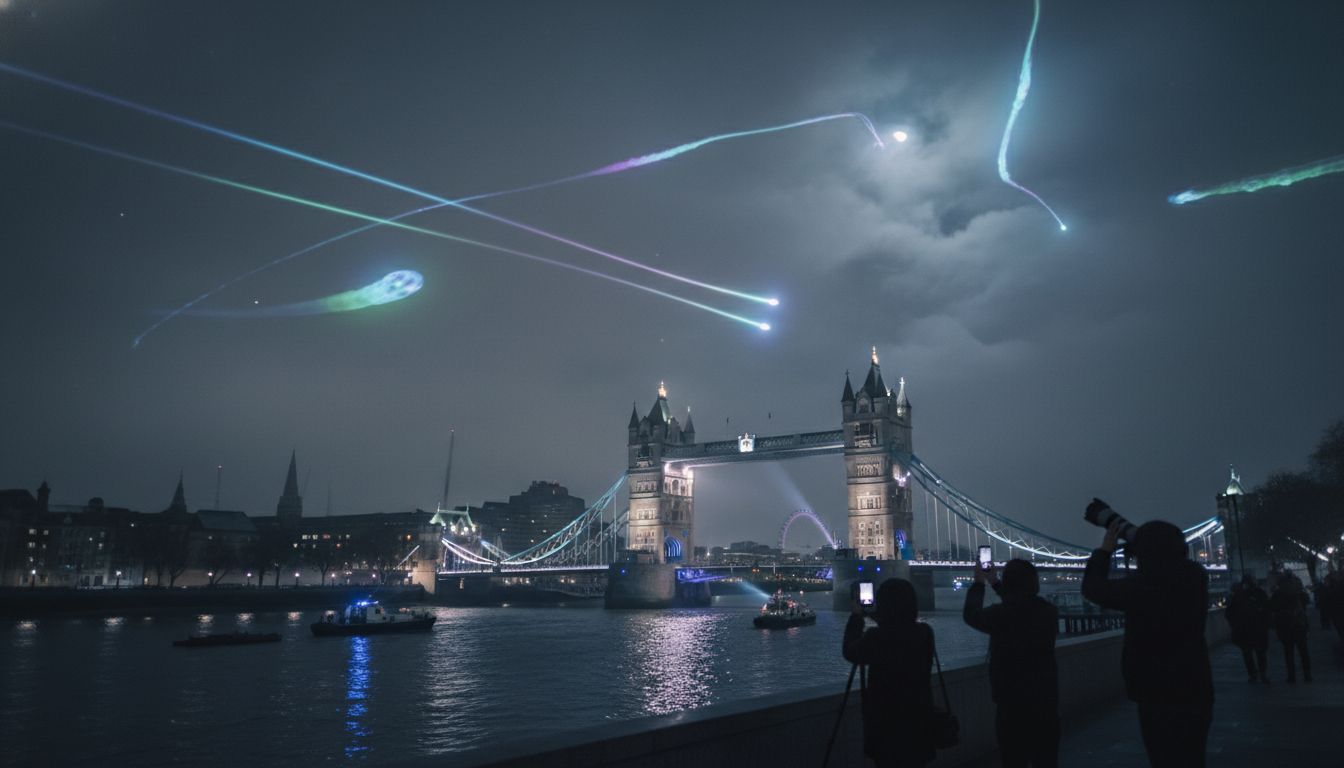
Residents of the small town of Thames on New Zealand’s North Island were treated to an unexpected aerial display on the night of 6 November, when a series of bright lights appeared to move erratically across the sky above the river. Several by‑standers captured the phenomenon on their smartphones, and the footage quickly circulated on social media platforms, prompting a flurry of online discussion. The videos show clusters of white and bluish‑white points that accelerate, pause, and change direction in a manner that differs from typical aircraft or conventional drone activity. None of the recordings display recognizable rotors or navigation lights, and the objects appear to hover at varying altitudes before disappearing from view.
Local witnesses described the event as “unsettling” but not overtly frightening. “I was walking my dog along the riverbank when I saw them—bright, like a string of fireflies, but moving in patterns you don’t see with birds or planes,” said 42‑year‑old resident Mara Thompson, who posted her video on a community Facebook page. Another observer, retired schoolteacher Peter Ngata, noted that the lights were visible for approximately three minutes before vanishing. “It was as if they were playing a game of tag in the sky,” he added. Neither the Thames District Council nor the New Zealand Police have issued an official statement, and a request for comment sent to both agencies on 7 November went unanswered at the time of publication.
The sighting has revived interest in a series of unexplained aerial phenomena reported in the Coromandel region over the past decade. In 2017, a similar cluster of lights was observed near Whitianga, and in 2021 a farmer near Katikati reported a “slow‑moving, pulsating orb” that lingered over his fields. While the New Zealand Ministry of Defence maintains a policy of not commenting on civilian UFO reports, the National Institute of Water and Atmospheric Research (NIWA) has previously cautioned that atmospheric conditions—such as temperature inversions, lenticular clouds, or auroral activity—can produce visual effects that are easily misinterpreted. Dr. Elaine McAllister, an atmospheric physicist at NIWA, said, “Without corroborating radar data or spectroscopic analysis, it is difficult to rule out natural explanations. Light refraction and reflection can create the illusion of movement where none exists.”
Amateur astronomers from the nearby Waikato Astronomical Society have offered to review the publicly available footage. Society president James Patel emphasized the importance of systematic analysis: “We can examine the video frame‑by‑frame to assess brightness, motion vectors, and any potential lens flare. If the objects are at a high altitude, their apparent speed and trajectory would differ markedly from low‑altitude drones.” Patel also noted that the region’s proximity to the Hauraki Gulf, a busy corridor for both commercial and private aviation, makes it essential to cross‑reference flight logs. “If no aircraft were logged in the area at that time, it narrows the field of possibilities, though it does not automatically point to an extraterrestrial origin,” he added.
For now, the Thames community remains divided between curiosity and caution. Local businesses have reported a modest uptick in visitors drawn by the viral videos, while some residents have expressed concern over potential misinformation. The incident underscores a broader pattern in New Zealand, where sporadic, unverified aerial sightings periodically capture public attention but seldom lead to official investigations. As more data emerges—whether through additional eyewitness accounts, radar records, or scientific scrutiny—the mystery may either be resolved through conventional explanations or persist as another entry in the region’s catalog of unexplained lights.