Overview
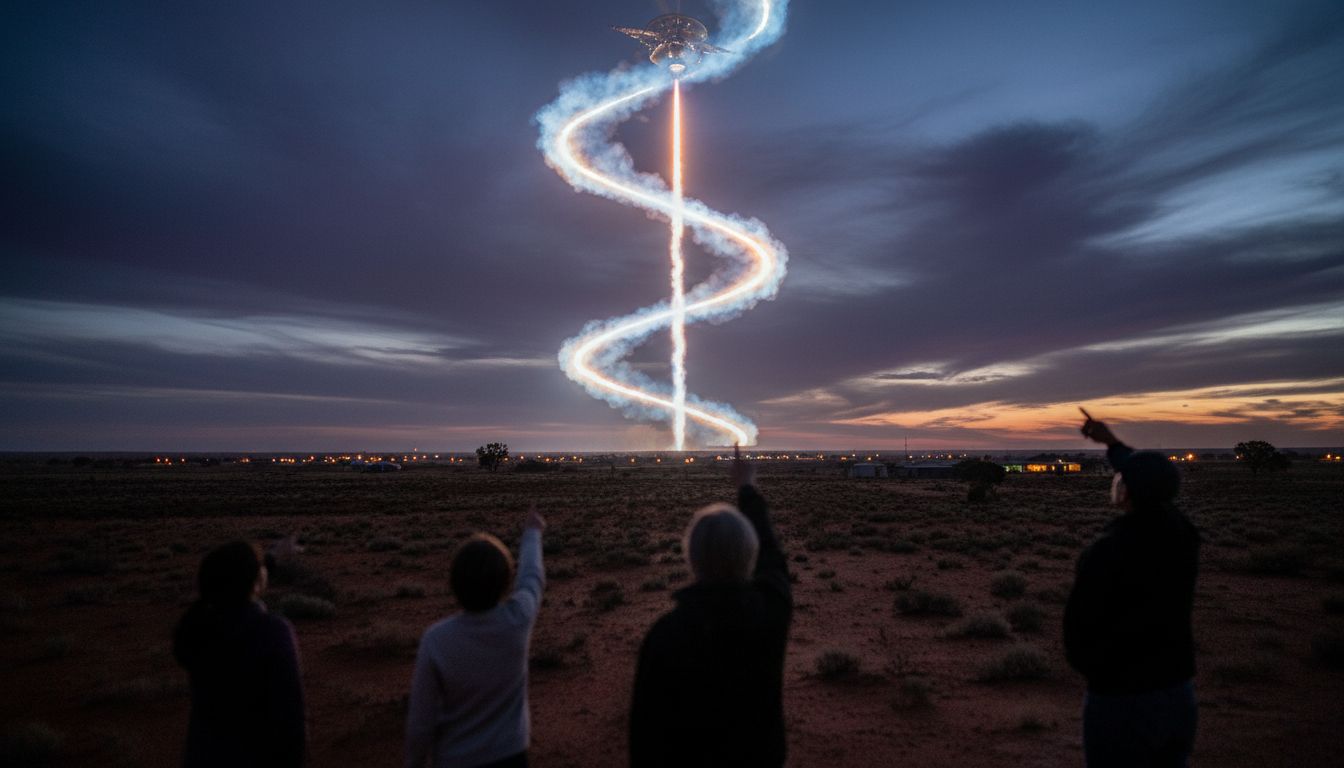
Early on Friday morning, a bright, double‑beamed light swirled across the sky of South Australia, prompting a wave of online speculation that the phenomenon might be a UFO or a mysterious aircraft. The sighting, reported at approximately 6 a.m. local time, was captured on video by several residents and quickly spread through social media. Within hours, analysts from the aerospace community identified the most plausible source: the Ari Ari 6 launch from the Guiana Space Centre in French Guiana, which had taken place three hours earlier and was placing a batch of Amazon‑owned satellites into orbit.
What Witnesses Saw
The phenomenon was described by eyewitnesses as “two beams of light that appeared to swirl together as they moved across the horizon.” The footage shows a narrow, sharply defined column of light that brightened and narrowed before disappearing behind the horizon of the southern horizon. The visual effect was accentuated by the low angle of the rising sun, which reflected off the rocket’s exhaust plume and the surrounding atmosphere, creating the illusion of a “double‑beamed” fireball. The incident sparked a flurry of conjecture on platforms such as 7 TV and local news sites, with some suggesting extrater‑territorial activity, while others humorously floated the idea of a “light‑topped pigeon.”
Expert Analysis
Australian astronomer Dr. Andrew Jones of the University of Adelaide, who examined the video in detail, noted that the timing and trajectory of the light matched the expected path of a launch from Kourou when observed from the southern hemisphere. “The apparent double‑beam is consistent with the first‑stage motor’s exhaust combined with the second‑stage ignition, both of which become visible at sunrise when the sun is just below the horizon,” Jones explained. A spokesperson for the Australian Defence Force, while not confirming the source, indicated that no unauthorized aircraft or known military activity was recorded in the region at that time. Space‑industry analysts also pointed to the Ari Ari 6’s recent maiden commercial launch, which was scheduled for early February and was known to carry a large batch of Amazon satellite assets.
Context of the Ari Ari 6 Launch
The Ari Ari 6 is Europe’s newest heavy‑lift launch vehicle, designed to replace the Ari Ari 5 and compete with the United States and China for commercial payloads. On February 13, the rocket lifted off from the Centre Spatial de Kourou at 02:45 a.m. local time (UTC‑03), placing 32 Amazon “Project Kuiper” satellites into a low‑Earth orbit. The launch was part of Amazon’s plan to build a global broadband constellation, and the first stage fell into the Atlantic while the second stage completed its mission. Because the launch occurred at night in the Atlantic, the exhaust plume was illuminated by the sunrise that was already beginning to rise over the Australian continent, making the phenomenon visible thousands of kilometres away.
Implications and Public Reaction
The incident underscores how high‑altitude rocket launches can create visual effects that are easily misinterpreted when observed from distant locations. While the initial surge of speculation reflected public fascination with the unknown, the rapid de‑linking of the sighting from a known launch demonstrates the value of open‑source intelligence and expert commentary in tempering misinformation. For the Australian public, the event offered a moment of awe that was ultimately rooted in advances in global satellite infrastructure and Europe’s expanding role in commercial space. As the Ari Ari 6 enters service, similar sightings may become more common, prompting both public curiosity and a need for clearer communication from space agencies and satellite operators.