Overview
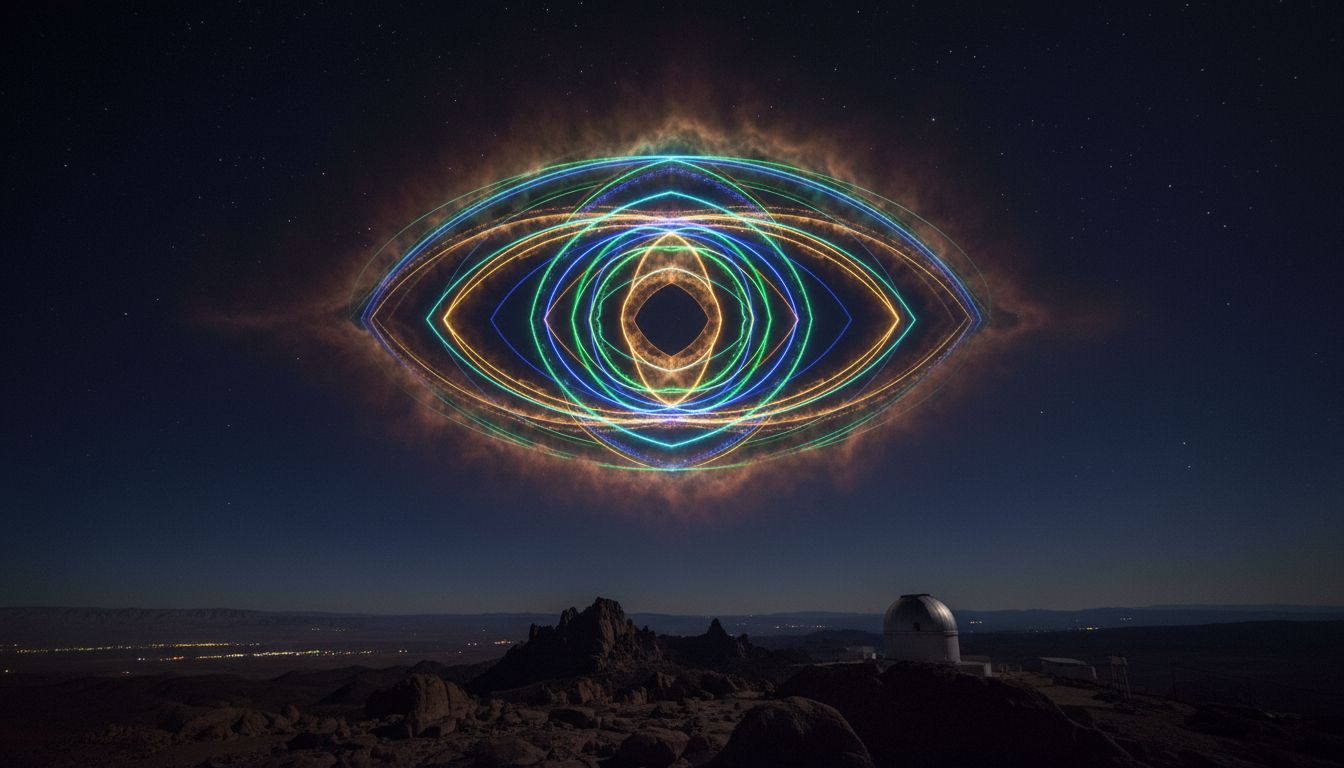
NASA’s internal SkyCam system captured a glowing, multi‑arc formation high in the upper atmosphere on June 12, 2025. The original video, recorded at a standard resolution of 1080p, showed a faint, luminous structure that quickly attracted the attention of the UAP community. SpaceTracker, a civilian open‑source analysis platform that specializes in enhancing aerospace imagery, subsequently processed the footage to an 8K resolution, revealing a strikingly detailed pattern of intersecting arcs surrounded by a faint dust halo. The enhanced imagery, released on the SpaceTracker website on June 20, has sparked renewed discussion among scientists and investigators about anomalous aerial phenomena that do not fit conventional explanations such as meteors, satellites, or known atmospheric events.
Technical Analysis
The 8K enhancement was achieved through a combination of frame‑averaging, de‑noise algorithms, and super‑resolution techniques that preserve the original sensor data while amplifying subtle features. In the refined footage, the arcs appear as geometrically consistent, semi‑circular bands extending roughly 30 km across the field of view, with a luminous core that maintains a steady intensity over several seconds. A diffuse, fine‑grained halo—interpreted by the SpaceTracker team as a dust or particulate scattering layer—encircles the arcs, suggesting interaction with a low‑density medium. The formation’s motion is coherent, lacking the erratic wobble typical of debris or re‑entry events, and it maintains a stable orientation relative to the horizon throughout the clip.
Expert Commentary
Dr. Elena Morales, an atmospheric physicist at the University of Colorado Boulder, cautioned against premature conclusions: “The geometry is unusual, but we must first rule out all conventional atmospheric optics. Gravitational lensing or light scattering from high‑altitude dust jets, such as those observed in comet 3I/ATLAS, are plausible mechanisms that can produce arc‑like luminous patterns.” Meanwhile, former NASA flight surgeon Lt. Cmdr. Aaron Patel (ret.) noted, “The SkyCam is calibrated for spacecraft exterior monitoring, not for scientific observation of transient phenomena. Its data integrity is solid, but we need corroborating observations—radar, infrared, or additional visual recordings—to assess the object's nature.”
Context Within UAP Research
The SkyCam footage joins a growing catalog of unidentified aerial phenomena (UAP) captured by space‑based platforms. Prior incidents, such as the 2023 “X‑Bump” event recorded by the International Space Station’s high‑definition cameras, have similarly exhibited structured light patterns that defy easy classification. SpaceTracker’s analysis draws a tentative parallel to dust jets emitted by cometary bodies, specifically referencing the high‑velocity dust streams of comet 3I/ATLAS, which have been hypothesized to generate transient luminous arcs when intersecting Earth’s upper atmosphere. However, the absence of any known cometary approach at the time of the SkyCam capture makes this connection speculative.
Path Forward
NASA has acknowledged receipt of the enhanced footage and indicated that its UAP Task Force will review the data alongside other sensor inputs. The agency’s statement emphasizes a methodical, data‑driven approach, noting that “any anomalous observation must be examined in the context of all available measurements, including radar, lidar, and spectroscopic data.” SpaceTracker has opened the 8K video for public download, inviting independent analysts to apply alternative processing techniques. Researchers are also calling for coordinated observations from ground‑based all‑sky cameras and satellite assets to capture similar events in real time, which would enable a multi‑modal reconstruction of the phenomenon’s physical properties.
Conclusion
While the enhanced 8K SkyCam footage presents a visually compelling and technically robust record of a multi‑arc luminous structure, the scientific community remains cautious. The formation’s coherent geometry, dust halo, and stable trajectory challenge simple explanations, prompting calls for comprehensive, interdisciplinary investigation. As more data become available, the incident may either expand our understanding of high‑altitude atmospheric dynamics or, if corroborated, add a new chapter to the ongoing study of anomalous aerial phenomena.