Overview
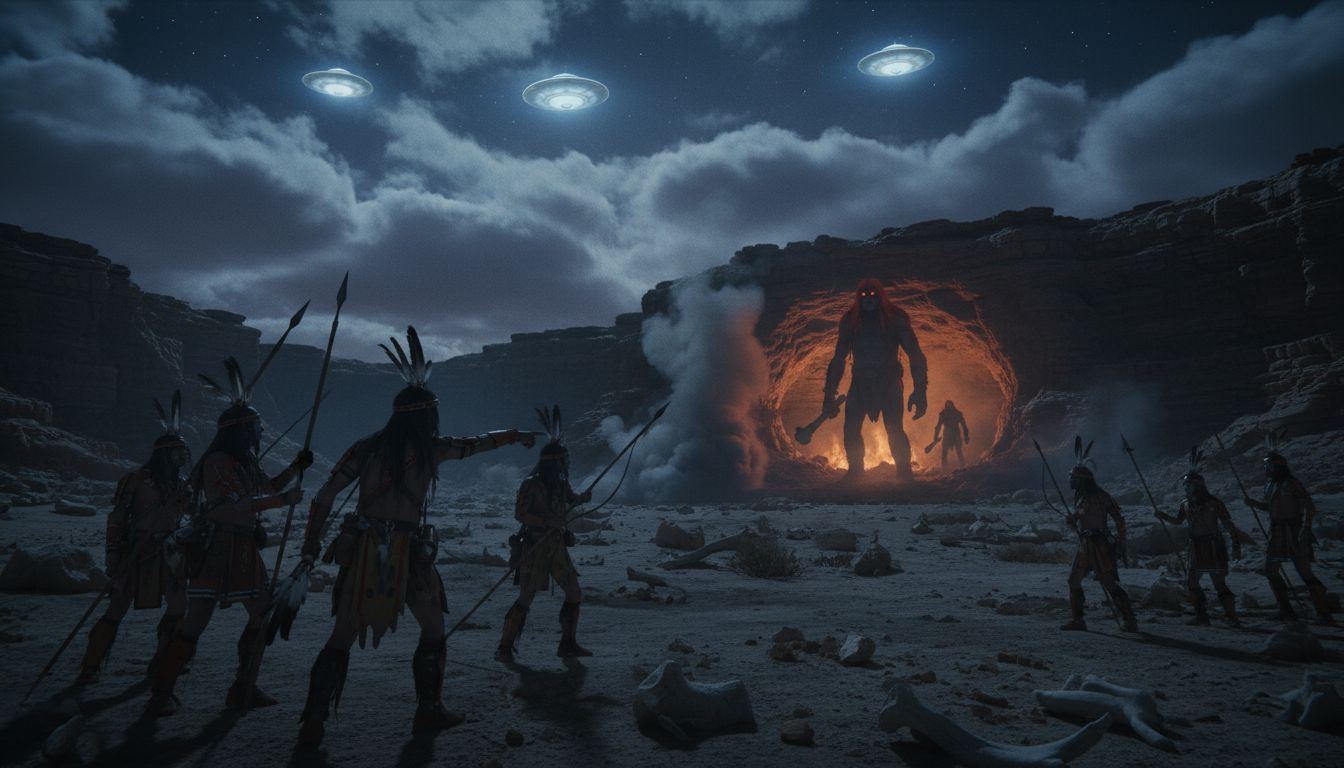
Near the small town of Lovelock in central Nevada, a legend of red‑haired giants has endured for generations. According to Paiute oral tradition, a formidable race of massive, red‑haired, cannibalistic beings once roamed the Great Basin. The story holds that the ancestors of the Paiute peoples confronted these giants, drove them into the depths of Lovelock Cave, and ultimately destroyed them. The tale, passed down through tribal narratives, has become one of the most recognizable elements of Nevada folklore, shaping both local identity and the broader perception of the state’s mysterious past.
Historical Record
The first written account of the giants appeared in the 1880s, when Paiute author Sarah Winnemucca included the story in her memoirs and public speeches. Winnemucca, a pioneering advocate for her people, described the giants as “towering beings with hair the color of fire, who feasted upon the flesh of the living.” Her documentation brought the legend out of oral circles and into the attention of settlers, scholars, and the emerging press of the American West. By recording the narrative, Winnemucca ensured that the giants would be recognized not merely as a mythic curiosity but as a cultural touchstone for the Paiute.
Archaeological Findings
Between 1911 and 1929, a series of excavations were conducted at Lovelock Cave under the direction of archaeologists such as Walter W. Dixon and John C. H. Lee. The digs uncovered a diverse assemblage: stone tools, woven textiles, well‑preserved mummified bodies, and a substantial quantity of human skeletal remains. At the time, sensational headlines proclaimed the discovery of “giant skeletons” and “evidence of a lost race,” fueling public speculation that the cave might indeed have housed the red‑haired beings of Paiute legend.
Modern analysis, however, attributes these remains to ancient Native peoples who inhabited the Great Basin for thousands of years. Radiocarbon dating places most of the human bones between 2,000 and 5,000 years ago, consistent with known Paleo‑Indigenous populations. The mummified remains exhibit typical physiological dimensions for the region’s prehistoric peoples, and no credible osteological evidence supports the existence of individuals of extraordinary stature.
Anthropological Perspective
Anthropologists emphasize that the Lovelock Cave artifacts illuminate the sophisticated lifeways of early Great Basin societies, rather than confirming a race of giants. Dr. Maria Alvarez, a cultural anthropologist at the University of Nevada, Reno, explains, “The material culture—basketry, obsidian tools, and burial practices—matches what we see at other contemporaneous sites across the Basin. The giant narrative likely emerged as a symbolic representation of inter‑tribal conflict or as a cautionary tale about cannibalism, rather than a literal historical account.”
Nevertheless, the legend persists in contemporary Paiute storytelling. Tribal elders recount the giants as a metaphor for resilience, illustrating how ancestral bravery overcame overwhelming odds. This duality—archaeological fact and cultural myth—underscores the importance of respecting both scientific inquiry and Indigenous oral histories.
Contemporary Relevance
Today, Lovelock Cave remains a protected archaeological site, and the red‑haired giants continue to feature in Nevada’s tourism brochures, museum exhibits, and school curricula as a compelling example of how folklore and archaeology intersect. Paiute community leaders, such as Tribal Council member Chief Nathan Red Cloud, advocate for collaborative stewardship: “Our stories are living history. When researchers study the cave, they must do so with an understanding that the legends are part of our identity, not just a curiosity.”
As interest in the Great Basin’s pre‑historic past grows, scholars plan new non‑invasive surveys—ground‑penetrating radar and DNA analysis of the existing remains—to deepen knowledge without disturbing the site. Whether future science uncovers additional clues, the legend of the red‑haired giants endures as a cornerstone of Nevada’s cultural landscape, reminding both residents and visitors that the state’s deserts and caves hold stories as vast as the horizons that surround them.


