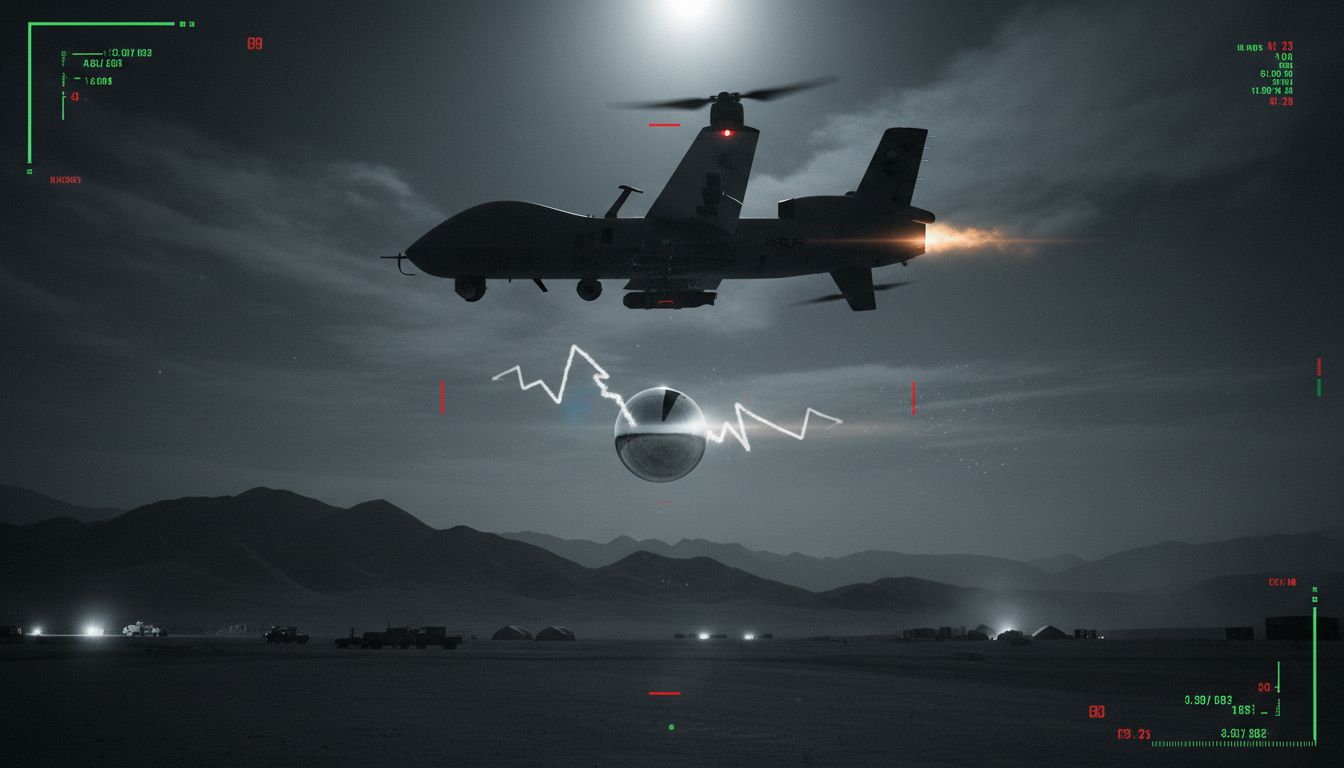
A video that surfaced on a public video‑sharing platform this week appears to capture a U.S. Air Force MQ‑9 Reaper unmanned‑aircraft pursuing a small, metallic‑looking object during an undisclosed operation. The footage, which has been labeled “top‑secret” by the uploader, shows the Reaper’s camera panning as the craft locks onto the target, then follows it as the object darts away at high speed, executes abrupt changes in direction, and disappears behind cloud cover. The metallic orb, roughly the size of a basketball, glints in the sunlight and seems to accelerate faster than the Reaper’s own maximum velocity, prompting analysts to question whether the object is a conventional drone, a classified test vehicle, or an unidentified aerial phenomenon (UAP).
The MQ‑9 Reaper is a medium‑altitude, long‑endurance platform equipped with a suite of sensors, including electro‑optical/infrared (EO/IR) cameras, radar, and a laser designator. According to publicly available specifications, the Reaper can cruise at about 300 knots and climb to 50,000 feet, but its maneuverability is limited by its wingspan and propulsion system. In the video, the metallic object appears to out‑maneuver the Reaper, executing lateral moves and rapid altitude changes that would exceed the Reaper’s documented performance envelope. “If the footage is authentic, we are seeing an object that can sustain accelerations and turn rates beyond what any known man‑made aircraft in the U.S. inventory can achieve,” said Dr. Jacques Vallée, a senior researcher at the Center for the Study of Extraterrestrial Intelligence. “That does not automatically mean it is extraterrestrial, but it does indicate a technology gap that merits serious investigation.”
The release has reignited debate within the defense community about aerial sovereignty and the need for updated detection protocols. In 2022, the Pentagon’s Unidentified Aerial Phenomena Task Force (UAPTF) released three declassified videos that showed similar unexplained objects captured by Navy F/A‑18 and F‑35 fighters. Those clips prompted the Department of Defense to establish the Airborne Object Identification and Management Synchronization Group (AOIMSG) earlier this year, tasked with standardizing reporting across services. “Every time we get a new visual record that shows an object performing beyond our known capabilities, it forces us to re‑examine our sensor coverage and response procedures,” noted Lt. Gen. Daniel Karbler, commander of the Air Force’s Air Combat Command, in a recent briefing. “We are not yet at a point where we can definitively label these encounters, but they are taken seriously at the highest levels.”
U.S. officials have not commented directly on the video, and the Department of Defense has not confirmed whether the operation depicted was a routine surveillance mission or a specific UAP‑tracking exercise. However, a spokesperson for the Office of the Secretary of Defense reiterated that “all credible sightings are logged and analyzed in accordance with existing protocols.” The lack of official acknowledgment leaves room for speculation, but it also underscores the challenges of balancing transparency with national security. Critics argue that the government’s reluctance to release more detailed information hampers public understanding, while proponents maintain that premature disclosure could compromise operational tactics and classified technologies.
Independent analysts are already dissecting the clip frame by frame. A team at the Scientific Coalition for UAP Research (SCU) has released a preliminary technical assessment, noting that the object’s apparent lack of propulsion plume and its consistent metallic sheen suggest a non‑combustion propulsion system, if any propulsion is present at all. “We have seen similar visual signatures in other UAP recordings, where the object appears to glide without observable thrust,” said Dr. Michael Salla, a physicist affiliated with the coalition. “The physics of such motion, if verified, would imply a breakthrough in thrust‑less or field‑based propulsion—a domain that is currently speculative in mainstream aerospace engineering.”
While the video has generated considerable buzz on social media, the journalistic consensus remains cautious. The footage’s provenance, the exact location and date of the operation, and the chain of custody for the recording have yet to be independently verified. Until those details emerge, the incident adds to a growing archive of unexplained aerial encounters that challenge existing aerospace paradigms and push policymakers to consider new frameworks for airspace management and national security.