Overview
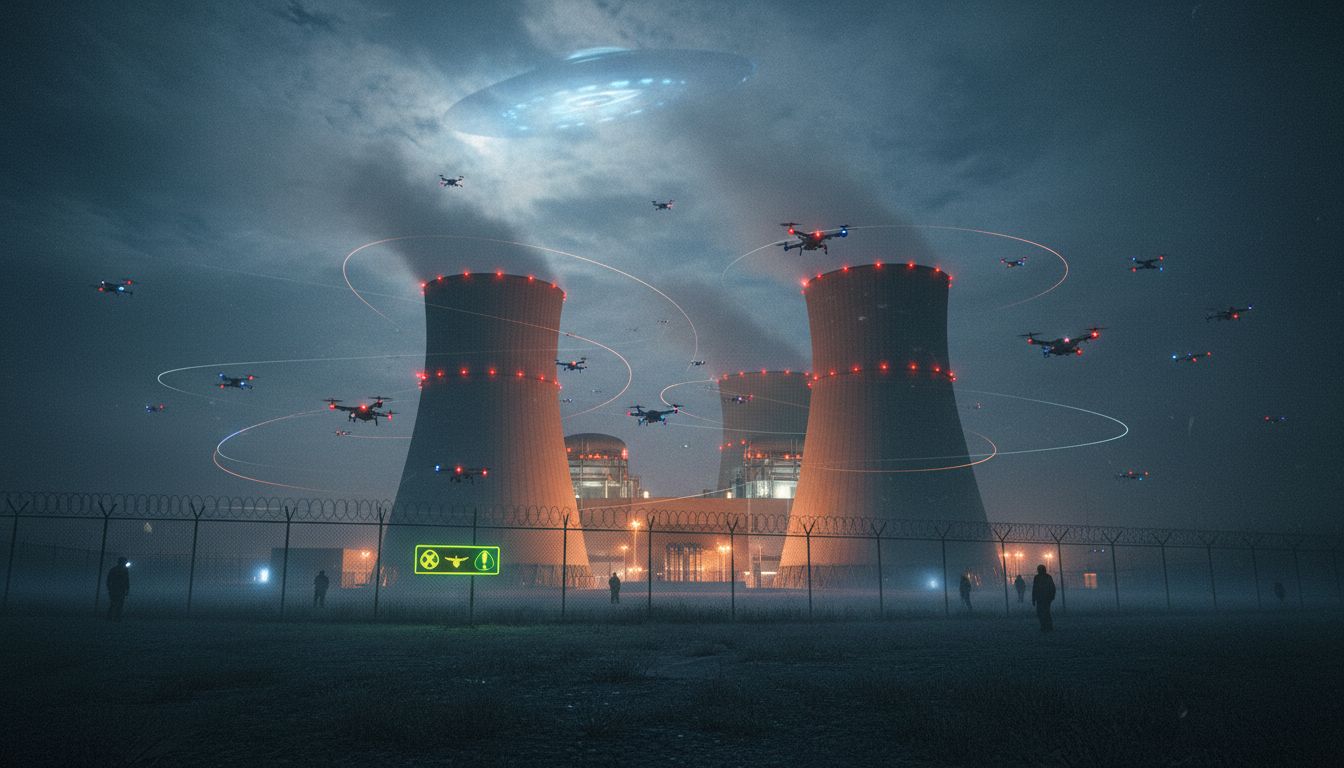
Newly released documents obtained by the U.S. Nuclear Regulatory Commission (NRC) under the Freedom of Information Act reveal a series of 22 drone‑related incursions at U.S. nuclear facilities between September 2022 and February 2023. The records, which were forwarded to the Pentagon’s All‑Domain Anomaly Resolution Office (AARO) – the agency tasked with investigating unidentified aerial phenomena – show that the incidents clustered around two plants: Susquehanna Steam Electric Station in Pennsylvania and Columbia Generating Station in Washington State. The most unusual case, reported in October 2022, involved a large triangular object equipped with a high‑intensity spotlight and multicolored navigation lights that lingered in the plant’s airspace for more than two hours.
Incident Details
The NRC’s files list eight separate drone sightings at Susquehanna over a 35‑day span, and nine at Columbia across roughly three months. The remaining five incidents were reported at other sites but were less documented. The October 2022 event at Susquehanna stands out because of its duration and the description provided by plant security personnel: a triangular craft roughly the size of a small aircraft, bearing a bright spotlight directed toward the turbine building, and flashing red, green, white, and blue lights. Witnesses noted that the object hovered at an altitude that placed it within the plant’s regulated security perimeter, prompting an immediate lockdown of the affected area while law‑enforcement and federal partners were notified.
NRC and Federal Coordination
In response to each breach, the NRC’s Office of Nuclear Security activated its standard protocol, which includes notifying the Department of Energy’s Office of Secure Transportation, the Federal Aviation Administration, and the Department of Homeland Security’s Office of Infrastructure Protection. A spokesperson for the NRC, who requested anonymity, confirmed that “all incidents were logged, investigated, and shared with AARO to ensure a comprehensive assessment of any potential national‑security implications.” The agency’s cooperation with AARO reflects a broader federal effort to centralize data on aerial anomalies that could pose threats to critical infrastructure.
Security Implications
While none of the documented incursions resulted in damage to plant equipment or interruption of power generation, the persistence of drone activity raises concerns about air‑space security at sites that are traditionally protected by multiple layers of surveillance. Experts in aviation security note that commercial and hobbyist drones can be modified to evade detection, and that persistent, low‑altitude flights near high‑value targets could be used for reconnaissance or to test defensive response times. Dr. Emily Chen, a senior analyst at the Center for Critical Infrastructure Studies, cautioned that “the pattern of repeated incursions at the same facilities suggests a systematic effort, whether benign or hostile, that warrants continued monitoring and adaptive counter‑drone measures.”
Looking Ahead
The NRC has indicated that it will enhance its monitoring capabilities by integrating radar and optical sensors capable of distinguishing between authorized aircraft and unauthorized unmanned systems. Additionally, the agency plans to conduct joint exercises with AARO and the U.S. Coast Guard’s Maritime Safety and Security Team to refine response protocols. As the AARO continues to compile and analyze reports of anomalous phenomena, officials stress that transparency and inter‑agency collaboration remain essential to safeguarding the nation’s nuclear assets without resorting to alarmist narratives.


