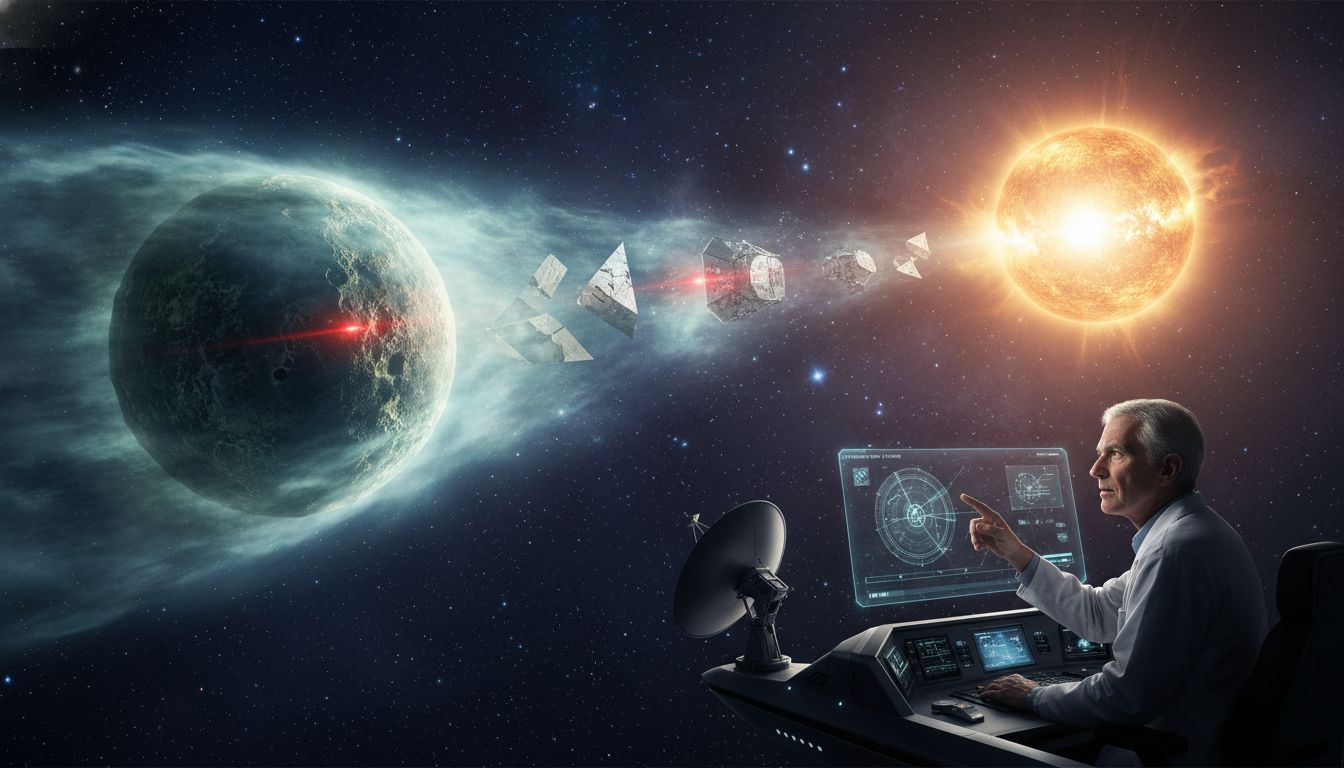
The object designated 3I/ATLAS was first spotted by the Pan‑STARRS survey in early July 2025, and within weeks its hyperbolic trajectory confirmed it as the third known interstellar interloper to enter the Solar System. Unlike the more familiar comet C/2017 K2 or the famous interstellar visitor ʻOumuamua, ATLAS exhibits a combination of a very low albedo, an unusually high proportion of volatile carbon monoxide, and a perihelion distance of just 0.09 AU that will bring it within a few solar radii of the Sun later this year. Spectroscopic analysis from the Keck Observatory and the European Southern Observatory suggests the material dates back to the early stages of planetary formation, leading some researchers to describe it as “the oldest comet ever observed.” Its inbound speed of roughly 45 km s⁻¹ and an orbital eccentricity of 1.02 reinforce its origin outside the Solar System.
The scientific community has been quick to place ATLAS in context with the two prior interstellar objects, 1I/ʻOumuamua (2017) and 2I/Borisov (2019). While ʻOumuamua’s elongated shape and lack of a detectable coma sparked debate over its nature, and Borisov behaved like a typical icy comet, ATLAS appears to blend characteristics of both: a faint, dusty coma that brightens dramatically as it approaches the Sun, yet a composition that hints at a primordial reservoir of ices preserved for billions of years. Dr. Elena Martínez, a cometary physicist at the University of Arizona, notes, “If the isotopic ratios we’re measuring hold up, we’re looking at material that formed before the Sun itself ignited, offering a rare glimpse into the chemistry of the early galaxy.” The object’s projected perihelion on 15 December 2025 will provide a narrow window for high‑resolution observations from both space‑based platforms such as the James Webb Space Telescope and ground‑based arrays.
The unusual properties of ATLAS have reignited speculation outside mainstream astronomy. Harvard astrophysicist Avi Loeb, who has long advocated for the possibility that some interstellar visitors could be artificial, has publicly suggested that ATLAS “cannot be dismissed outright as a natural probe” and called for “targeted radar and optical studies to test for any anomalous acceleration or engineered surface features.” Loeb’s comments have been amplified by UFO‑focused media outlets and a growing segment of the public that links unexplained space phenomena with extraterrestrial technology. Nevertheless, NASA’s Near‑Earth Object Program Office has cautioned against alarmist interpretations. In a statement released on 2 October, program manager Dr. Karen Liu emphasized, “All available data to date are consistent with ATLAS being a natural cometary body. Its trajectory poses no impact risk to Earth, and its interaction with the Sun will likely result in complete disintegration.”
The debate underscores a broader tension in the scientific discourse surrounding interstellar objects. Researchers such as Dr. Miguel Hernández of the European Space Agency argue that “extraordinary claims require extraordinary evidence,” and they point to the need for systematic, peer‑reviewed measurements before entertaining non‑natural explanations. At the same time, the rapid dissemination of preliminary findings on social platforms has fueled a “wild‑theory” cycle, where speculative headlines precede the publication of detailed analyses. The upcoming solar conjunction will allow astronomers to collect high‑cadence photometry and spectropolarimetry, data that could either confirm the comet’s primitive composition or reveal anomalies that merit deeper investigation.
Regardless of the eventual conclusion, 3I/ATLAS is already reshaping expectations for future interstellar detections. The Vera C. Rubin Observatory, slated to begin full operations in 2026, is expected to increase the discovery rate of such objects by an order of magnitude, providing a statistically robust sample to test hypotheses about their origins and physical properties. For now, ATLAS serves as a reminder that the Solar System’s borders are not closed, and that each new visitor carries the potential to expand our understanding of planetary formation—while also highlighting the importance of measured, evidence‑based communication in a media landscape eager for sensational stories.


