Overview
On International Women’s Day, the Weird in the Wade podcast released a special episode titled “Paranormal Women: An International Women’s Day Celebration.” Recorded on 2 March 2026, the hour‑long discussion examines the prevalence of female spectres across the United Kingdom and Ireland, using the “Green Lady” of the River Great Ouse in Kempston as a focal point. Host Nat Doig brings together four leading voices—parapsychologist Evelyn Hollow, psychologist and folklorist Deborah Hyde, folklorist Bethan Briggs‑Miller, and researcher Steph Lay—to explore how women experience, report, and investigate hauntings, and why “colourful lady ghosts” appear so frequently in local lore.
The Green Lady of Kempston
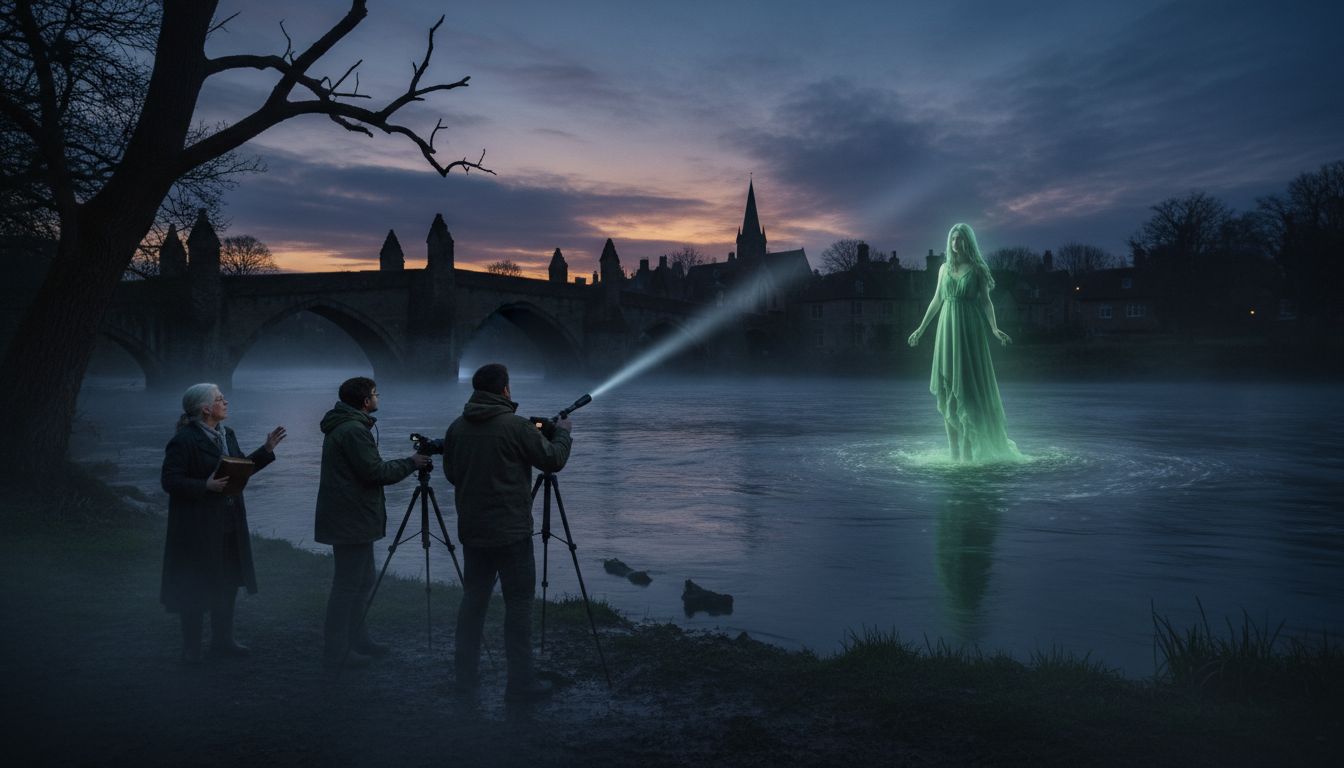
The episode opens with a description of the Green Lady, a translucent figure said to glide along the banks of the Great Ouse southwest of Bedford. Local accounts describe her as wearing a flowing green dress, occasionally pausing to stare at passers‑by before vanishing into the reeds. While the legend has been passed down through oral tradition for generations, there is little archival evidence beyond 19th‑century newspaper mentions of a “woman in green” seen near the river after dark. Nat Doig notes that the Green Lady “represents the archetype of the lady ghost” that populates many British and Irish ghost stories, from the “Grey Lady” of Edinburgh Castle to the “White Lady” of County Mayo. The discussion positions the Green Lady as a case study for investigating why female apparitions often carry vivid colour symbolism and how these images persist in community memory.
Expert Perspectives
The panel’s first task was to assess whether female‑identified ghosts behave differently from their male counterparts. Evelyn Hollow, author of Spectral Sisters, argues that “women‑appearing spirits tend to be tied to themes of loss, mourning, or unresolved domestic narratives,” citing examples such as the Green Lady’s association with the river—a historic trade route linked to women’s labor. In contrast, Deborah Hyde, a sceptic and folklorist, cautions against over‑generalisation, pointing out that many “male ghosts” are portrayed as protectors or aggressors, reflecting broader cultural gender scripts. Bethan Briggs‑Miller adds a regional dimension, noting that East Anglian folklore records a higher concentration of lady‑ghosts near waterways, possibly because rivers have long been sites of female‑centred activity such as laundry or market trade. Steph Lay, who curates the City of Secrets project, highlights the methodological challenges of separating anecdote from pattern, emphasizing the need for systematic documentation of sightings.
Gender Bias in Haunting Reports
A recurring theme was the societal bias against women who report hauntings. The panel cited media analyses showing that female witnesses are often portrayed as “over‑emotional” or “prone to imagination,” whereas male witnesses receive more credence. Hyde referenced a 2022 study from the University of Glasgow that found women’s paranormal testimonies were quoted in the press 38 % less frequently than men’s, even when the accounts were otherwise identical. The experts discussed how this bias can discourage women from speaking publicly, potentially skewing the historical record toward male‑dominated narratives. The episode also explored how folklore itself can reinforce stereotypes, with many lady‑ghost tales casting the spectre as a warning against “improper” female behaviour, such as the 18th‑century “Maid of the Marsh” legend used to police women’s nocturnal movements.
Women Leading the Field
In celebrating International Women’s Day, the podcast highlighted several pioneering women in parapsychology and folklore. Evelyn Hollow’s work on gendered hauntings, Deborah Hyde’s long‑standing role as a sceptical voice in the Committee for Skeptical Inquiry, Bethan Briggs‑Miller’s co‑founding of the East Anglian Folklore Centre, and Steph Lay’s digital archiving of urban legends were all presented as examples of how women shape contemporary paranormal research. Nat Doig remarked that “the field is richer because these women bring interdisciplinary lenses—psychology, history, community studies—that broaden our understanding of why hauntings matter to people today.” The discussion concluded with a call for more inclusive fieldwork, encouraging aspiring female investigators to document local lore without fear of dismissal.
Looking Forward
The Weird in the Wade episode serves as both a scholarly overview and a cultural commentary on the intersection of gender and the supernatural. By anchoring the conversation in a specific case—the Green Lady of Kempston—and expanding to broader patterns, the program offers listeners a balanced view that respects folklore while applying critical analysis. As the podcast’s website notes, further resources, including photographs and transcripts, are available for those wishing to explore the topic in depth. In an era where representation matters across all disciplines, the episode underscores that women’s voices are essential to unraveling the mysteries that haunt both history and the present day.


