Overview
The recent episode of Paranormal Center examined three developments that have drawn attention within the UAP research community: a brief airspace restriction over El Paso, Texas; a new statistical “Alien Abduction Odds Map” derived from a large UFO‑sighting database; and a peer‑reviewed study linking the phenomenology of N,N‑Dimethyltryptamine (DMT) experiences to classic alien‑abduction narratives. Hosts Tyler and Roopy presented the material alongside official statements and scholarly commentary, aiming to separate documented facts from speculative interpretation.
El Paso Airspace Restriction
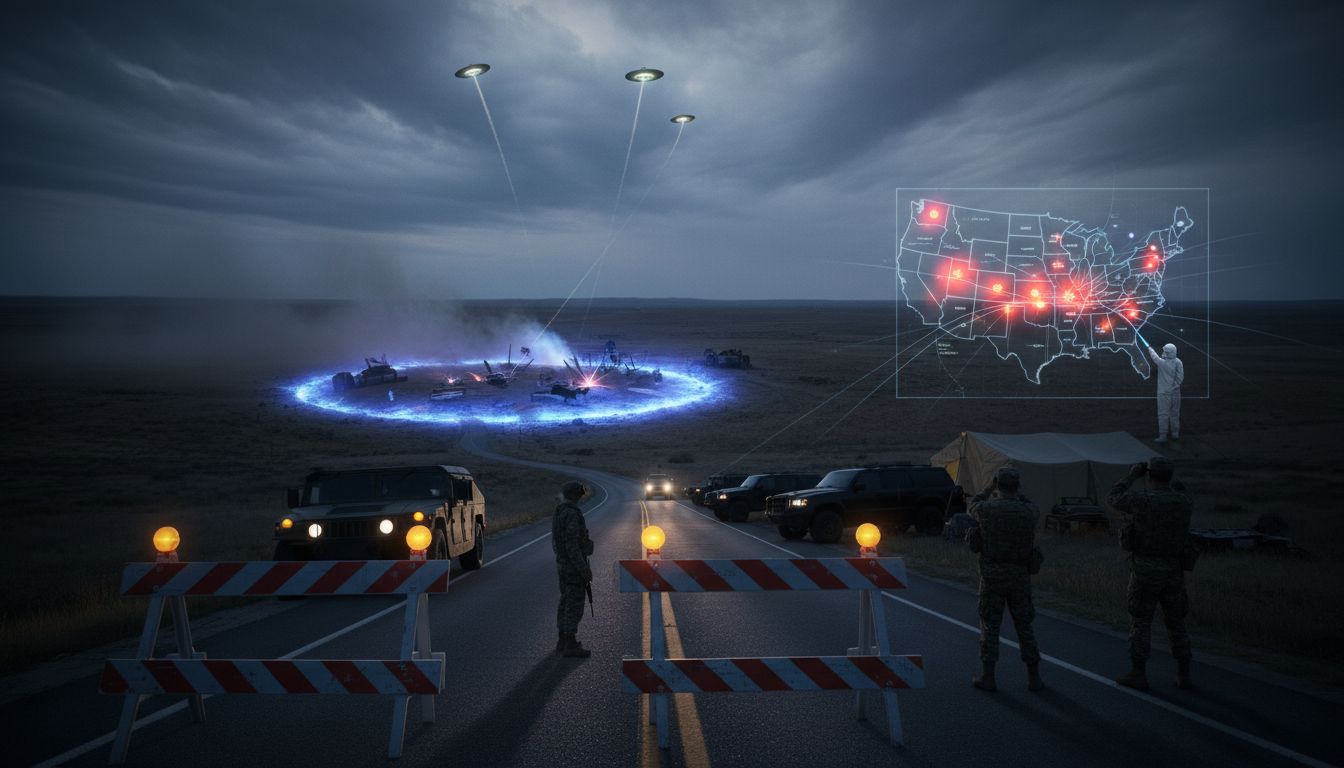
On 11 February 2026 the Federal Aviation Administration issued a Notice to Airmen (NOTAM) that temporarily barred all aircraft below 18,000 feet within a 10‑mile radius of El Paso, Texas. The restriction was slated for ten days but was lifted after only seven hours. The FAA, citing a social‑media post from Secretary of Transportation Sean Duffy, attributed the closure to “drug‑cartel drone incursions.” However, Tyler suggested an alternative hypothesis, noting the unusually short duration and the proximity to a known UAP‑reporting corridor. He referenced the 1947 Roswell incident as a historical parallel, proposing that the shutdown could have facilitated a “UAP crash retrieval” operation. While the hosts offered no direct evidence, the FAA has not released further details, leaving the official rationale the only verifiable explanation at this time.
Alien Abduction Odds Map
The program highlighted a newly released “Alien Abduction Odds Map,” which aggregates 150,000 UFO‑sighting reports collected by the National UFO Reporting Center and other databases. The map ranks states by the density of sightings per 100,000 residents and the proportion of reports that include “missing‑time” or contact claims. New Hampshire leads the nation, with 24 sightings per 100,000 people. Idaho, Vermont, Oregon and Wyoming follow as “high‑risk” states for close‑encounter reports. Wyoming, in particular, shows that more than 25 % of its sightings involve alleged abduction‑style experiences. The hosts emphasized that the map reflects self‑reported data, which can be subject to reporting bias and regional variations in public willingness to file a report. Nonetheless, the geographic clustering offers a useful baseline for researchers examining environmental or sociocultural factors that may influence UAP reporting.
DMT and Extraterrestrial Connection
The final segment reviewed a peer‑reviewed article titled “More Real Than Real” by Brendan Graham Dempsey, published in Frontiers in Psychology (March 2026). Dempsey’s study surveyed 1,238 individuals who had taken DMT and compared their phenomenological accounts with a corpus of alien‑abduction testimonies. The analysis identified recurring motifs: encounters with humanoid entities, telepathic communication, perceived medical examinations, and settings described as “spaceship‑like.” Dempsey cautioned that correlation does not imply causation, noting that both DMT experiences and abduction reports may draw on shared cultural archetypes or neuropsychological mechanisms. Tyler and Roopy debated whether the overlap suggests a common underlying phenomenon or simply reflects the brain’s tendency to interpret anomalous sensory input in familiar narrative frames.
Conclusion
While Paranormal Center presented a range of data points—from an FAA‑issued NOTAM to a statistically derived risk map and a scholarly article on altered states of consciousness—the episode underscored the challenges of distinguishing verified information from conjecture in UAP research. Official explanations for the El Paso airspace closure remain limited to drug‑related drone activity, whereas the odds map and DMT study provide quantitative and qualitative frameworks for future investigation. As the hosts noted, ongoing monitoring of both governmental