Overview
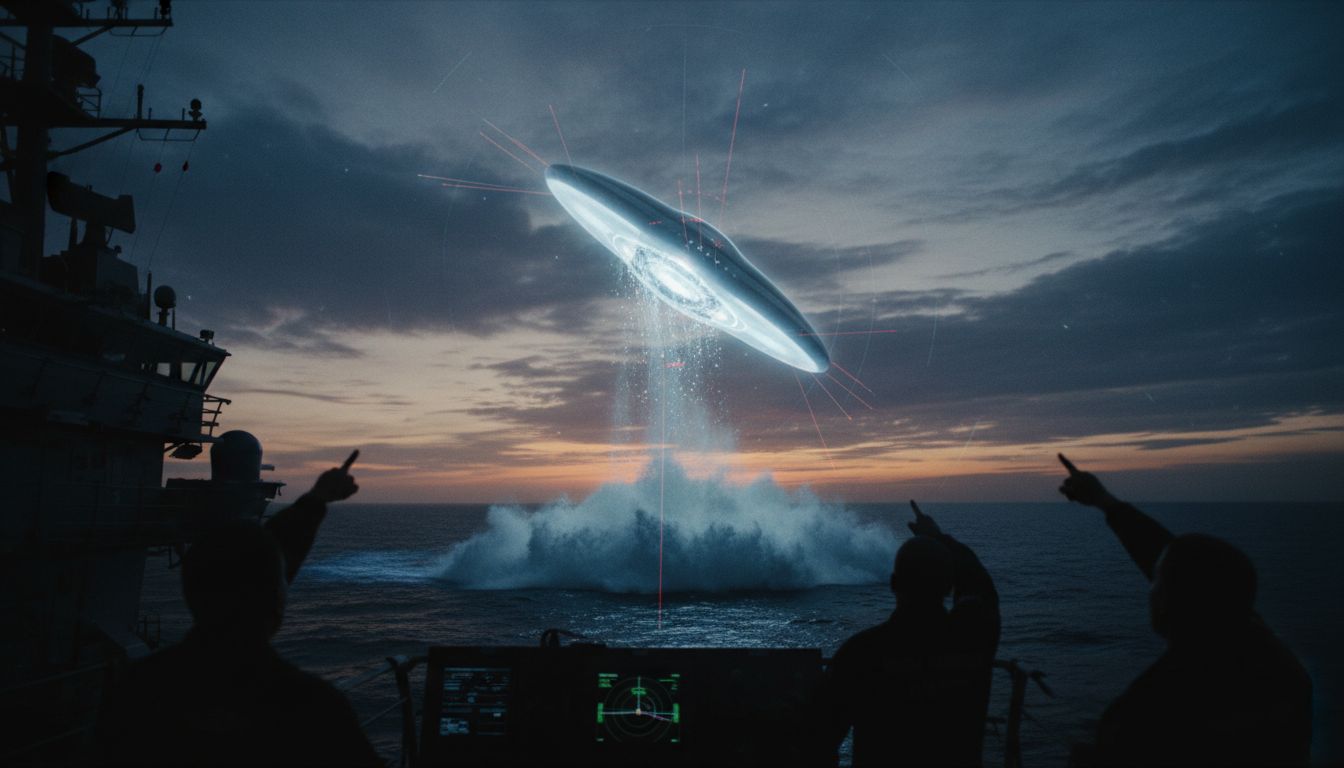
A newly released report from the Pentagon’s All-domain Anomaly Resolution Office (AARO) has drawn significant attention from both military analysts and the public. The January 2026 document details a striking incident involving a luminous, wingless object observed by U.S. Navy personnel over the Pacific Ocean. The sighting, which remains unexplained, was documented by multiple independent sources, including radar, infrared sensors, and direct pilot observation, lending it an unusual degree of credibility within the typically murky world of unidentified aerial phenomena (UAP).
The Sighting: Multi-System Confirmation
The event unfolded during routine night operations conducted by carrier-based aircraft from the USS Theodore Roosevelt, a modern aircraft carrier equipped with some of the world’s most advanced surveillance systems. According to the AARO report, the carrier strike group was not engaged in exercises nor testing experimental equipment at the time, eliminating common sources of confusion or misidentification.
“The object was detected by multiple systems simultaneously,” the report notes. Ship and aircraft radars initially picked up a target at an altitude of approximately nine kilometers—well within the range of commercial and military aircraft. Infrared cameras, which detect thermal emissions, also recorded the object. Most compellingly, Navy pilots observed the phenomenon visually, describing it as a luminous body with no wings, no tail, no structural elements, and no exhaust. The absence of a typical heat signature further distinguished the object from known jet- or rocket-powered vehicles.
Unprecedented Maneuver: Physics-Defying Descent
The most remarkable aspect of the encounter was the object's movement. In less than a second, the object plunged from its initial altitude of nine kilometers to just above sea level—an apparent vertical speed of 32,000 kilometers per hour (9 km/s). Such a maneuver is beyond the capabilities of any known aircraft or drone, and would subject any physical occupant to forces that are not survivable by humans.
One of the pilots succinctly described the event: “The object wasn’t accelerating—it was simply appearing in a different location.” This comment, included unedited in the official report, highlights the anomalous nature of the movement: there was no indication of continuous motion, no visible acceleration arc, and no sonic boom or environmental impact as would be expected from such a rapid descent.
No Conventional Explanation
The AARO report methodically ruled out known explanations. There were no concurrent military exercises, missile tests, or drone operations in the area. The infrared analysis did not reveal the intense heat signature characteristic of powered propulsion systems. Critically, when the object reached sea level, there was no splash, vapor cloud, or thermal disturbance detected—phenomena that would be unavoidable for any physical object dropping from such a height at such speed.
Commercial pilots in the region also reported seeing similar objects, further corroborating the Navy’s account and reducing the likelihood of sensor error or equipment malfunction.
Conclusion: An Unresolved Mystery
“The object’s origin could not be determined,” the AARO report concludes, breaking from the standard practice of offering plausible explanations or hypotheses. Analysts emphasize that the convergence of independent detections—radar, infrared, and visual—makes this one of the most robustly documented UAP cases to date. Despite exhaustive analysis, the event remains unexplained, fueling ongoing debate and investigation into the nature of unidentified aerial phenomena over the world’s oceans.


