Overview
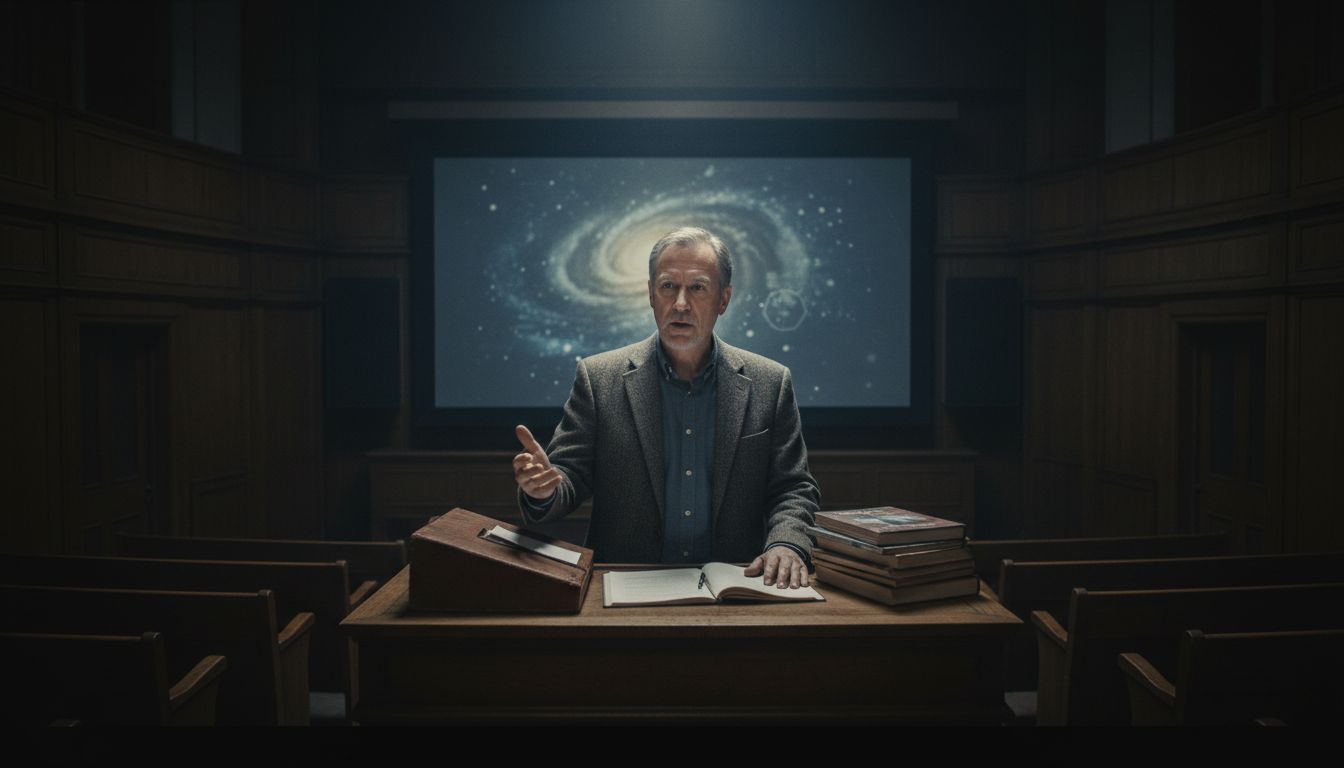
Professor Michael Bohlander, a leading scholar in law and technology at Durham University, used a recent press briefing to call out what he described as “superficial” media coverage of Search for Extraterrestrial Intelligence (SETI) and Unidentified Aerial Phenomena (UAP) research. Speaking after the university’s April 2026 symposium on “Science, Security, and the Search for Extraterrestrial Life,” Bohlander urged journalists and commentators to apply the same academic rigor that underpins peer‑reviewed studies when reporting on these rapidly evolving fields.
Media Landscape
Bohlander noted that headlines often reduce complex scientific work to sensational sound bites: “A single sighting or a speculative claim about alien contact can dominate the news cycle, while the painstaking data analysis that follows receives little attention.” He pointed to recent coverage that framed a new UAP video released by the U.S. Department of Defense as proof of extraterrestrial technology, without acknowledging the extensive methodological debates taking place in scholarly journals. “When the media treats SETI and UAP as tabloid fodder, it undermines public understanding and the credibility of legitimate research,” he warned.
Academic Response
The Durham symposium, attended by astrophysicists, legal experts, and policy analysts, highlighted a shift toward peer‑reviewed publications that treat UAP sightings as data points requiring rigorous statistical treatment. Papers published in The Journal of Astronomical Instrumentation and Science & Public Policy this year have introduced standardized reporting protocols, similar to those used in particle physics, to evaluate anomalous aerial observations. Bohlander praised these efforts, saying, “The community is moving beyond anecdote. We now have reproducible methodologies, open data repositories, and interdisciplinary review panels.”
He also emphasized the role of universities in fostering transparent research. Durham’s Centre for Space Law, which co‑hosted the symposium, has launched a new graduate module on “Evidence Evaluation in Extraterrestrial Research,” aimed at training the next generation of scholars to navigate both scientific and legal dimensions of the debate.
Government Engagement
Governments, too, appear to be taking a more measured approach. In the United States, the Office of the Director of National Intelligence released an unclassified report last month acknowledging that “UAP incidents merit systematic scientific investigation.” The United Kingdom’s Ministry of Defence announced a joint task force with the UK Space Agency to develop a national framework for data collection and analysis. Bohlander remarked, “When state actors allocate resources to structured research rather than speculation, it signals a maturation of the discourse.”
Outlook
Bohlander concluded that a collaborative ecosystem—linking academia, government, and responsible media—will be essential for progress. He called on journalists to consult the growing body of peer‑reviewed literature and to provide context that distinguishes hypothesis from evidence. “The public deserves accurate information,” he said, “and that can only be achieved when we treat SETI and UAP research with the same scholarly discipline we apply to any frontier science.”
As the scientific community continues to publish rigorously vetted findings and policymakers allocate funding for systematic study, the hope is that future headlines will reflect substantiated insight rather than sensational conjecture.


