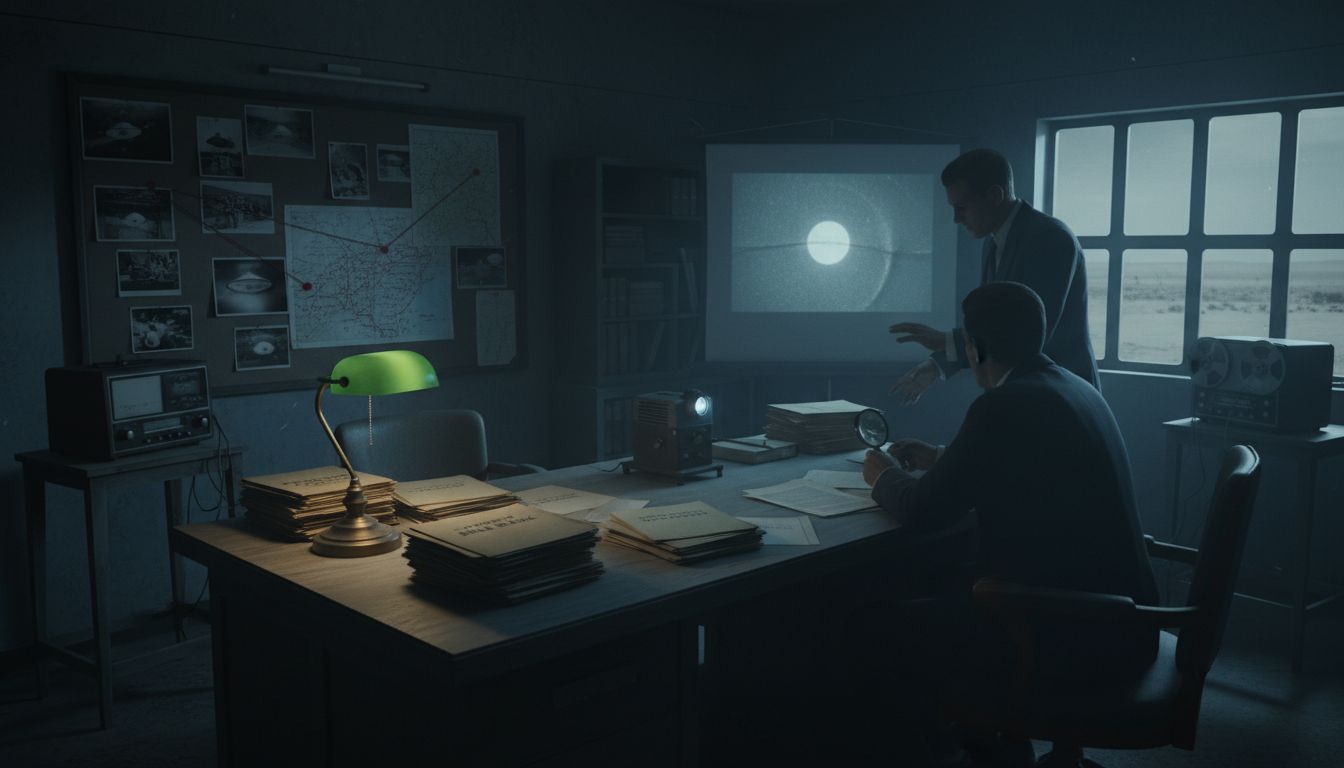
Project Blue Book, the United States Air Force’s most extensive investigation of unidentified aerial phenomena, operated from 1952 until its official termination in 1969. Over the course of seventeen years the program collected 12,618 reports from civilian witnesses, military personnel, and radar operators, and subjected each case to a standardized analytical process at Wright‑Patterson Air Force Base in Ohio. The effort marked a decisive shift from earlier, more dismissive attitudes toward UFO sightings, instituting formal categories—“identified,” “insufficient data,” and “unidentified”—that allowed the Air Force to quantify how many encounters truly defied conventional explanation. Of the total submissions, 701 remained classified as “unidentified,” a figure that continues to shape contemporary discussions about the prevalence of anomalous aerial observations.
The program’s methodology was largely shaped by Major Edward Ruppelt, who took command of the investigation in 1952. Ruppelt introduced a scientific framework that required systematic data collection, cross‑checking of radar returns, and the involvement of civilian experts. He also instituted the “Project Blue Book” reporting forms that demanded precise information on time, location, weather conditions, and witness description. “Our goal was not to prove or disprove the existence of extraterrestrials,” Ruppelt wrote in a 1954 memorandum, “but to determine whether any reported objects posed a threat to national security.” This pragmatic stance reflected the Cold War context, where unidentified objects could potentially be Soviet aircraft or advanced technology.
One of the most influential civilian consultants was Dr. J. Allen Hynek, an astronomer initially skeptical of UFO claims. Over the course of his involvement, Hynek’s perspective evolved, leading him to develop the now‑familiar “Close Encounters” classification system—ranging from simple visual sightings (Close Encounter I) to alleged contact with occupants (Close Encounter III). Hynek’s later writings, especially his 1972 book The UFO Experience, argue that the “unidentified” cases often shared common characteristics such as high‑speed maneuvers, sudden acceleration, and lack of conventional propulsion signatures. While Hynek never asserted extraterrestrial origins, he warned that the Air Force’s dismissal of these cases risked overlooking genuine scientific opportunities.
Declassified documents released under the Freedom of Information Act in the early 2000s provide a clearer picture of the program’s internal deliberations. Among the files are radar transcripts from the 1957 “Washington, D.C., Flap” incident, where multiple ground stations recorded objects executing rapid, coordinated turns at altitudes exceeding 30,000 feet—maneuvers beyond the capabilities of known aircraft at the time. A 1966 internal memo noted that “the data set for case 3875 remains inconclusive; further analysis is warranted,” yet the recommendation to pursue additional study was overruled by senior officials citing resource constraints and the program’s impending closure. These records have been cited by contemporary UAP investigators as evidence that some data were not fully explored before the program was terminated.
The legacy of Project Blue Book extends into today’s Unidentified Aerial Phenomena (UAP) task forces. In 2020 the Department of Defense established the UAP Task Force, explicitly referencing Blue Book’s archives as a historical baseline. Former Pentagon officials acknowledge that the earlier program’s emphasis on rigorous data handling set a precedent, even as they admit that “the culture of secrecy during the Cold War limited the full dissemination of findings.” While the Air Force’s final 1969 report concluded that UFOs posed no threat to national security and that the majority of sightings could be explained, the lingering 5‑percent of unresolved cases continues to fuel scholarly inquiry and public interest, underscoring the enduring relevance of a program that, for a generation, tried to bring the unknown into the realm of scientific scrutiny.