Overview
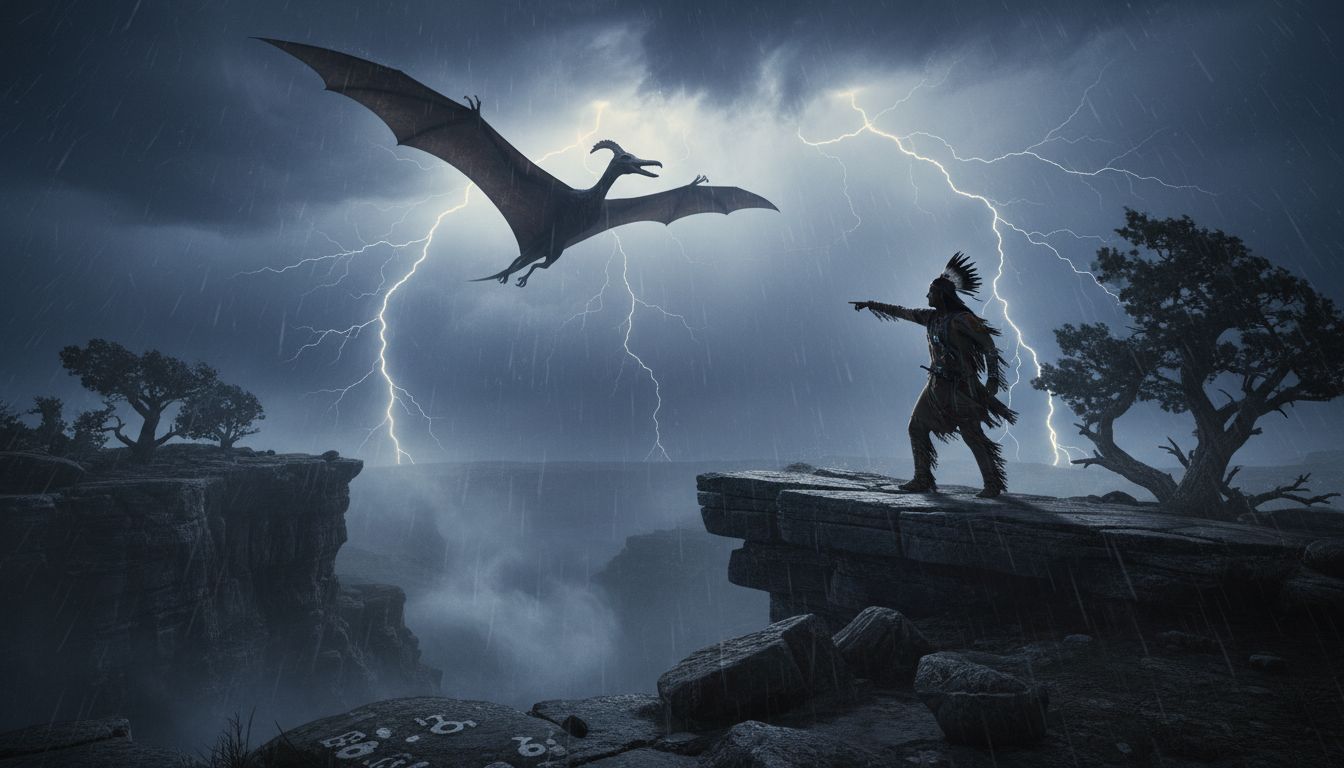
A growing number of internet forums and popular‑culture pieces have suggested that the Native American thunderbird—a powerful spirit figure found in the oral traditions of Pacific‑Northwest, Great‑Plains and Great‑Lakes peoples—might be a cultural memory of living pterodactyl‑like reptiles. While the notion captures the imagination, scientists stress that no fossil, bone or ecological evidence supports the survival of pterosaurs into historic times. The discussion, however, offers a useful lens on how ancient peoples interpreted dramatic natural phenomena and the occasional exposure of prehistoric fossils.
Cultural Background
The thunderbird appears in the myths of the Lakota, Ojibwe, Menominee, Kwakiutl and many other nations. Across these traditions the creature is described as possessing enormous wings that generate thunder, eyes or beaks that flash lightning, and the ability to lift whales or other large animals. It is typically portrayed not as an ordinary animal but as a spiritual guardian or enforcer of cosmic order, sometimes a shape‑shifter that dwells in mountains or the sky. Scholars such as Dr. Elaine M. Redbird (University of Minnesota) note that “the thunderbird functions as a narrative device to explain storms, lightning and the awe‑inspiring power of the sky.”
Scientific Perspective
From a paleontological standpoint, pterosaurs—including the iconic “pterodactyl”—went extinct about 66 million years ago at the end of the Cretaceous. Their fossil record shows no evidence of survival into the Holocene, and no bones, nests or other remains have ever been recovered from archaeological layers associated with human activity. Biologists point out that a breeding population of giant flying reptiles would leave unmistakable ecological footprints—such as abundant carcasses, distinctive nesting sites, and measurable impacts on prey species—none of which have been documented. Moreover, pterosaur bones are thin, hollow and highly fragile, making long‑term survival in a North American climate highly implausible.
Historical Reports and Misidentifications
During the late 19th and early 20th centuries, a handful of newspaper articles claimed that “giant birds with leathery wings” had been shot in the American West, or that “pterodactyls” were sighted over the plains. These stories were never corroborated by physical evidence and are now regarded by historians as hoaxes or misidentifications of large birds such as condors and golden eagles. In some cases, the sensational press conflated Indigenous legends with contemporary fascination for prehistoric monsters, creating a feedback loop that reinforced the pterosaur hypothesis despite its lack of scientific foundation.
Scholarly Assessment and the “Middle Ground”
Most anthropologists and paleontologists conclude that thunderbird myths arose from symbolic storytelling, observations of large raptors, and encounters with exposed fossil bones. North America’s badlands, desert mesas and riverbanks frequently reveal fragmented dinosaur and pterosaur remains, which could have sparked imaginative explanations among pre‑modern peoples. A minority of fringe researchers propose that such legends might preserve ancient cultural memories of now‑extinct megafauna, but they acknowledge that this remains speculative and unsupported by direct evidence. As Dr. Michael J. Hawkins of the Smithsonian notes, “while it is plausible that Indigenous peoples saw large fossil fragments, interpreting those as living flying reptiles is a leap that the archaeological record does not substantiate.”
In sum, the thunderbird continues to occupy a vital place in Indigenous cosmology as a spiritual embodiment of storm and sky, not as a surviving dinosaur. The allure of linking myth to prehistoric creatures reflects a broader human tendency to seek tangible origins for the extraordinary, but the current body of scientific data does not validate the pterodactyl hypothesis. Ongoing dialogue between scholars of Indigenous cultures and paleontologists, however, enriches our understanding of how ancient peoples related to the deep past that lies literally beneath their feet.