Overview
On December 26, 1980, retired U.S. Air Force Colonel Dan “Tanna” Isbell recounted a close‑range encounter with an unidentified aerial phenomenon (UAP) near RAF Upper Heyford in Oxfordshire, England. The incident, which he kept private for 45 years, involved a silent, triangular craft that hovered low over a golf course and displayed rapidly shifting, multicolored lights that appeared to emanate from a plasma‑like surface. Isbell, a former instructor on directed‑energy systems, shared his account this week with the UFO research community, adding a rare first‑hand perspective from a senior military aviator during the Cold War era.
Encounter Details
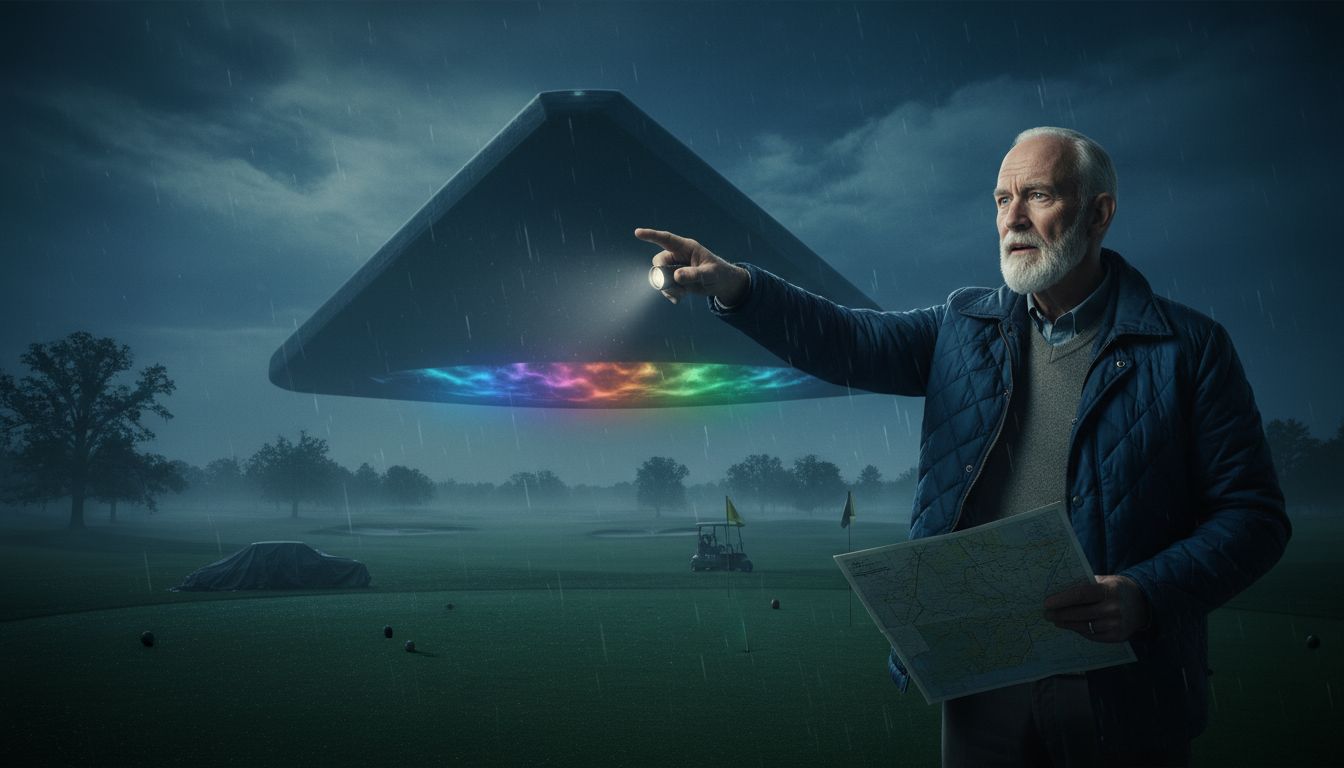
According to Isbell, he was driving a two‑lane, wooded road adjacent to the RAF Upper Heyford golf course when “a series of rapidly shifting, multicolored lights appeared above the treeline.” He described the object as a triangular shape with a curved leading edge, hovering 50 to 60 feet above the ground. The craft stopped “instantaneously from high speed,” producing no audible noise despite its size. Its underside emitted a blend of colors that, in his engineering judgment, resembled plasma rather than conventional illumination. When the craft descended toward the green, Isbell stopped his vehicle, noted the lack of visible wings or rotors, and withdrew, fearing both physical hazards and professional repercussions.
Professional and Institutional Context
Isbell’s decision to remain silent reflects a broader cultural and institutional climate within the military that, for decades, discouraged pilots from reporting anomalous sightings. “Reporting something that can’t be identified could jeopardize a career, especially when you’re involved in top‑secret programs,” he told the UAP community. At the time, Upper Heyford was a key NATO airbase hosting U.S. tactical aircraft, and the Cold War heightened vigilance against Soviet surveillance. Isbell’s background—spanning fighter operations, test‑pilot duties, and later instruction on directed‑energy weapons—gave him a technical lens through which he judged the phenomenon as “inconsistent with any known NATO or Soviet platform.”
Broader Implications
The 1980 Upper Heyford sighting aligns with a pattern of triangular UAP reports that emerged in the 1980s and 1990s, most famously the 1986 “Belgian Wave.” While the Department of Defense has recently declassified several UAP videos, many historical accounts remain undocumented in official archives. Researchers note that the absence of propulsion signatures, the hover capability, and the color‑shifting plasma effect challenge conventional aeronautical explanations. Isbell’s testimony, corroborated by his rank and technical expertise, adds weight to calls for a more systematic collection of pilot reports, free from career‑risk concerns.
Next Steps and Outlook
The disclosure of Isbell’s experience comes as the U.S. government continues to refine its UAP reporting framework, including the establishment of the All‑Domain Anomaly Resolution Office (AARO). Analysts suggest that veteran accounts like his could help calibrate sensor data and inform future investigations. “Understanding what our own pilots saw decades ago can guide current research and policy,” said Dr. Emily Hart, a senior analyst at the National Aviation Safety Board, who was not involved in the original sighting. As the UFO community digests this new testimony, the focus remains on objective documentation and transparent analysis, ensuring that historical encounters contribute meaningfully to the evolving scientific discourse on unidentified aerial phenomena.