Overview
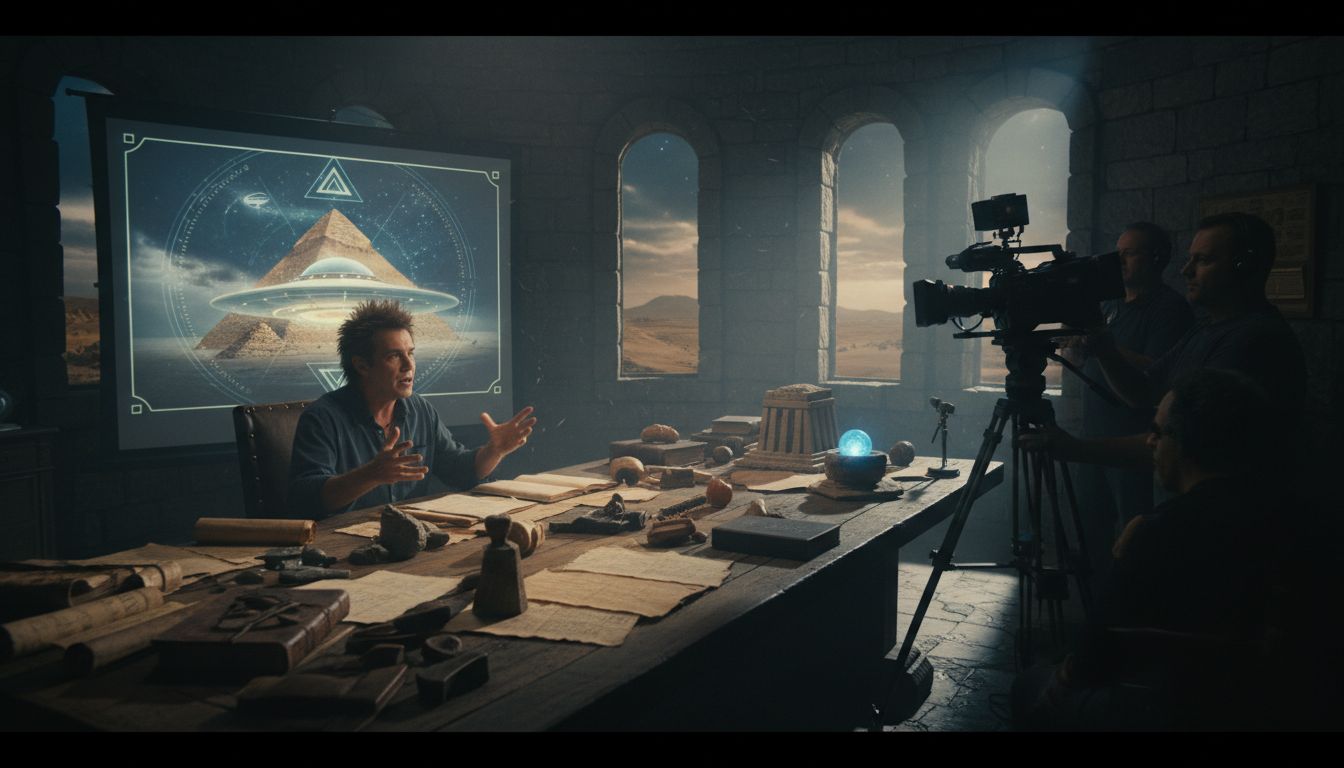
In a 50‑minute interview recorded on December 24, 2025, author and television personality Giorgio A. Tsoukalos sat down with broadcaster Rob McConnell to revisit the core arguments of the ancient astronaut hypothesis. The conversation, hosted on the “X Zone Radio/TV Show” podcast, revisited a familiar roster of subjects—ancient texts, megalithic monuments, and mythic narratives—that Tsoukalos believes point to extraterrestrial contact in humanity’s distant past. While the interview reiterates themes long championed by the “Ancient Aliens” franchise, it also introduces recent archaeological anomalies that Tsoukalos claims bolster his case for “advanced ancient engineering possibly aided by alien visitors.”
Key Themes from the Interview
Tsoukalos opened by emphasizing the “overwhelming amount of evidence” scattered across global cultures. He cited the precision of the Great Pyramid of Giza, the astronomical alignment of Stonehenge, and the intricate stonework of the Peruvian site of Sacsayhuamán as examples of engineering feats that, in his view, exceed the technological capabilities of their purported builders.
“When you look at the weight of a single Sacsayhuamán stone—over 100 tons—and the way it fits perfectly with its neighbors, you have to ask: who moved it and how?”
The interview also highlighted ancient literary sources, such as the Mahabharata, the Epic of Gilgamesh, and the Vedic Vāyu Purāṇa, which Tsoukalos interprets as describing “flying machines” and “beings from the sky.” He argued that these accounts are not mythic allegories but literal observations of technologically sophisticated visitors.
Archaeological Anomalies Under Scrutiny
McConnell pressed Tsoukalos on recent discoveries that have sparked debate among scholars. The conversation referenced a 2024 study of the Göbekli Tepe pillars, which revealed tool marks suggesting the use of metal implements far earlier than the accepted Iron Age timeline. Tsoukalos framed this as “a possible hint of external knowledge being transferred to early societies.”
Similarly, the Nazca Lines were discussed in the context of a 2023 satellite survey that identified previously unseen geoglyphs visible only from high altitude. Tsoukalos suggested that “the necessity of an aerial perspective implies that the creators either possessed flight or were guided by observers who did.”
While Tsoukalos treats these findings as supportive breadcrumbs, he acknowledged that mainstream archaeology often attributes them to cumulative human ingenuity, experimental reconstruction, or later reinterpretation.
Scholarly Response and Scientific Context
The interview did not shy away from criticism. McConnell asked whether Tsoukalos considered the principle of parsimony, to which Tsoukalos replied that “the simplest explanation is not always the correct one when the data are anomalously sophisticated.” He cited Dr. Robert Schoch, a geologist who has publicly entertained the possibility of ancient advanced knowledge, as a credible voice within the scientific community.
However, the broader academic consensus remains skeptical. Experts such as Dr. Sarah Parcak, a leading space archaeologist, argue that “the technological gaps cited by ancient astronaut proponents can be explained by undiscovered local techniques and regional trade networks.” Peer‑reviewed journals continue to publish methodical analyses that attribute the precision of monuments to careful planning, labor organization, and incremental innovation, without invoking extraterrestrials.
Implications for UFO and UAP Research
Tsoukalos concluded the interview by linking ancient astronaut theory to contemporary UFO/UAP investigations, noting that “if we accept that non‑human intelligence has interacted with Earth before, it reshapes how we interpret modern sightings.” He referenced the 2023 U.S. Office of the Director of National Intelligence report, which documented unidentified aerial phenomena with “potentially advanced propulsion characteristics.”
By framing historical anomalies alongside current UAP data, Tsoukalos aims to broaden the evidentiary base for what he calls “a continuum of contact.” While the interview stops short of presenting new primary evidence, it underscores a persistent narrative that blends archaeology, mythology, and modern aerospace mysteries—a narrative that continues to attract both popular interest and academic scrutiny.


