Overview
During a routine installation of an elevator shaft at the Gran Hotel Barcino in Barcelona’s historic Gothic Quarter, a team of archaeologists uncovered a massive Roman stone pavement that appears to be the central forum of ancient Barcino. The find, announced on March 11, 2026, challenges long‑standing reconstructions of the city’s Roman layout, which have placed the forum further north near the current Plaça del Rei. Researchers say the pavement’s dimensions and construction techniques match those of other known Roman forums across the Iberian Peninsula, prompting scholars to rewrite maps of the ancient metropolis.
Discovery Details
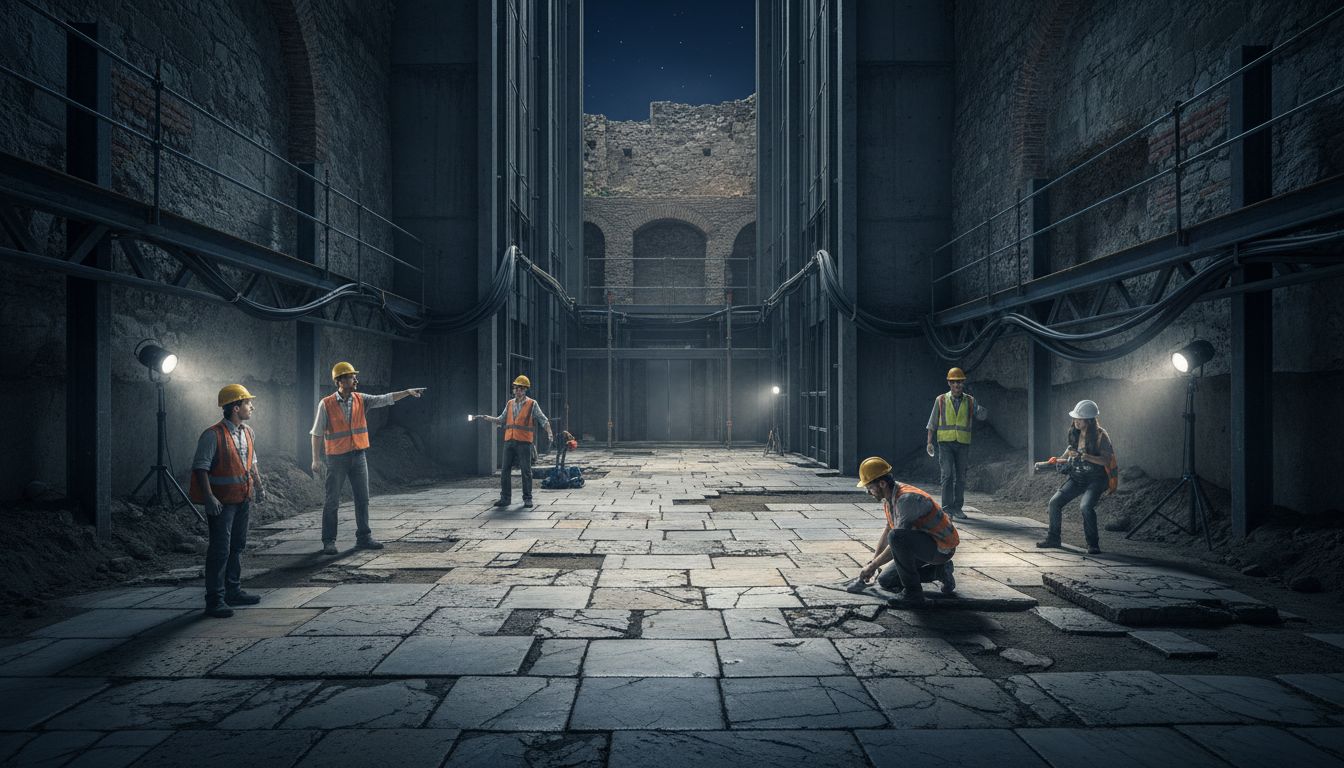
The unexpected discovery occurred when workers broke through a layer of compacted earth to lay the new shaft. “We immediately halted the construction and called in the city’s archaeological service,” said María Llorente, senior archaeologist with the Barcelona Heritage Authority. Excavation revealed a rectangular stone surface measuring roughly 70 × 50 meters, laid in the characteristic opus quadratum pattern of Roman public spaces. Beneath the pavement, fragments of pottery, bronze fittings, and a few inscribed tiles bearing the name Forum were recovered, providing strong epigraphic evidence of the site's function. The preservation state is unusually good, likely due to the continuous overlay of medieval and modern structures that insulated the Roman layer from erosion.
Historical Implications
Barcino, founded as a Roman colonia in the 1st century BC, has been partially mapped through centuries of excavation, but the exact location of its civic heart has remained debated. The new forum sits directly beneath the modern Gran Hotel, placing the ancient civic center closer to the waterfront than previously thought. “If the forum was this far south, it suggests the Roman city was oriented around a different axis, with the main thoroughfare (the Cardo) running parallel to today’s Carrer del Bisbe,” explained Professor Josep Roca, a specialist in Roman urbanism at the University of Barcelona. This shift may also affect interpretations of trade routes, defensive walls, and the spatial relationship between the forum and the Roman theater previously identified near Plaça del Rei.
Museum and Public Impact
Barcelona’s network of museums is already preparing to incorporate the discovery into exhibits. Carmen Puig, curator at the Museu d’Història de Barcelona (MUHBA), announced plans for a new permanent display that will feature a 3‑D reconstruction of the forum and interactive maps showing the revised city plan. “Our goal is to bring this hidden layer of Barcelona’s past to the public in a way that respects the archaeological integrity of the site,” Puig said. The city council has also pledged funding for a protective viewing platform within the hotel’s lobby, allowing visitors to see the pavement in situ while preserving it from foot traffic.
Next Steps and Outlook
The Gran Hotel Barcino will remain partially closed while a comprehensive archaeological assessment proceeds. Authorities are coordinating with the hotel’s owners to develop a preservation plan that balances commercial use with heritage protection. Further excavations are scheduled for the surrounding blocks to determine the full extent of the forum’s precincts, including potential basilicas, market stalls, and administrative buildings. As the evidence accumulates, historians anticipate a re‑evaluation of Barcino’s urban development in academic publications and textbooks. For now, the stone pavement beneath a bustling modern hotel stands as a tangible reminder that the layers of Barcelona’s history continue to surface, reshaping our understanding of the city’s ancient roots.