Overview
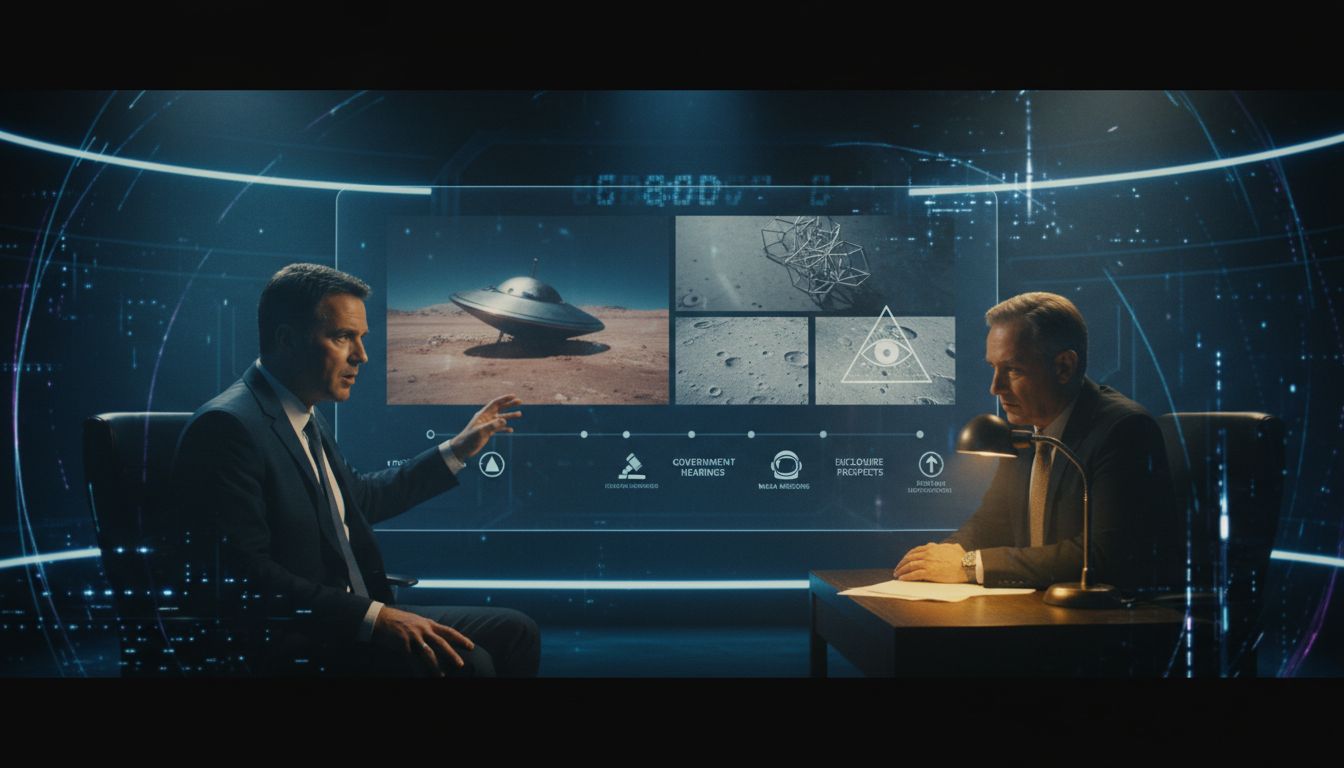
In a recent NewsNation interview, investigative journalist Ross Coulthart fielded viewer questions about Unidentified Aerial Phenomena (UAP), alleged government secrecy, and the prospects for public disclosure. Appearing with producer Meagan Medick, Coulthart referenced recent congressional hearings, statements from Representative Eric Burlison, and a range of individuals who have been linked to a purported “legacy retrieval” program that dates back decades. While he refrained from revealing classified details, Coulthart offered a concise summary of the current state of UAP investigations and the obstacles that continue to impede full transparency.
The “Massive Craft” Claim
The interview opened with a clip of Rep. Eric Burlison describing a “non‑human craft” so large that a building had been constructed around it to conceal its presence in a foreign nation. Coulthart confirmed that he has been aware of the site for several years but declined to name the country, citing national‑security concerns and the safety of personnel. He emphasized that the existence of such a structure, if verified, would represent a “significant data point” for any credible UAP assessment, yet he cautioned that public confirmation remains impossible without official declassification.
Whistleblowers and Congressional Dynamics
Coulthart addressed recent reports of a high‑level whistleblower from the alleged legacy program preparing to testify before Congress. He noted that several potential witnesses have contacted him, but he criticized the oversight committees for being “paralyzed by leadership,” a phrase he attributed to the reluctance of committee chairs to pursue aggressive inquiries. “Good people in Congress are asking hard questions, but the process is being throttled,” Coulthart said, underscoring the need for stronger whistle‑blower protections, especially for private‑sector contractors who may hold critical evidence.
Identified “Gatekeepers”
During the discussion, Coulthart validated the names recently circulated by UAP researcher “UAP Gerb,” naming former Air Force Special Investigations executive and Northrop Grumman vice‑president Terry Phillips as a “key gatekeeper” to the legacy program. He also referenced Lee Russ, Randall Walden, and Henry Wang as individuals with possible knowledge of retrieval activities. While Coulthart stopped short of providing documentary proof, he described these figures as “people who have been repeatedly mentioned in classified briefings and internal memos,” suggesting a network of officials who have overseen the handling of recovered material.
NASA, Lunar Anomalies, and Disclosure Outlook
The conversation shifted to upcoming lunar missions and the work of physicist Dr. Manali Derakhshani, who has published analyses of anomalous structures observed on the Moon’s surface. Coulthart expressed measured skepticism about NASA’s willingness to disclose all findings, referencing late astronaut Edgar Mitchell’s claim that Apollo flights were occasionally followed by “non‑human craft.” He framed the potential for a “soft disclosure” as contingent on whether forthcoming missions can gather independent data that corroborates terrestrial UAP reports, noting that “without clear, peer‑reviewed evidence, the public narrative will remain speculative.”
Conclusion
Coulthart’s interview paints a picture of an ongoing tension between congressional investigators seeking accountability and a military‑industrial complex that appears intent on preserving secrecy. He characterized the Pentagon’s stance as “mendacious” and highlighted the lack of robust whistle‑blower safeguards as the primary barrier to comprehensive disclosure. While acknowledging that credible evidence of non‑human technology is increasingly difficult to suppress, Coulthart urged a cautious, evidence‑based approach, emphasizing that **“the


