Overview
A team of theoretical physicists has published a paper proposing a fully physical model for a warp drive that sidesteps the long‑standing requirement for exotic negative‑energy matter. The study, released on 8 December 2025 in Classical and Quantum Gravity, builds on Miguel Alcubierre’s 1994 concept of a spacetime “bubble” that expands behind a spacecraft while contracting in front of it. By re‑examining the energy‑momentum conditions of general relativity, the authors claim the bubble can be generated using only positive energy density, albeit with a mass requirement that far exceeds anything humanity can presently marshal.
The New Model
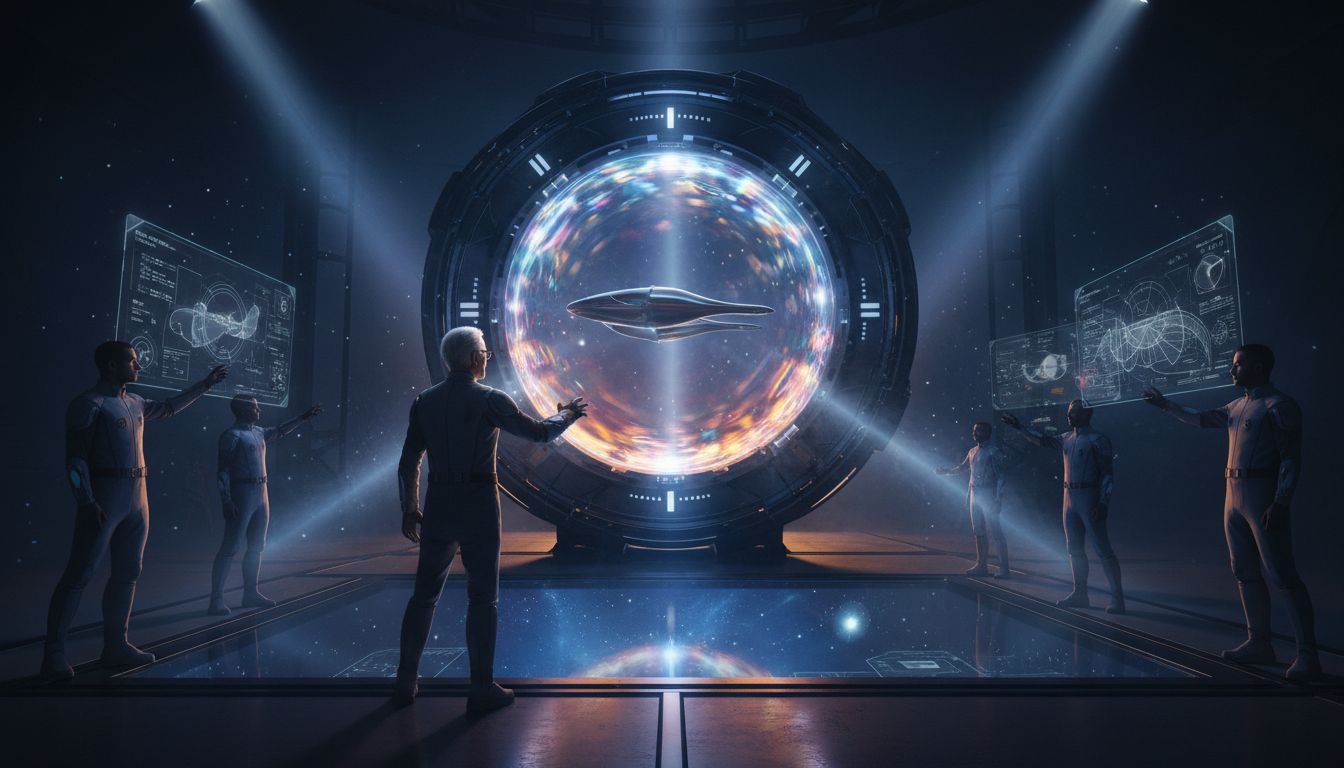
The paper, authored by researchers from the University of Cambridge and the Max Planck Institute for Gravitational Physics, introduces a modified metric that replaces the negative‑energy stress‑tensor with a configuration of ultra‑dense ordinary matter arranged in a toroidal shell around the craft. In this arrangement, the curvature of spacetime is achieved through shear stresses rather than exotic energy. The authors demonstrate mathematically that the resulting geometry still satisfies the Einstein field equations and produces a superluminal “effective” velocity for external observers, while the interior of the bubble remains an inertial frame free of tidal forces.
Technical Hurdles
Despite the theoretical breakthrough, the model demands astronomical amounts of mass—on the order of 10³⁰ kg, comparable to the mass of a small planet—to create the necessary spacetime distortion. The energy budget, while no longer exceeding the total energy of the observable universe, still dwarfs the output of the most powerful human‑made reactors by many orders of magnitude. Moreover, engineering a toroidal shell of such density would require materials capable of withstanding extreme pressures and temperatures, a challenge that current materials science cannot meet. The authors acknowledge that “practical implementation lies far beyond present‑day technology,” positioning the work as a proof‑of‑concept rather than an imminent engineering roadmap.
Expert Reactions
Miguel Alcubierre, whose original 1994 paper introduced the concept, reviewed the new study in a brief commentary accompanying the publication. He praised the authors for “clearing a major theoretical obstacle” and noted that “removing the need for negative energy brings the warp idea into the realm of conventional physics, even if the scale remains prohibitive.” Independent physicist Dr. Priya Raman of Caltech cautioned against premature optimism, stating, “The shift from exotic to ordinary matter is significant, but the sheer mass involved means we are still talking about a technology that may be decades or even centuries away from feasibility.”
Outlook for Interstellar Travel
The renewed interest in warp‑drive research reflects a broader consensus that faster‑than‑light propulsion is essential for reaching neighboring star systems within human lifespans. At light speed, a trip to Proxima Centauri would take over four years; without a warp mechanism, interstellar missions remain confined to robotic probes that take centuries. While NASA’s Eagleworks laboratory continues to explore exotic propulsion concepts, the new model offers a fresh theoretical pathway that could inform future experimental programs. The authors suggest that incremental advances—such as laboratory‑scale demonstrations of spacetime shear effects—might eventually pave the way toward a viable warp bubble, though such steps are likely to unfold over many generations of research.
The paper can be accessed through the Institute of Physics journal at https://iopscience.iop.org/article/10.1088/1361-6382/abdf6e.


