Overview
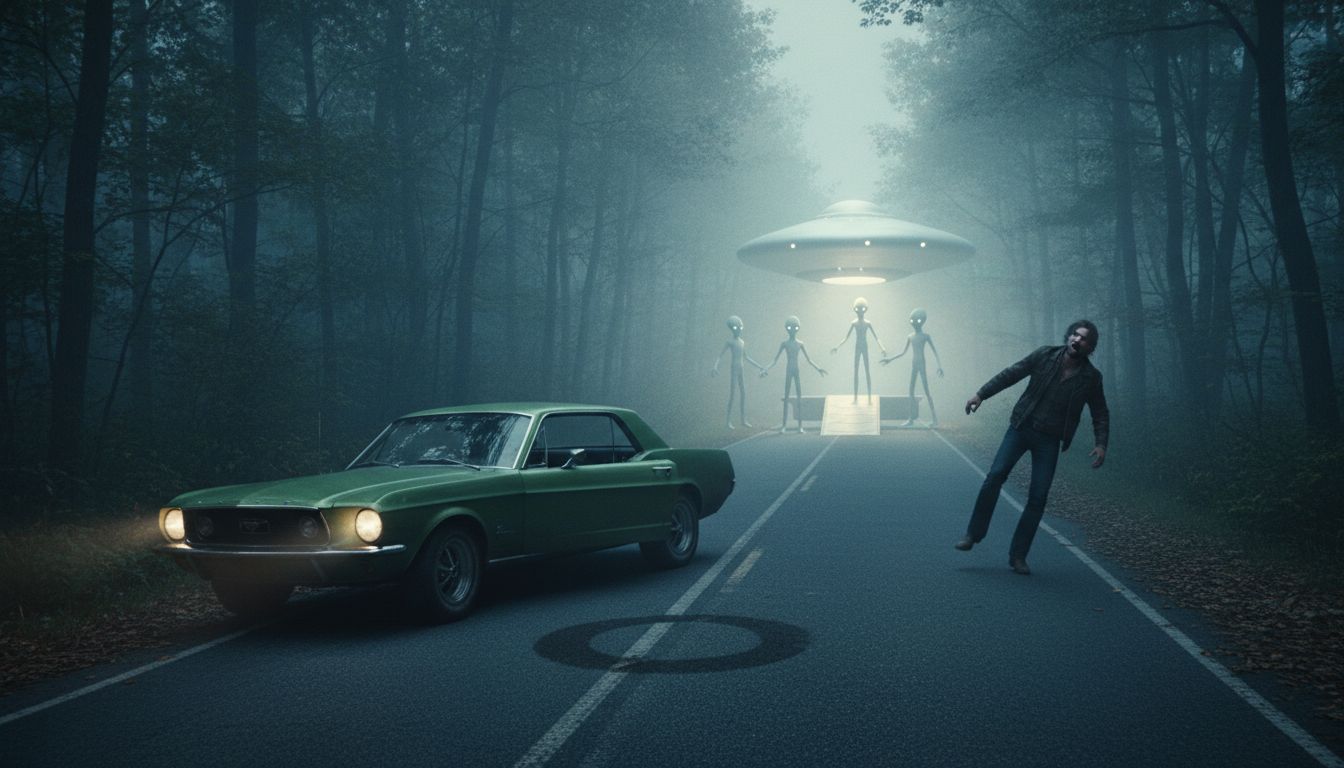
In the early 1970s a routine drive along Maryland’s Route 40 left Steven Kilburn with a lingering sense of dread that resurfaced whenever he thought about that stretch of road. Decades later, the feeling prompted him to contact noted UFO researcher Budd Hopkins, whose extensive work on alleged alien abductions includes the 1981 study Missing Time: A Documented Study of UFO Abductions. Under hypnosis, Kilburn recalled a series of events that mirror many classic abduction narratives: a fleeting visual of an unidentified craft, a period of missing time, and a subsequent medical examination conducted by pale, white‑skinned entities with black, liquid‑like eyes.
The Night on Route 40
According to Kilburn’s hypnotic regression, he was driving home after work when a “bizarre object” appeared above the road. He described a sudden, disorienting sensation of being “outside of the car,” as if his consciousness had detached from his body. The experience was accompanied by a flash of light that seemed to erase the surrounding environment, leaving him with the impression that day had turned into night in an instant. The episode ended with a loss of several minutes of memory—a hallmark of “missing‑time” cases documented by Hopkins and other researchers.
Hypnotic Regression and Entity Encounter
During a series of sessions with Dr. Aphrodite Clamar, a specialist in hypnotherapy for alleged abduction victims, Kilburn reported being drawn toward a fence bordering the highway. He felt a presence on his shoulder and, in a subsequent trance, visualized white‑clad figures whose faces were dominated by black, endless eyes. The entities communicated telepathically, assuring him that “he was not supposed to remember” the details of what would follow. Kilburn’s recollection of the beings’ appearance—pale skin described as “not like skin” and eyes that seemed to absorb light—aligns closely with descriptions from other cases compiled in Missing Time.
The Medical Examination
The regression narrative culminated in a stark, clinical setting: a bright white room where Kilburn underwent a series of neurological and physiological tests. He recalled being strapped to a table while the entities performed non‑invasive examinations, noting a sensation of pressure on his head and a faint humming sound. Although no physical evidence was collected, the consistency of this scenario with dozens of other abduction reports—where victims describe bright rooms, metallic tables, and detailed medical procedures—has been cited by scholars as a point of convergence that warrants further study.
Comparative Context and Credibility
Kilburn’s account adds to a growing body of abduction testimonies that feature white, featureless entities with black eyes, a motif first noted in the 1960s and repeatedly documented in Hopkins’ archives. Researchers such as Dr. John Elliott and Dr. John Blaine have argued that the recurrence of specific visual and procedural details across independent cases may indicate a shared cultural template or, alternatively, a genuine phenomenological pattern. While skeptics caution that hypnosis can produce confabulated memories, the correspondence between Kilburn’s narrative and earlier, independently gathered reports strengthens the case for systematic analysis rather than outright dismissal.
The Steven Kilburn encounter underscores the enduring challenge of distinguishing subjective experience from empirical evidence in UFO research. As more historical cases are revisited with modern investigative tools, the dialogue between proponents and skeptics continues to evolve, reminding the public that the pursuit of understanding unexplained phenomena remains both a scientific and a human endeavor.


