Overview
In a recent episode of the “Metaphysical” series, investigative researcher Rob Counts and remote‑viewer John Vivanco sat down with photo‑analysis specialist Allan Sturm to discuss his ongoing review of Apollo‑era imagery. Sturm, a former graphic designer turned professional photo analyst, has spent thousands of hours scrutinizing NASA’s archival photographs in search of what he calls “Unidentified Lunar Objects” (ULOs). The conversation centered on Sturm’s analytical methods, his most cited findings—particularly a set of geometric features near the Tycho crater—and the broader implications for lunar research. While the interview promotes Sturm’s book The Exoarchaeologist’s Field Guide to Lunar Mission Photography, it also raises questions about the standards of evidence applied to such claims.
Methodology and Technical Approach
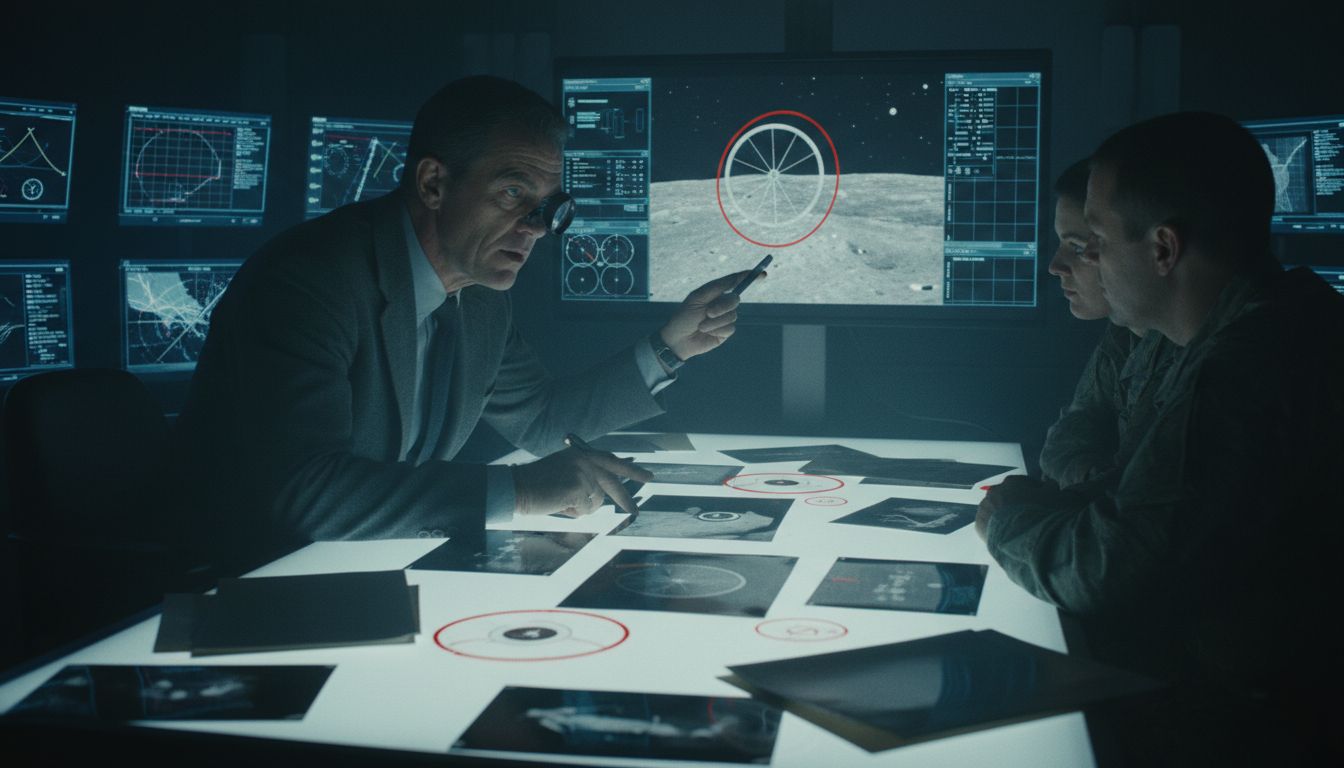
Sturm’s technique borrows from “military‑grade” image‑analysis practices originally designed to detect camouflaged structures in low‑resolution aerial reconnaissance. He explains that by adjusting contrast, brightness, and color balance—what he refers to as “perception hacks”—he can tease out subtle spatial relationships that are invisible in standard, raw NASA frames. “When you treat a lunar photo the same way you would a wartime reconnaissance shot, you begin to see patterns that the original processing may have suppressed,” he told the hosts. Sturm also emphasizes the value of oblique‑angle photographs, arguing that angled views provide a three‑dimensional perspective that makes it harder to mask or “airbrush” potential anomalies.
Key Claims and Presented Evidence
The most frequently cited example from Sturm’s work is the series of formations he labels “wagon wheels” located near the Tycho crater. He describes these as concentric, radially symmetric structures that, in his view, display a level of geometric regularity unlikely to arise from natural impact processes. “The consistency of the angles and the repetition across multiple frames suggest an engineered origin,” Sturm asserted. He also points to the 1994 Clementine mission—operated under the auspices of the U.S. Navy and the Department of Defense—as a case where low‑resolution data and “blocky” image artifacts may have hindered independent verification. According to Sturm, the mission’s limited public data set leaves room for speculation about intentional data suppression.
Scholarly and Community Response
The lunar‑science community remains largely skeptical of Sturm’s conclusions. Critics cite pareidolia—the human tendency to perceive familiar shapes in random patterns—as a more parsimonious explanation for the “wagon wheels.” Dr. Elena Martinez, a planetary geologist at Arizona State University, noted that “high‑resolution, 14‑bit scans of Apollo photographs, now available through NASA’s archives, have not revealed any corroborating evidence of artificial structures when examined under rigorous scientific protocols.” Moreover, while Sturm distances himself from overt conspiracy narratives, the interview references figures such as former CIA pilot John Lear, whose more sensationalist interpretations of a “living moon” have been widely discredited. This association underscores the challenge of separating legitimate image‑analysis inquiry from fringe speculation.
Context and Future Directions
Sturm’s work arrives at a time of renewed interest in lunar exploration, with both governmental agencies and private enterprises planning new missions to the Moon’s south pole and other regions. The availability of high‑fidelity digital scans from the recent ASU‑NASA digitization project offers researchers an unprecedented opportunity to re‑examine historic imagery with modern tools. Sturm argues that “applying disciplined photographic principles, while setting aside both extreme skepticism and unfounded conspiracy, can help us identify genuine anomalies.” Whether his identified ULOs will withstand peer‑reviewed scrutiny remains to be seen, but the dialogue highlights the importance of transparent data access and methodological rigor as humanity prepares for the next era of lunar science.