Overview
Across the Caribbean, few folklore figures inspire as much unease as the soucouyant, a shapeshifting witch-vampire said to move quietly through villages by day and terrorize homes by night. Described in oral tradition as a living woman who sheds her skin after dark, the creature occupies a unique place in regional mythology: part vampire, part witch, and entirely rooted in the fear of what may be hiding in plain sight. The legend remains especially strong in Trinidad, Dominica, Saint Lucia, and Haiti, where stories of the soucouyant have been passed down for generations as warnings about the dangers lurking in the night.
Shedding the Human Form
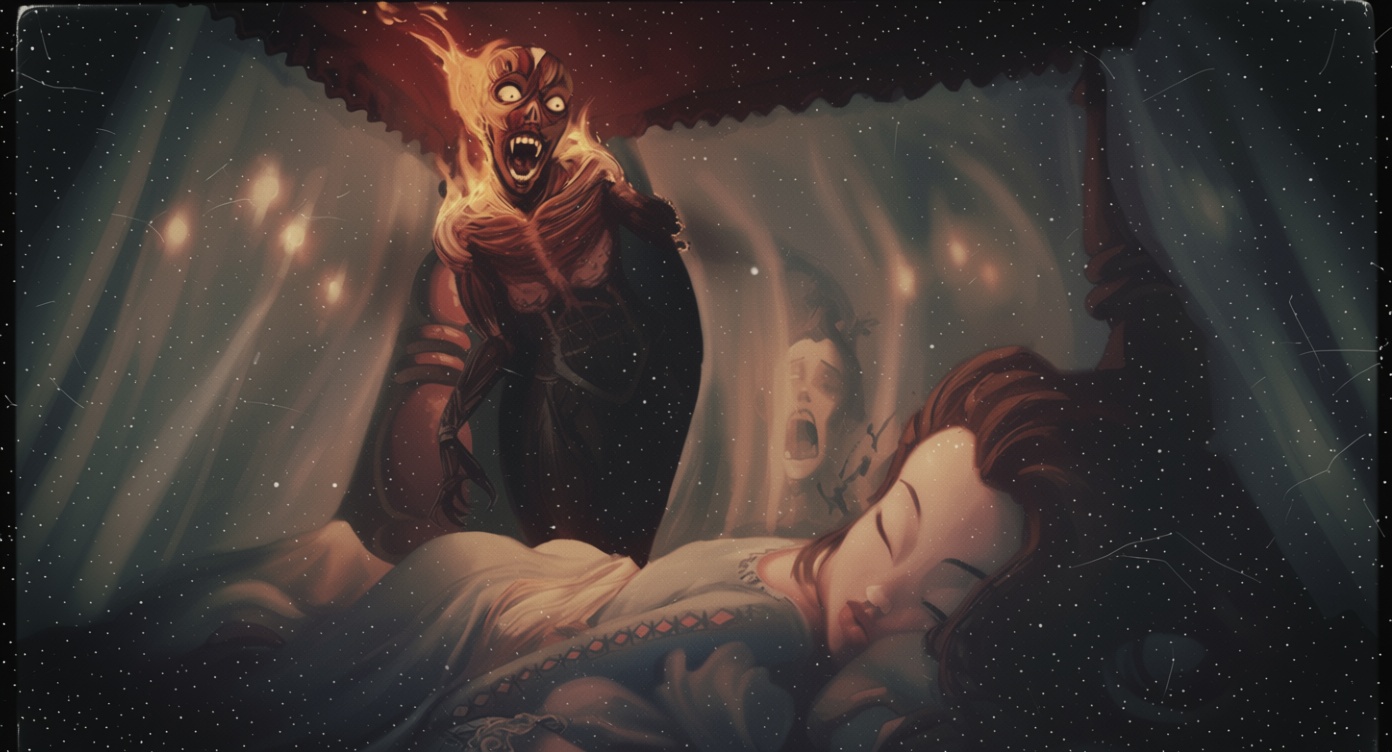
In many accounts, the soucouyant appears as an ordinary woman during daylight hours, often depicted as elderly and isolated, though some versions describe her as a younger woman who lures men astray. At night, however, she is said to remove her skin and conceal it in a mortar, hollow tree, or dark corner of her home before transforming into a ball of fire or ember-like light. From there, she is believed to slip through cracks, keyholes, shutters, and door gaps to reach sleeping victims. The name itself is tied to French Creole roots, reportedly derived from “sucer,” meaning to suck, and “couir,” meaning to run or flow, reflecting the creature’s blood-drinking role in the folklore.
Victims and Vulnerabilities
Traditional stories portray the soucouyant as targeting the most vulnerable members of the community, particularly children, the elderly, and the sick. Rather than leaving dramatic wounds, she is often said to leave behind subtle bruise marks or signs that are easy to dismiss, while the victim slowly weakens without explanation. In the most severe versions of the tale, the victim dies or becomes a soucouyant themselves, reinforcing the legend’s broader theme of contamination and inherited danger. The creature’s power, however, is said to depend entirely on the hidden skin she leaves behind, making discovery of that skin one of the few defenses available in folklore.
Regional Variations and Local Belief
The soucouyant is not a single uniform figure across the Caribbean. Similar beings appear under different names and in different forms, including Ol’ Higue in Guyana, Belize, and Jamaica; Asema in Suriname; and Hag in the Bahamas and Barbados. In Haiti, related traditions refer to the lougawou, while in the Dominican Republic the creature is known as the Lugarú, also called Galipote or Zángano. Despite the variations, the core idea remains strikingly consistent: a hidden predator within the community, a woman whose ordinary appearance masks a nocturnal, blood-consuming transformation.
Enduring Folklore
What gives the soucouyant its lasting power is not just its horror, but its symbolism. The creature reflects anxieties about secrecy, vulnerability, and the dangers believed to reside close to home. Folklore describes methods for defeating her—salt sprinkled into the hidden skin, rice scattered in her path, or hot peppers used to prevent her return—but even these protections underscore how deeply the legend is woven into local belief systems. In many Caribbean communities, the soucouyant remains more than a monster story: it is a cultural inheritance, a cautionary tale, and a reminder that the region’s supernatural traditions continue to shape how fear, morality, and memory are told.