Overview
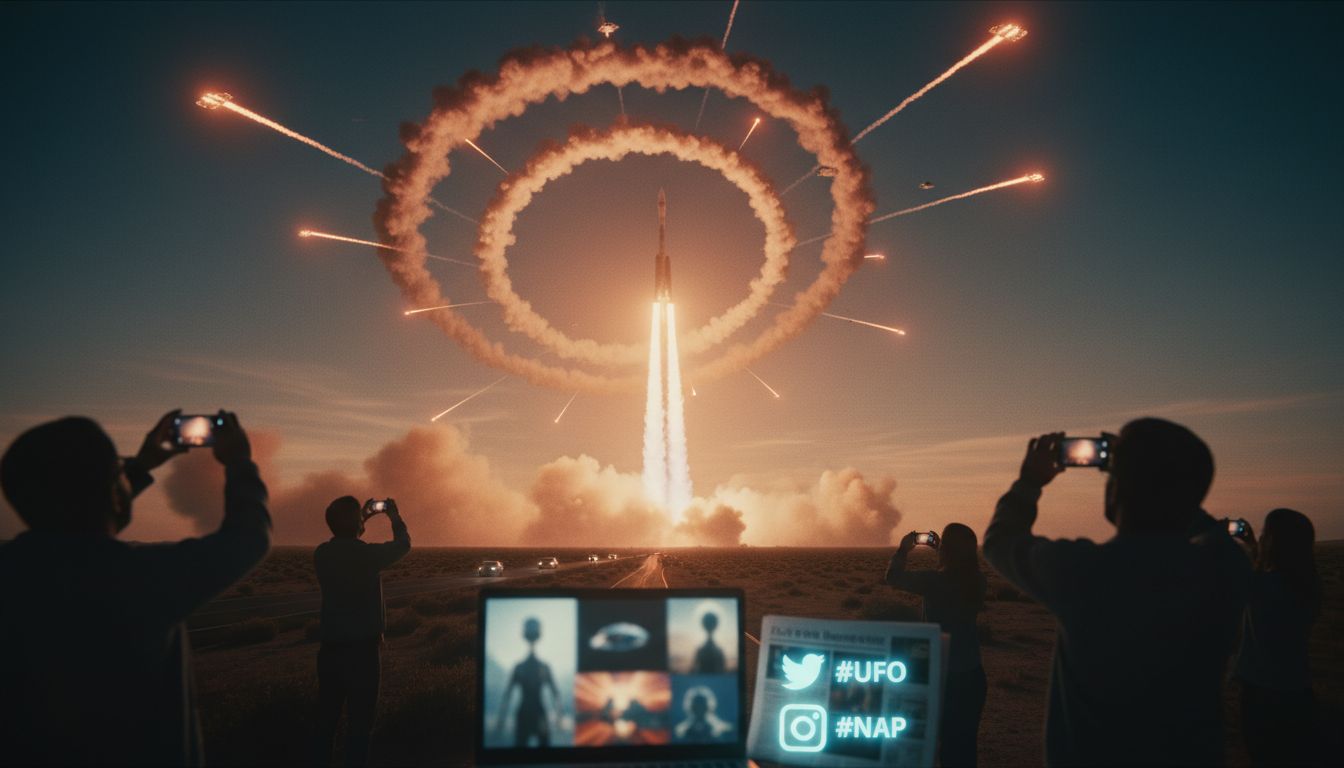
A routine SpaceX launch on February 20, 2026 sparked an unexpected surge of UFO chatter across social‑media platforms, coinciding with former President Donald Trump’s public call for the U.S. government to declassify all “alien‑related” documents. The timing amplified reports of unidentified aerial phenomena (UAP) and reignited debate over the Pentagon’s ongoing effort to release previously classified files. Within hours, hashtags #ufo and #uap trended on X, with users sharing videos of the Falcon 9 booster ascent that many initially mistook for a mysterious craft.
The SpaceX Launch
SpaceX lifted off from Launch Complex 39A at Kennedy Space Center at 02:14 UTC, deploying a Starlink‑12 satellite batch into a low‑Earth orbit. The launch profile featured a rapid, bright ascent followed by a “boost‑back” maneuver that caused the first stage to flip and descend near the Atlantic coast—a maneuver that, when viewed from the ground, can appear as a “silent, hovering disc.” Amateur astronomers and sky‑watch groups posted footage showing the booster’s bright plume and unusual trajectory, prompting a wave of speculation. SpaceX later clarified that the visual anomaly was the standard “boost‑back burn” used to recover the first stage on its drone ship, a routine part of the company’s re‑usability program.
Presidential Disclosure Push
On the same day, former President Trump, speaking at a rally in Florida, urged the Department of Defense to “release every single file on UFOs, aliens, and the truth they’ve been hiding for decades.” He referenced a 2023 executive order signed by the incumbent administration that mandated the Pentagon to compile a comprehensive UAP inventory, and he claimed the government “still has a mountain of classified material.” The Pentagon’s spokesperson reiterated that the agency is “continuing to evaluate and release unclassified portions of the UAP report” but cautioned that “national security considerations may limit full disclosure.” While Trump’s remarks resonated with UFO‑enthusiast circles, several former intelligence officials expressed skepticism, noting that many of the remaining documents are likely redacted for operational security.
Public and Expert Reaction
The convergence of the launch footage and Trump’s statement generated a noticeable uptick in UAP sighting reports filed with the All‑Domain Anomaly Resolution Office (AARO). According to AARO’s latest weekly summary, submissions rose by 38 % compared with the previous week, with the majority coming from the eastern seaboard. Dr. Jacqueline Miller, a senior researcher at the Center for Aerospace Studies, warned against “jumping to extraterrestrial conclusions” and emphasized that “a significant portion of UAP sightings are attributable to commercial launch activities, atmospheric phenomena, or sensor artifacts.” Nevertheless, community leaders in the #ufo and #uap forums highlighted the launch as “the clearest modern example of a civilian launch being misidentified as a craft of unknown origin,” fueling calls for greater transparency.
Looking Ahead
The heightened interest comes as the U.S. government prepares to submit a supplemental UAP report to Congress later this year, a requirement set by the 2022 Intelligence Authorization Act. Lawmakers, including Sen. Maria Cortez (D‑CA), have pledged to hold hearings that could pressure the Pentagon to release more detailed data. Meanwhile, SpaceX has announced plans for additional high‑visibility missions, including a crewed Starship test flight slated for mid‑2026, which analysts predict may trigger further public scrutiny. As the dialogue between aerospace operators, government agencies, and the public evolves, experts agree that clear communication about launch activities and systematic data release will be essential to separating genuine anomalies from misidentified human‑made events.


