Overview
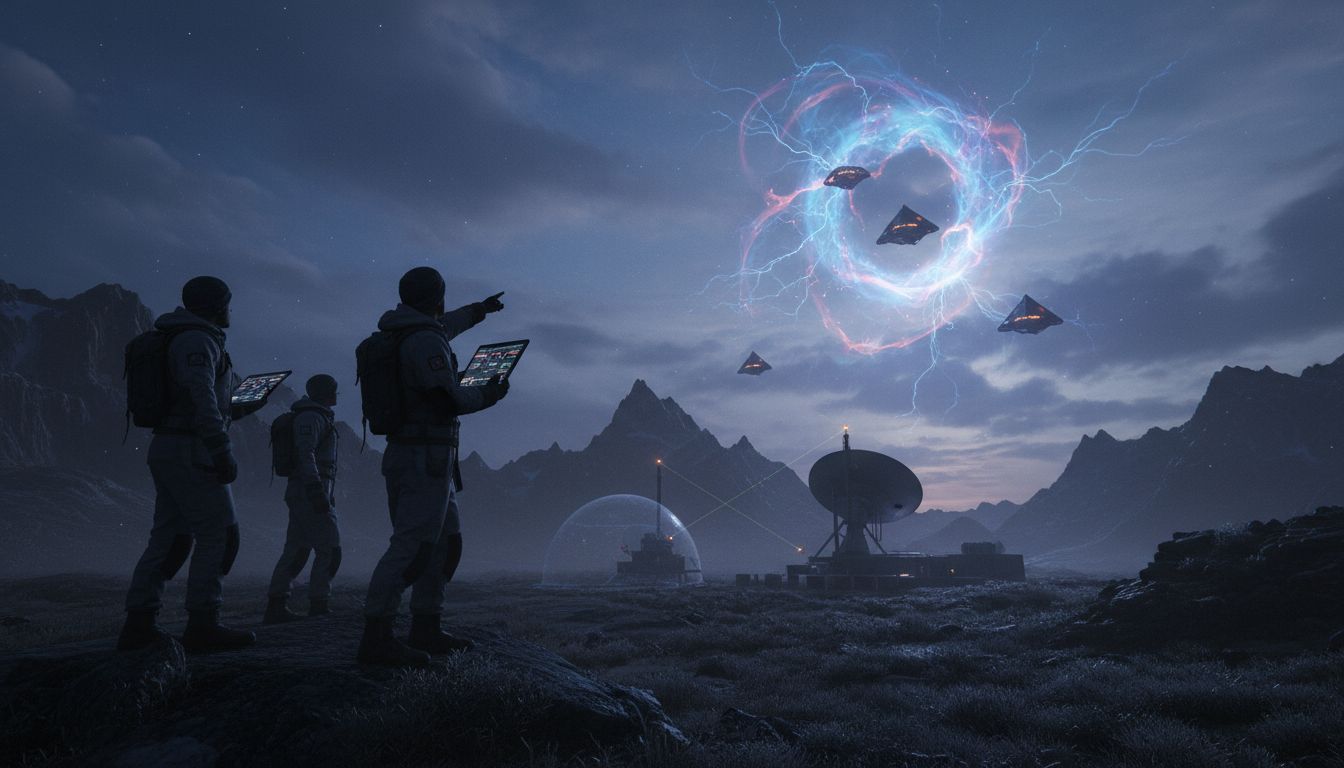
Recent reports of bright, fast‑moving lights across the night sky have once again sparked public interest and media speculation. According to data compiled by UFO research sites, the United States logged 12,000 sightings in 2019, up from 5,000 in 2015—a rise attributed largely to the ubiquity of smartphones and the speed of social‑media sharing. While the term “UFO” (Unidentified Flying Object) still conjures images of extraterrestrial craft, officials and scientists stress that the label simply denotes any aerial phenomenon that cannot be immediately identified. The U.S. government’s renewed focus on Unidentified Aerial Phenomena (UAP), through entities such as the All‑Domain Anomaly Resolution Office (AARO), underscores a shift from outright dismissal toward systematic data collection.
Common Explanations
A substantial portion of the recent “strange lights” can be traced to well‑understood natural or human‑made sources. Bright planets—particularly Venus—are frequently mistaken for hovering objects when they appear low on the horizon under twilight conditions. Atmospheric events like ball lightning, a rare plasma discharge, produce luminous, erratic globes that can linger for seconds before dissipating. Military training exercises and experimental aircraft also contribute to the mix; advanced propulsion or stealth technologies may generate visual signatures unfamiliar to civilian observers. Psychologists note that cognitive biases such as pareidolia and expectation‑driven perception often amplify ambiguous visual cues into perceived craft.
Scientific Perspective
Researchers at the University of Colorado’s Atmospheric Physics Department, led by Dr. Mara Patel, explain that many reported lights are plasma formations created by localized electric fields in the upper troposphere. “When you have a sudden discharge in a region of high humidity, the resulting ionized air can emit a spectrum of colors that moves erratically, mimicking what laypeople describe as ‘darts’ or ‘orbs,’” Patel said in an interview. Similarly, aerospace engineer Lt. Cmdr. James Ortega of the U.S. Navy, who previously contributed to the AARO’s data‑analysis team, cautions against jumping to conclusions about “intelligent control.” “Our sensors pick up a variety of radar and infrared signatures that, without corroborating visual evidence, remain ambiguous. Assigning intent without rigorous cross‑validation is scientifically premature,” he noted.
Calls for Improved Reporting
The surge in sightings has highlighted gaps in current reporting mechanisms. Amateur observers often rely on social platforms, posting low‑resolution videos that lack timestamps, geographic coordinates, or calibration data. Advocacy groups such as the National UFO Reporting Center (NUFORC) have urged the public to use standardized forms that capture altitude estimates, duration, and environmental conditions. “A systematic approach—much like the protocols used in meteorology—would allow analysts to filter out known phenomena and focus resources on truly anomalous events,” says NUFORC director Karen Liu. Federal agencies are reportedly drafting guidelines to integrate civilian submissions into the AARO’s central database, a move that could enhance both transparency and scientific rigor.
Looking Ahead
While the majority of strange lights are likely to be explained by atmospheric physics or human activity, the persistence of unexplained cases keeps the conversation alive in both scientific circles and the broader public. The upcoming congressional hearing on UAPs, scheduled for early 2026, is expected to address funding for advanced sensor networks and collaborative research with academic institutions. As Dr. Patel emphasizes, “Understanding the full spectrum of aerial phenomena—whether mundane or mysterious—improves our knowledge of atmospheric science and safeguards airspace security.” Until more robust data are available, experts agree that cautious investigation, rather than sensational speculation, remains the most responsible path forward.


