Overview
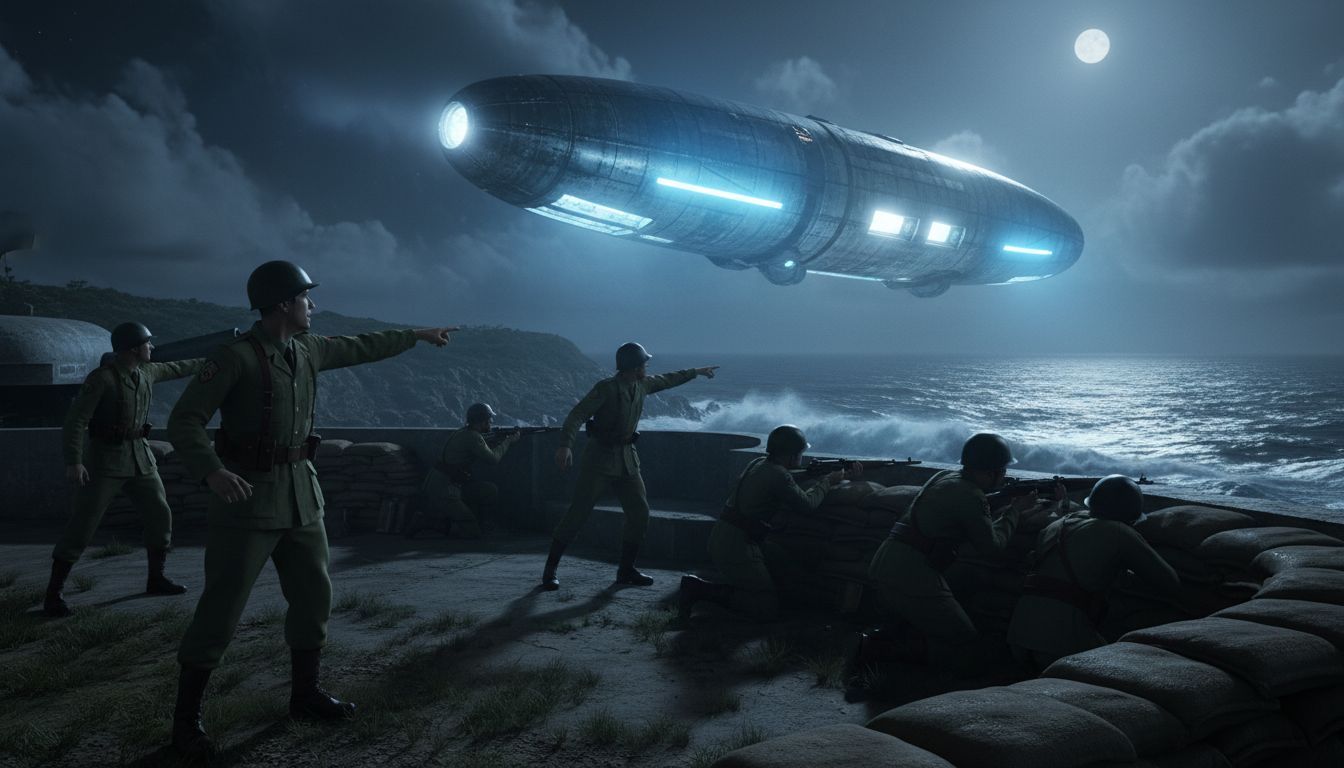
In the summer of 1957, a contingent of Brazilian soldiers stationed at Fort Itaipu reported an extraordinary aerial encounter that would become one of the most thoroughly documented UFO cases in South America. According to declassified military logs, the object appeared over the base in the early afternoon, hovering at a relatively low altitude before disappearing from sight. The incident was recorded in the same era that global air forces were intensifying Cold‑War surveillance, lending the report an added layer of strategic concern.
Eyewitness Accounts
Multiple servicemen described a cigar‑shaped craft roughly 100 meters long, its surface shimmering with a metallic appearance and punctuated by a pulsing bright light that flickered rhythmically. Captain João Gouveia da Silva, the senior officer on duty, recounted seeing the object “up close enough to discern a series of unfamiliar markings etched along its hull,” a detail that later investigators noted as unique among contemporary sightings. Sergeant Manoel Pereira da Cruz reported a sudden sense of disorientation, stating that “the air felt charged, and my head spun as if a field were passing through us.” Dr. Olavo Fontes, an army medical officer who later interviewed the witnesses, documented these physiological effects alongside the visual description, emphasizing that the phenomenon was not limited to a single observer.
Military Response
The Brazilian Ministry of Defense activated an emergency protocol, dispatching a joint task force of the Army’s Aviation and Intelligence branches to secure the site and collect evidence. Investigators gathered written statements, attempted to photograph the craft, and retrieved fragments of debris that some witnesses claimed had fallen to the ground. The unit also conducted electromagnetic surveys of the surrounding area, aiming to detect residual energy signatures that could explain the reported disorientation. All findings were compiled into a formal report submitted to the highest levels of the armed forces for classification review.
Investigation Findings
After weeks of analysis, the official investigation concluded that no conventional aircraft, weather balloon, or known atmospheric phenomenon could account for the observed characteristics. The craft’s size, metallic hull, and the energy field it allegedly generated were deemed “far beyond the technological capabilities of any known nation in 1957.” While the report stopped short of a definitive attribution, it highlighted the possibility of an extraterrestrial origin, noting that the object represented a potential national security threat should similar technology be employed by an unknown adversary. The final memorandum recommended continued monitoring of the region’s airspace and the establishment of a dedicated UFO research cell within the armed forces.
Continuing Significance
More than six decades later, the Fort Itaipu incident remains a reference point for both scholars of aerospace anomalies and policymakers assessing unconventional threats. The case is frequently cited in comparative studies of Cold‑War era sightings, illustrating how disciplined military documentation can lend credibility to otherwise speculative reports. Although no new physical evidence has emerged, the incident continues to inspire archival research and occasional calls for a modern, transparent inquiry. As Brazil and other nations revisit their historical UFO files, the 1957 Fort Itaipu encounter stands as a reminder that unanswered aerial phenomena can intersect with national defense, scientific curiosity, and the broader public’s enduring quest for answers.


